
The Siege of Tyre
Wael Al Awar
In 332 BCE, Alexander the Great conducted a six-month siege of Tyre, in what is today southern Lebanon. The Kingdom of Tyre, then a client state of the vast Persian Empire, was concentrated on this major port city, which consisted of two parts: a coastal settlement, Old Tyre, and an island one kilometer from the shore. On the island, a new city had been built behind forty-five-meter-high walls a short distance from the sea. In his campaigns against the Persians, the young Macedonian conqueror had plunged through Asia Minor and was now descending along the eastern coast of the Mediterranean. After capturing Old Tyre, Alexander’s army was confronted with their greatest challenge yet in New Tyre, an insular citadel fiercely defended by a skilled, experienced navy that could sail from two harbors at either end of the island. These were the Sidonian Harbor to the north and the Egyptian Harbor to the southeast, the exact locations of which have remained a puzzle for archeologists. Alexander built a causeway so his army could transport catapults, ballistas, battering rams, and wooden siege towers from which his archers could fire over the city walls.
1
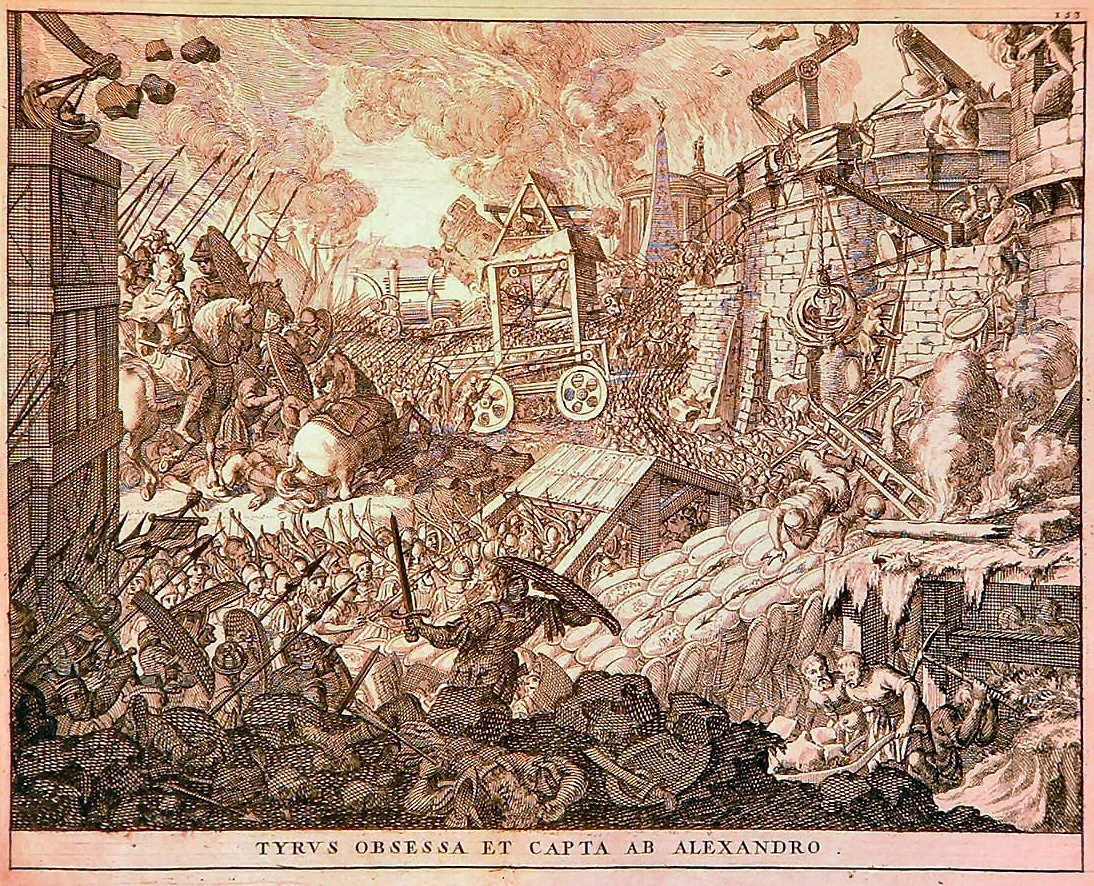
Adriaan Schoonebeek, ‘Tyrus obsessa et capta ab Alexandro’, engraving from Quintus Curtius Rufus’s first-century CE De rebus gestis Alexandri Magni, published in 1696 by Petrus van der Aa in Leiden.
To construct the causeway, Alexander used wood from the cedar forests of Lebanon and demolished buildings in Old Tyre for stone. Diodorus of Sicily writes that the causeway was only sixty meters wide and that it extended the full distance from the shore to the island, forming an artificial isthmus. The Tyrian navy quickly destroyed the Macedonian siege equipment along the causeway and Alexander retreated to the mainland, concluding that only an assault by sea could secure his victory. He gathered ships from the other Phoenician city-states of Sidon and Byblos, which he had recently taken, outnumbered the Tyrian ships, and blockaded both of the island’s ports. The Macedonians finally breached the walls, overcame the defenders, and sacked the city (fig. 1). According to the historian Arrian, writing in the second century CE in what today would strike us as a callous tone, Alexander was so enraged at the difficulty of the months-long siege that he massacred eight thousand Tyrian civilians and sold thirty thousand into slavery (Lane Fox, 2004, pp. 181–91).
2
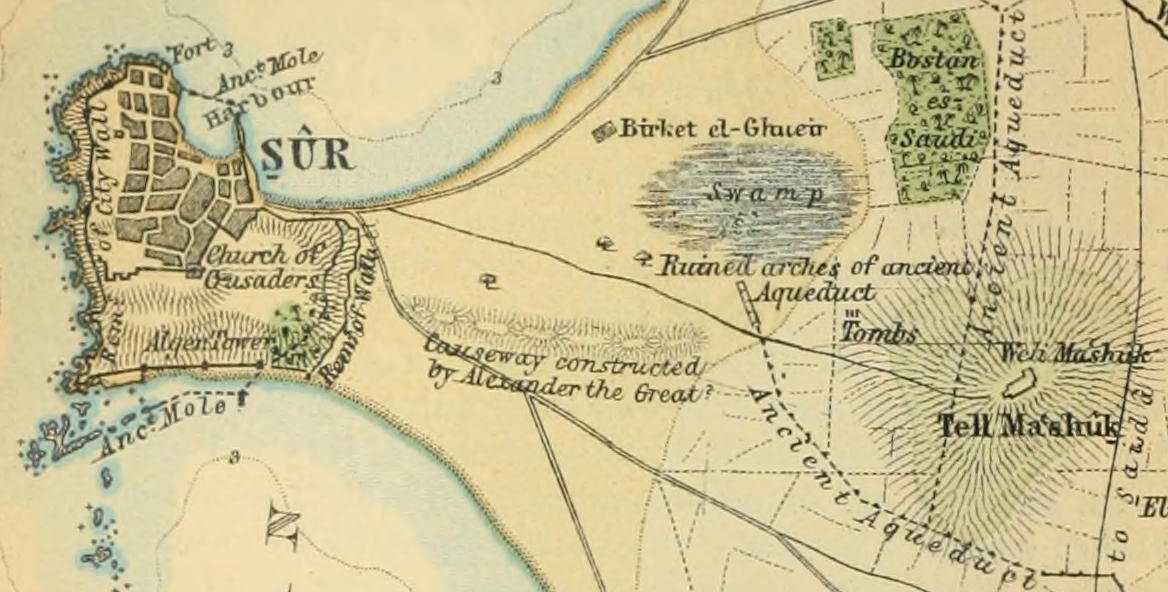
Map of Tyre by Wagner & Debes, published by Baedeker in 1906.
Alexander swiftly moved south towards Egypt, where he would eventually embark on a curious journey into the western desert to consult the oracle of Ammon, a ram-headed deity, at Siwa oasis. After his departure, much of Tyre lay in ruins, but Alexander’s narrow causeway remained as a new link between the island and the mainland (fig. 2). This twin legacy of destruction and construction left an enduring mark on the city, and today the isthmus has widened and formed part of a continuous city that extends from the coast into a wedge jutting out into the Mediterranean. Alexander’s siege was far from the first that Tyre experienced, and far from the last. The city was besieged by a succession of Assyrian kings, including the great Ashurbanipal, and by Nebuchadnezzar II of Babylonia, whose ultimately frustrated assault lasted thirteen months. In subsequent centuries, the Crusader king Baldwin I of Jerusalem, another Crusader army led by the Venetians and the Franks, and the great Muslim military commander Saladin captured the port city, all causing much destruction and loss of life. In the twentieth and twenty-first centuries, the city has suffered from Israeli attacks, most intensely since the 1970s. Tyre was founded in the third millennium BCE, according to Herodotus, who visited the city one hundred years before Alexander’s conquest. It is one of the oldest continuously inhabited cities in the world.
3
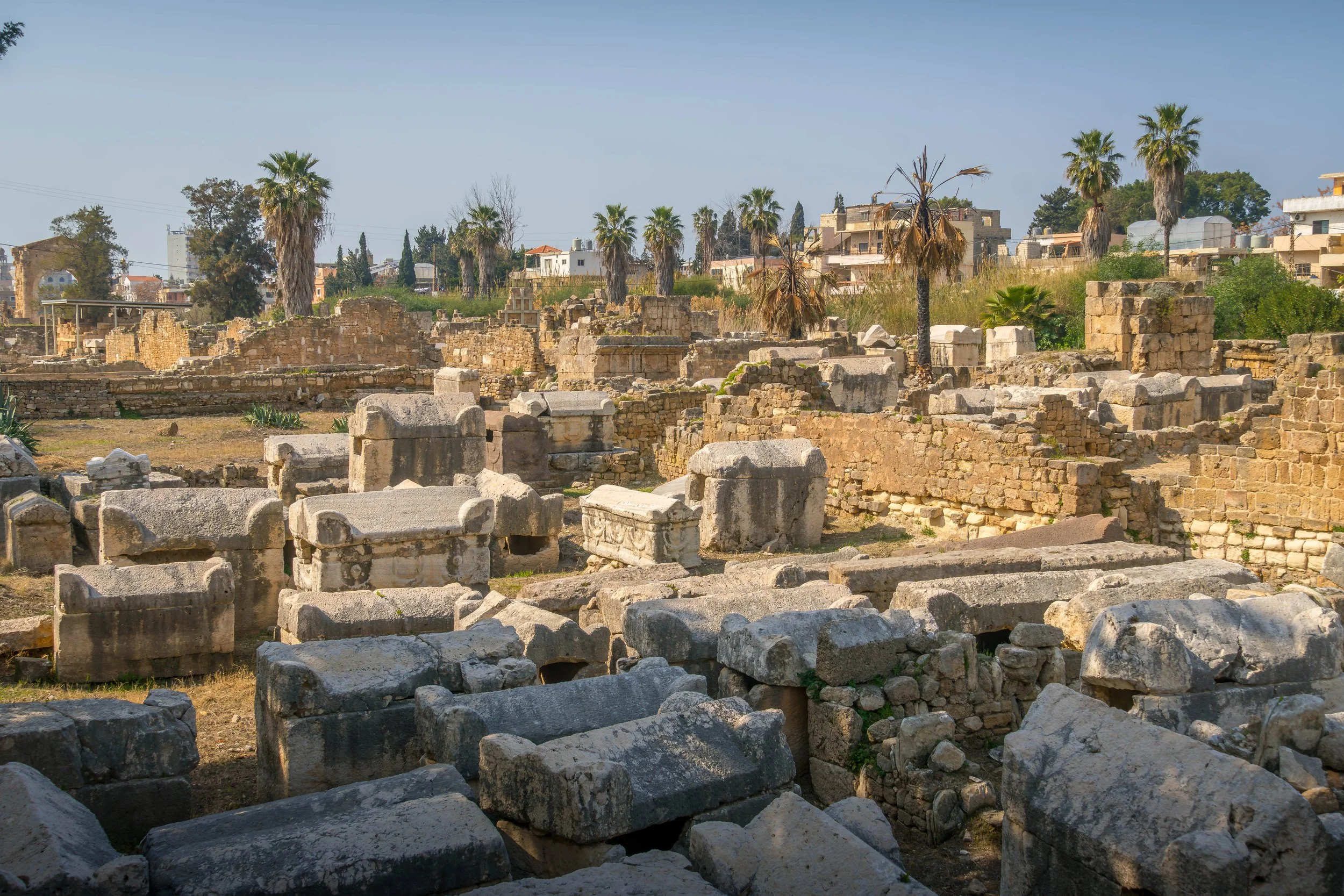
Roman-era tombstones at the Tyre necropolis, a UNESCO World Heritage site
Photo: Artaxerxes Longhand/iStock
Like many cities that were eventually conquered by the Romans, Tyre could be reached by a road lined with tombs on either side (fig. 3). The grandest and most famous example of this road-and-tomb typology can be found along the Appian Way connecting Rome with the port city of Brundisium at the southeastern end of the Italian Peninsula. Remains of the elongated Roman necropolis of Tyre are present today, part of a UNESCO World Heritage site, but in fragments and at a reduced density that only hint at the effect of their original presence. The necropolis was built on the site of a Phoenician burial ground, which remained in use throughout the Hellenistic period that followed Alexander’s conquest. For the Roman traveling overland to Tyre, the experience would have been one of journeying through a landscape of funerary monuments and grave steles, of traversing the city of the dead in order to reach the city of the living. But elements of life were present in the necropolis too, including a hippodrome and an important aqueduct that brought water into the city. Since the 1930s, the necropolis has been home to refugee communities, of Armenians first, and then Palestinians. On 6 March, 2026, the Lebanese ministry of culture reported that an airstrike launched by Israel caused ‘material damage’ to the necropolis, in the area near the hippodrome, and killed at least one person (Ditmars, 2026). Two days later, UNESCO issued a statement expressing concern about the protection of built heritage in areas where hostilities are taking place, mentioning specifically Golestan Palace, which was the seat of monarchs of the Qajar dynasty in Tehran for centuries; the White City, a collection of International Style buildings in Tel Aviv designed by German Jewish architects, many of them Bauhaus educated, who fled Germany in the 1930s; and Tyre (UNESCO, 2026).
4
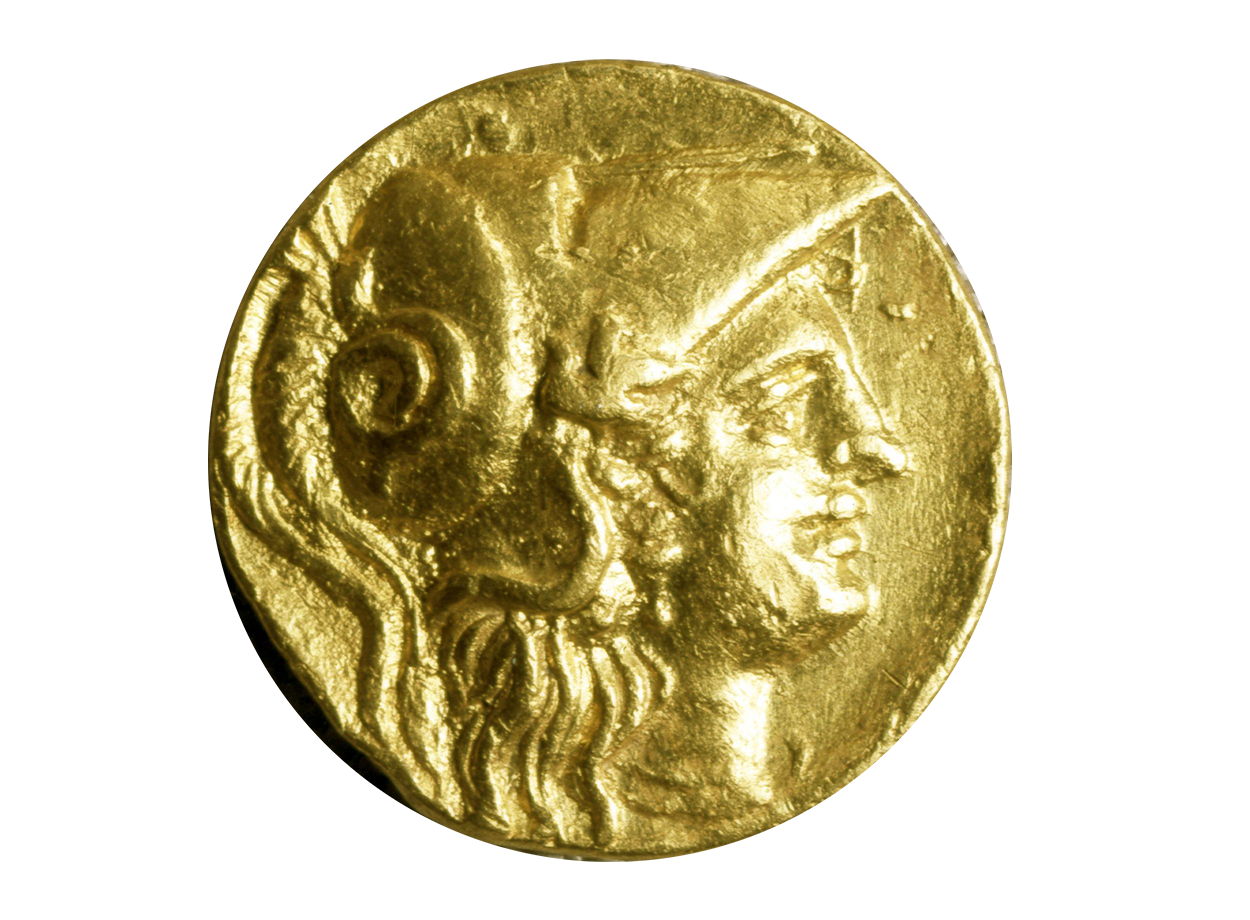
Stater of Alexander the Great
Greece, ca. 300 BCE
Gold; 1.9 cm in diameter
The British Museum
© The Trustees of the British Museum, shared under a Creative Commons Attribution-NonCommercial-ShareAlike 4.0 International (CC BY-NC-SA 4.0) license
In Alexander’s time, of course, there was no international body devoted to the protection of built heritage. As demonstrated by his demolition of Old Tyre to build his causeway, classical civilizations acknowledged the continuity of the past with the present, that a work of architecture is the accumulation of centuries of change and encompasses both additions and subtractions, sometimes violent, and sometimes done to meet an immediate functional need or political will fig. 4). The early-modern and especially nineteenth-century lineage of architectural preservation is well known and its effects are enduring. Today, we are experiencing a regime of preservation that is ambiguous in its criteria but rigid in its enforcement. This is led by the UNESCO World Heritage program. UNESCO and other organizations devoted to the preservation of a network of architectural heritage around the world exist alongside the global capitalist economy’s furious drive to build, a ‘wrenching simultaneity’ described by Rem Koolhaas in 2011. These competing regimes, he argues, define a segment of the world as immune to change and occlude different definitions and uses of architectural heritage (Koolhaas, 2011, p. 119 and p. 122). The current conflict unfolding across Alexander’s former empire shows that lament of the destruction of architectural heritage and calls to protect it are fundamentally intellectual exercises, without real geopolitical force. This leads us to a different conclusion about the nature of heritage, that it is not frozen in time but continually changing, shaped by both destruction and construction (fig. 5). What we call ancient heritage is just a slice of vernacular architecture, perhaps its most exceptional rather than its most representative examples, as Koolhaas points out. Vernacular architecture is an adaptable system of designing and building that is intrinsically attuned to local conditions of climate and local ways of living. The materials, designs, and construction techniques that it encompasses reveal a continuity between past and present and spaces that can evolve to accommodate life over generations. This is something closer to the ancient approach to architecture, to building and rebuilding continuously.
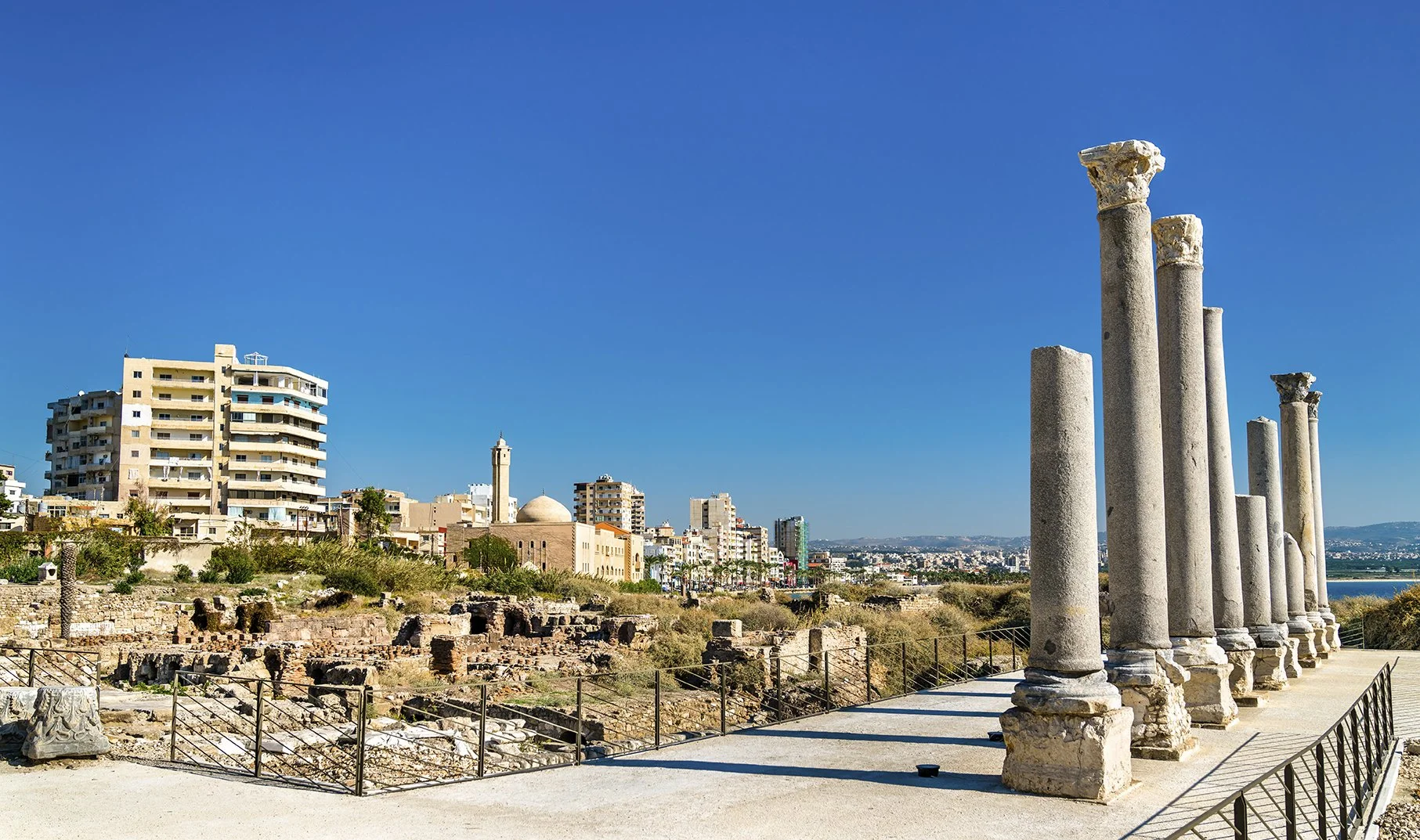
5
Palaestra at Al Mina, Tyre
Photo: Leonid Andronov/iStock
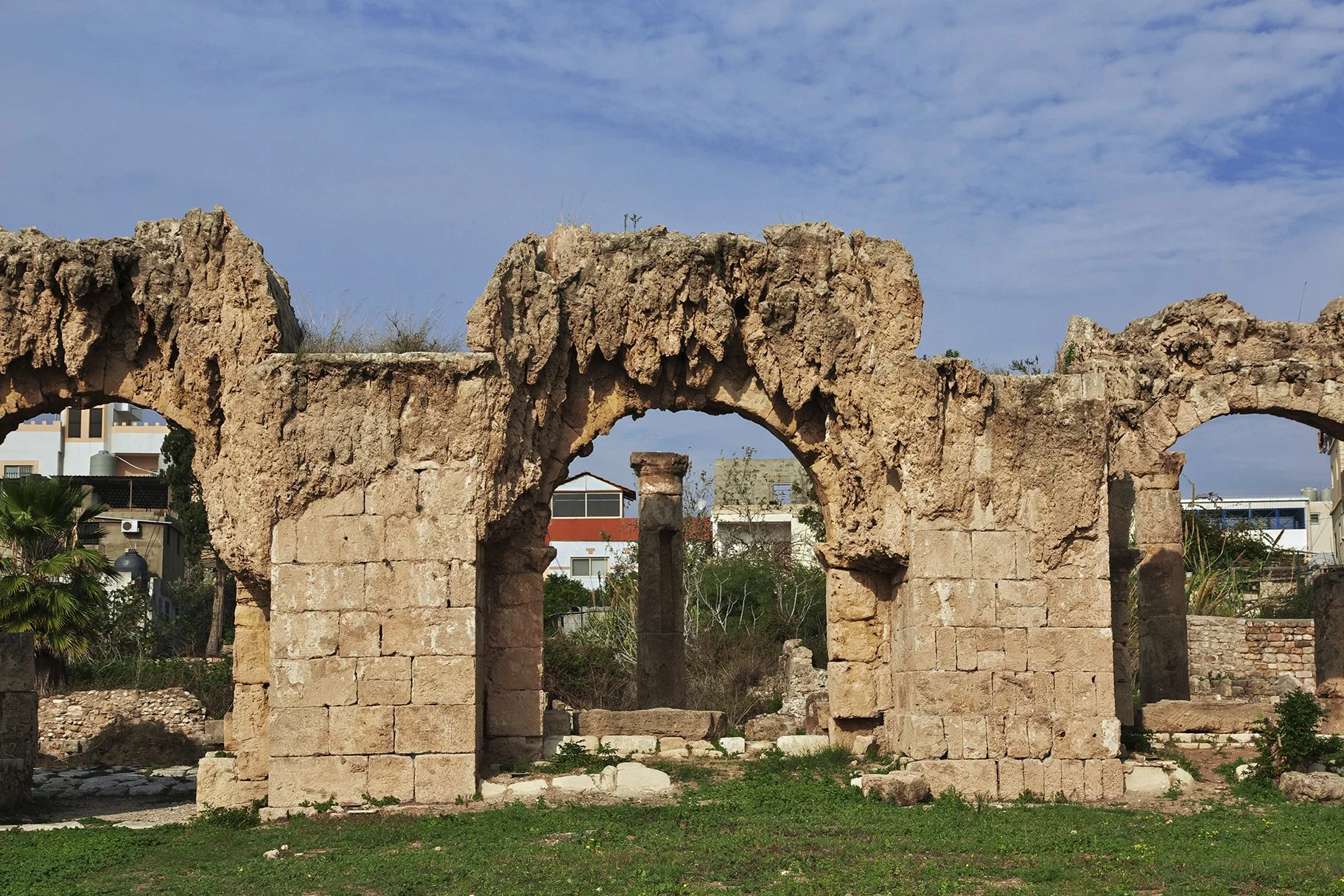
6
Roman ruins in Tyre
Photo: Sergey Strelkov/iStock
The necropolis of Tyre is an example of this. It has been inhabited for thousands of years and it is a site that is ostensibly protected by UNESCO but that is functionally open to contemporary life. Openness to contemporary life includes the good and the bad, both the transfer of knowledge and tradition—architectural and otherwise—and the haunting memories of a troubled history. The low-rise blocks of the refugee camp near the necropolis are visible from the heritage zone. Residents there often report encounters with Al-Qreene, a malevolent entity, something that ‘is not a dream, but she comes in one’s dreams’ (Perdigon, 2018, pp. 566–83). Recognizing the past’s immediacy in the present, made evident in the built environment, is an acknowledgement of its living, malleable, adaptable character, which even UNESCO’s definition of ‘intangible cultural heritage’ cannot grasp. It is also an acknowledgement of our tremendous capacity to create and destroy, often simultaneously. The city of Tyre, including Alexander’s causeway and the necropolis, has been made and unmade through construction and destruction over millennia. Even in fragments, architecture bears traces of this history, and it cannot be protected from it. Architectural history’s violent episodes only make this clearer, and also only add clarity to the depth and resilience of human history (fig. 6). Vernacular architecture, not an ideal of unchanging heritage, points the way to a future in which we can adapt, connect, and transform, no matter how horrific the conditions that we face and that we create. Mosques, monasteries, triple-arch houses, and terracotta elements made from local stone can be found across Lebanon, merging with the landscape and calling attention to the continued life of the necropolis and sites like it. Simultaneity and the linear passage of time then become complementary rather than remaining locked in perpetual competition for dominance over historical architecture. In thousands of years, UNESCO’s statement about the world today can be read alongside the chronicles of Alexander’s siege of Tyre by Diodorus, Arrian, and even Plutarch.
An enduring mystery is what the oracle at Siwa said to Alexander during his pilgrimage into the Egyptian desert. He entered the temple of Ammon alone, and to reach it he would have passed among the salt- and mud-brick buildings of the oasis city, which had been continuously rebuilt for thousands of years and can still be visited today.
Wael Al Awar is an architect and founding partner of the Dubai- and Tokyo-based firm waiwai. He curated the UAE National Pavilion at the Venice Architecture Biennale in 2021, which was awarded the Golden Lion. He served as Creative Director of Architecture for the 2025 Bukhara Biennial and was responsible for the masterplan of the renovation of Bukhara’s heritage district.
Selected Bibliography
Ditmars, Hadani. ‘Lebanon’s Ancient City of Tyre Hit by Strikes as Minister Calls for UNESCO Intervention’, The Art Newspaper, 10 March, 2026.
Koolhaas, Rem. ‘CRONOCAOS’, Log 21 (Winter), 2021: 119–23.
Lane Fox, Robin. Alexander the Great, Penguin, 2024.
Perdigon, Sylvain. ‘Life on the Cusp of Form: In Search of Worldliness with Palestinian Refugees in Tyre, Lebanon’, HAU: Journal of Ethnographic Theory 8, no. 3, 2018: 566–83.
UNESCO (@UNESCO). ‘UNESCO reiterates its deep concern over the protection of education, culture, media and the environment amid the escalation of hostilities in the Middle East and beyond’, 8 March, 2026. https://x.com/UNESCO/status/2030761629147701466.