
Sentinels of History
Francis Estrada
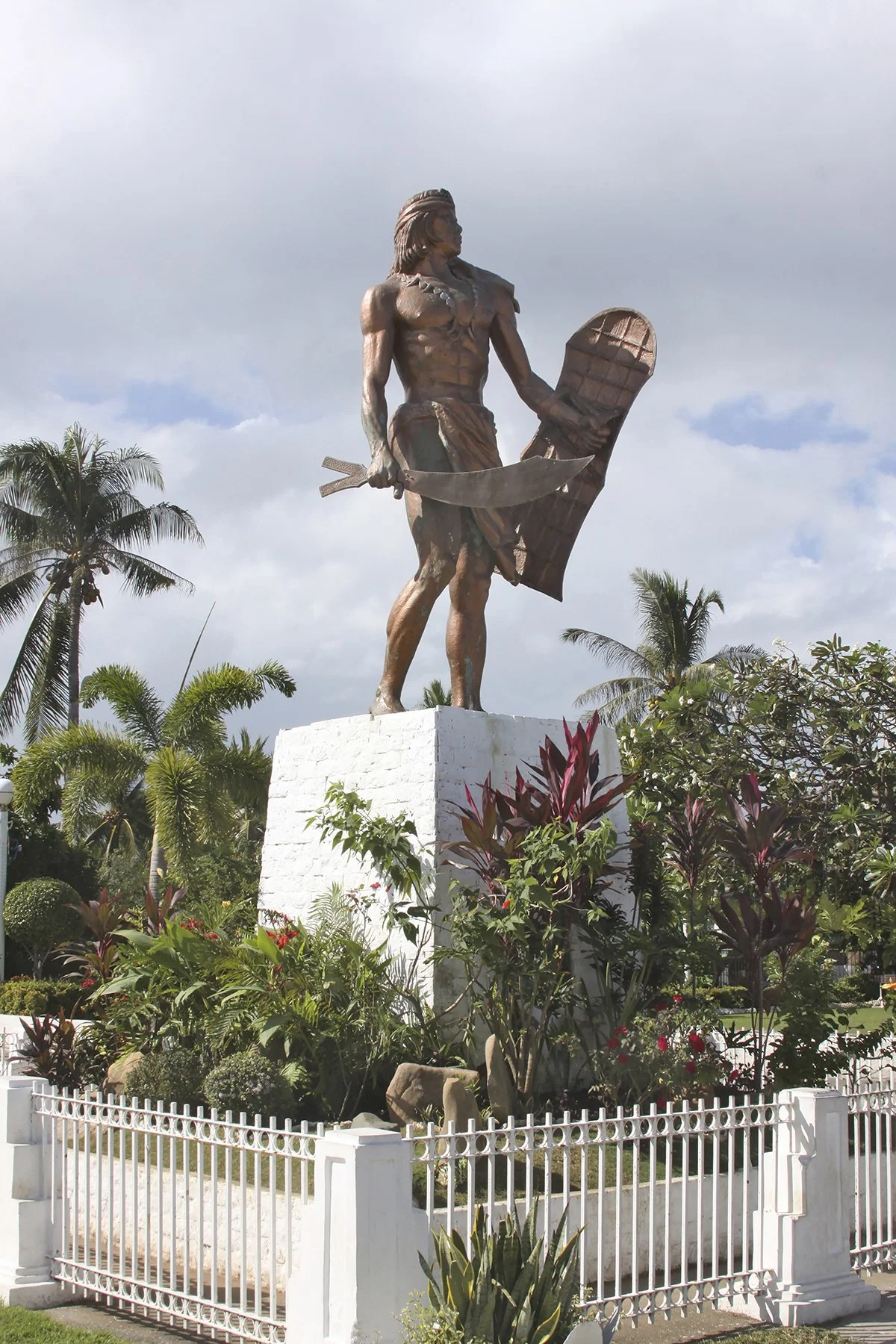
1 Lapu Lapu Shrine on Mactan Island
On Mactan Island in the Visayas region of the Philippines stands a 20 meters bronze statue of Datu Lapu Lapu (fig. 1), who is celebrated as the first Filipino hero. Staring off to the Magellan Bay, he stands triumphantly with his right foot slightly bent, holding a curved kampilan on his right hand and a shield on his left. A plaque that commemorates him reads:
Here on 27 April 1521
LapuLapu and his men repulsed the Spanish invaders,
Killing their leader, Ferdinand Magellan.
Thus LapuLapu became the first Filipino
To have repelled European aggression.
Magellan and his men had arrived in the neighboring islands to introduce and convert them into Catholicism and were amicably welcomed by their leaders. Lapu Lapu and his people, however, resisted religious conversion. Thus, Magellan and his men attempted to take the island by force. Though possessing greater firepower, they were overwhelmed by fire-hardened bamboo spears, poisoned arrows, and swords, were ultimately defeated and Magellan was killed.
This victory is not only celebrated by the descendants of the Battle of Mactan; the legacy of Datu Lapu Lapu has been symbolically tethered to the nation, signifying independence, national pride, bravery, and resistance. Another prominent statue of Lapu Lapu (Sentinel of Freedom), at approximately 11 meters tall, stands proudly in the nation’s capital in the complex of the National Museum of the Philippines (fig. 2). The image of the warrior single-handedly defeating invaders has also been appropriated by contemporary pop culture designs, graphic novels, marketing materials for Filipino martial arts schools, and even common items such as local vinegar brands, all to embody the prowess and resilience of the warrior spirit.
My interest lies in thinking about the social history of the kampilan that is now identified with Lapu Lapu. Holding a kampilan in my hands, I followed the trajectory of a blade that was specifically used by and designed for warriors. It had been tied to the country’s culture and mythology. Te handle, made from wood local to the region of origin, often represents a mythological being. These histories are obscured by the figure of Lapu Lapu in the contemporary Philippine imagination.
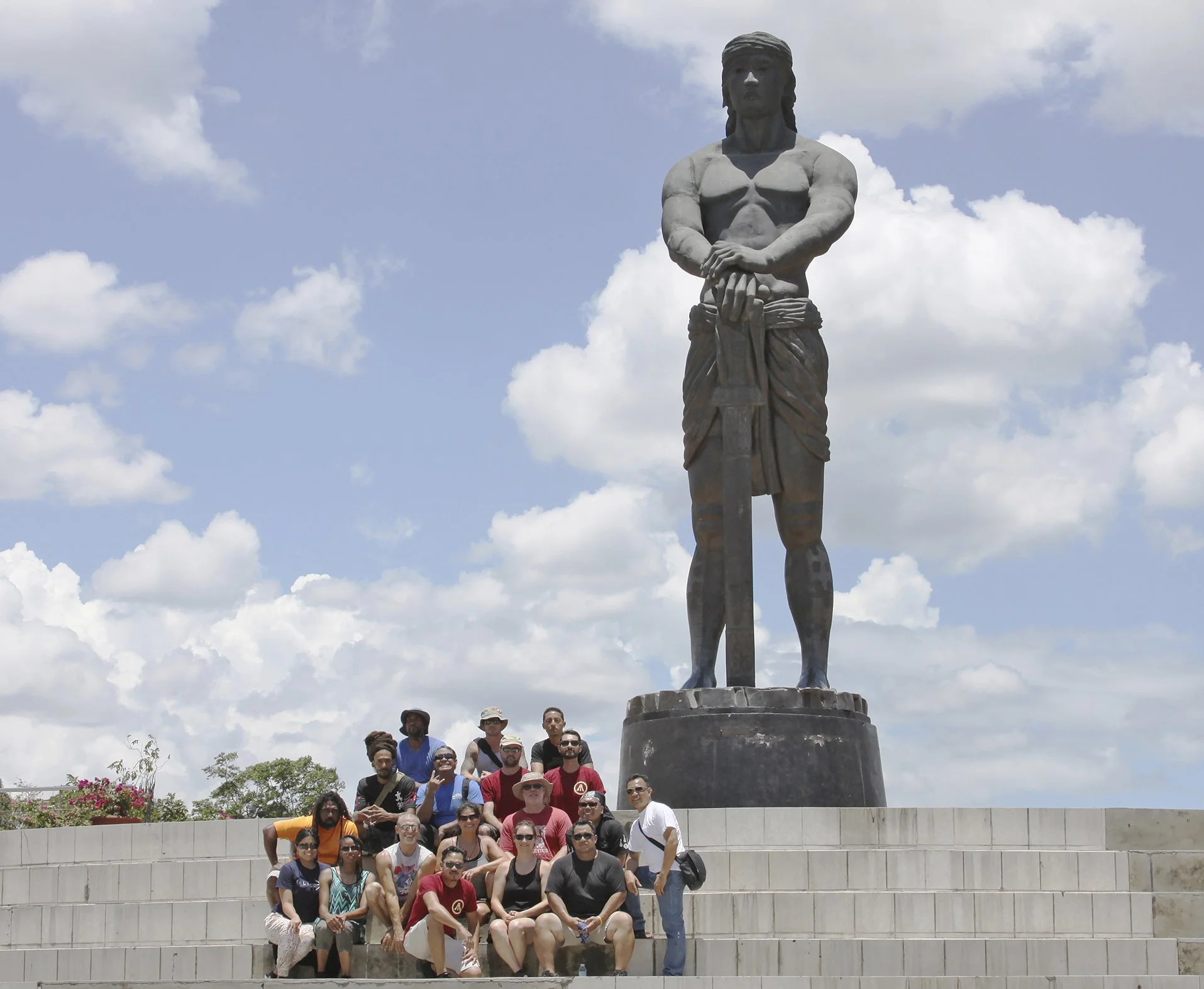
2 With my martial arts group visiting from the USA besides the Sentinel of Freedom in Manila
I have trained in Pekiti Tirsia Kali, a Filipino martial art that originated in the Visayas. In this system, the blade is an extension of the body and belongs to non-colonial and modern martial arts/defense practices that exceed the work and the myth of one man, even Lapu Lapu. The blade tells a story.
In 2022, I was selected as a resident artist for the ReConnect/ReCollect: Reparative Connections to Philippine Collections at the University of Michigan program. The multi-year project, led by Professors Deirdre de la Cruz (History and Asian Languages and Cultures) and Ricky Punzalan (School of Information), builds on recent efforts to decolonize collections by bringing together a diverse group of faculty, librarians, archivists, curators, collections managers, students, and members of the Filipino community to develop models for culturally-responsive and historically-minded stewardship of the Philippine collections at the University. The residency served as an opportunity to engage in conversations with the ReConnect team and the Filipino community around creative expression as inspired or provoked by the content of the University's collections in the encounter with them. I returned three times since then, engaging with the Philippine weapons collection, talking about their varied attributes, offering my interpretations of how they may have been wielded.
When exploring the University of Michigan Museum of Anthropological Archaeology (UMMAA) Philippine Collections, I was not certain which objects would catch my attention or pique my curiosity. At first, I looked for objects with which I was unfamiliar in order to gain a better understanding of them as well as study historic items that were unique and rare to come across. I eventually found myself returning to the weapons collection. As a practitioner of Filipino martial arts, I have had several opportunities to handle and wield a variety of modern blades and replicas. I was intrigued by how the weapons which were used in battles may feel in my hands as I made slashing and thrusting motions.
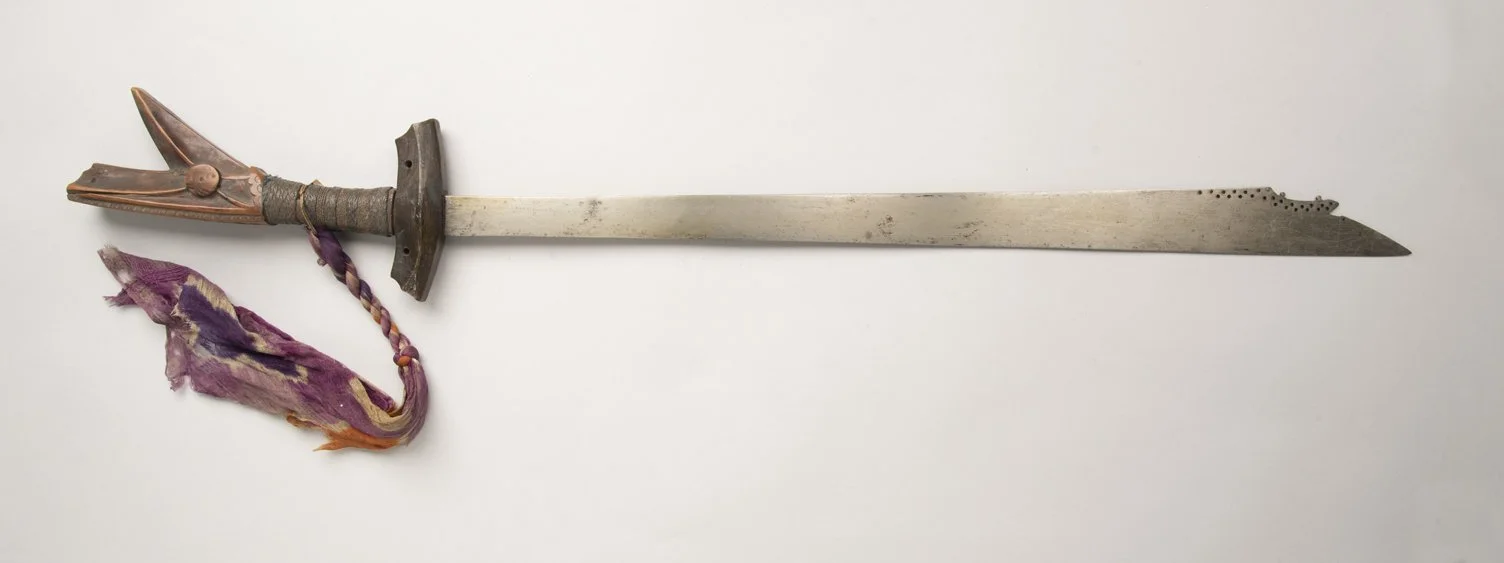
3 Kampilan
Upon seeing their varied collection of kampilan swords, I immediately pictured the statue of Lapu Lapu and thought of stories about the Battle of Mactan. Picking up the object (fig. 3), I took on the pose of Lapu Lapu and imagined myself wading in the shallow waters of Magellan Bay, sword in hand and prepared to fight. The note attached to the kampilan reads (fig. 4):
One straight-edged Kampilan, captured in the Taraca District April 5, 1904.
Has a kalaw (hornbill) pommel design.
Purple variegated silk tied to hilt, braided near hilt but open and fraying at end.
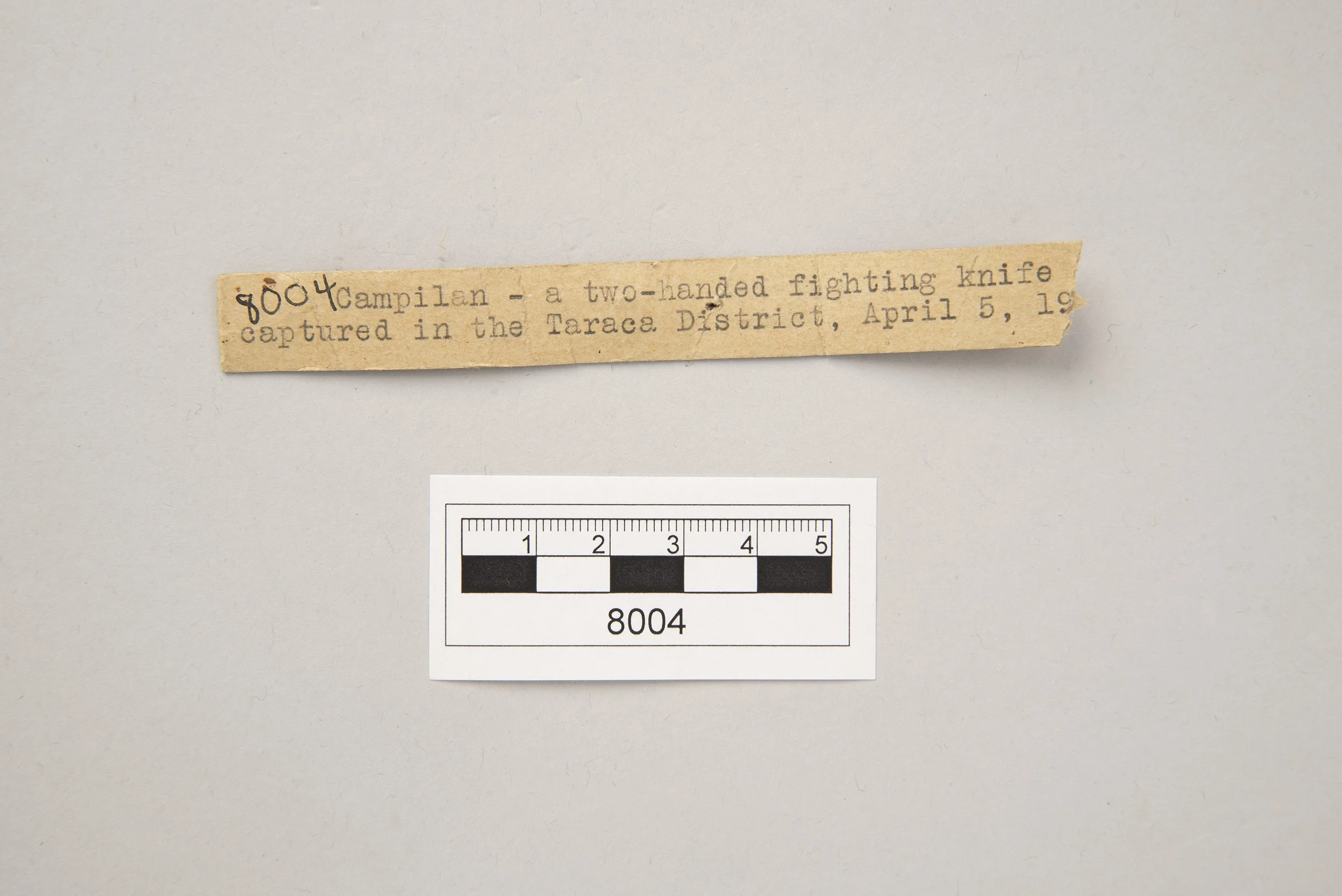
4 Note attached to the kampilan
A typical kampilan is long (around 100 cm), straight, single-edged, and widens toward the tip which typically features a protruding spikelet on the end of the flat edge. This sword is primarily used by different Muslim groups around the southern part of the Philippines. According to the National Museum of the Philippines:
Their design for single-handed use allows the warrior to carry shields made of wood and layers of abaca (hemp) cloth with their other hand to protect the upper body. [The kampilan is] seen as a symbol of power and status among the datus, sultans, and members of the nobility and warrior classes. Their designs, such as the naga, the mythical serpent, and the intricate carvings in the handle resembles variations from blades seen in neighboring polities in Southeast Asia.
I adopted a wide stance when I made slashing movements. Because I could feel the weight toward the edge of the blade, I allowed for this weight to lead my movements, like a pendulum. The motions I made were wide and fluid, creating a variety of X-like patterns while I maintained the edge and tip of the blade ahead of me. It is inexplicable to express in words, but once I allowed my body to follow the lead of the blade, I found myself moving in smooth sweeping motions that covered my feet to the top of my head in movements that would intimidate any oncoming opponents, or would counter any attacks that came my way. Once my body felt aligned with the kampilan, it felt as though I was following the blade’s lead. My shoulders rolled and swayed with the sword’s movement and my feet followed the path that the slashes provided.
Among the collections, there was one blade with which I felt an inexplicable connection. There was something about the curve of the talibong (fig. 5) that I found intriguing. What would the balance feel like? The curve of the blade seemed to be set at an acute angle from the handle that it seemed like it would be unwieldy to handle comfortably. Primarily used in Southern Luzon and the Visayas, this type of sword is known for its versatility; it was used for agricultural purposes, clearing brush, slaughtering game, and for combat. It dates back over one thousand years before Spanish colonization, and was said to have been used during the Spanish and American colonial eras, and by guerrilla fighters against the Japanese in the second World War. According to the collection’s notes:
[I]t was acquired during a University of Michigan Museum of Anthropological Archaeology expedition to the Philippines in 1925. It was collected under the assumption that the sword was used during the Philippine-American war of 1899. The blade is just over one and a half feet long, or nearly 50 centimeters…the diamond motif on the three petal flower pommel, this pattern is a traditional carving style that symbolizes a reticulated python, an animal that is both ecologically and culturally important to the Philippines.
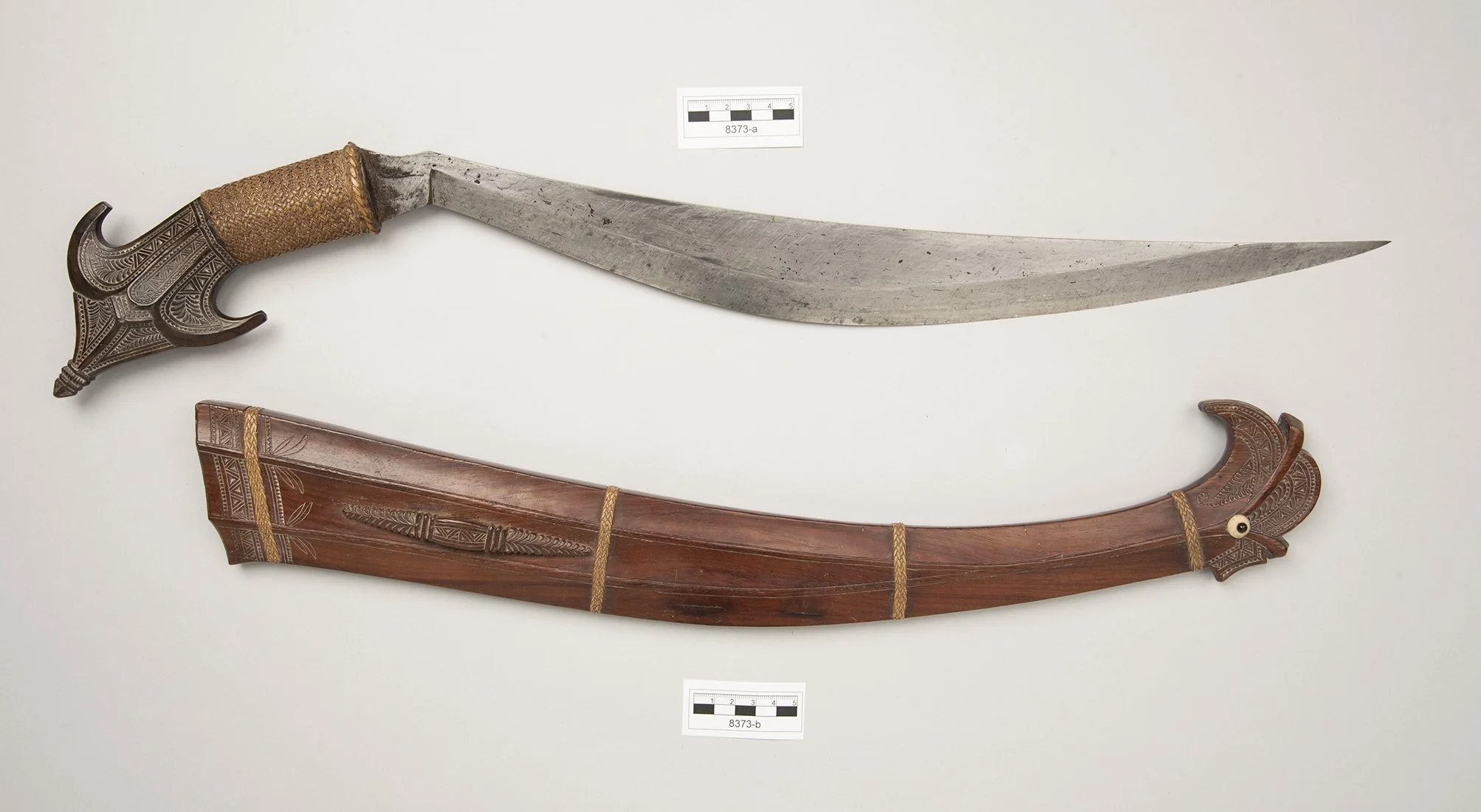
5 Talibong
I was surprised how comfortable the talibong felt in my hands. The handle nestled firmly into my palm, the curved part of the hilt allowed my little finger to manipulate the blade forward while the thumb rest where the blade and handle meet allowed me to have a secure grip. The sword felt almost weightless, as I was able to make flower-like motions as I bridged slashes and thrusts, I was able to effortlessly change the direction of the strikes. I also found myself in a balanced stance where I was able to change the direction where I was facing. I felt that I was able to continue these motions without feeling much exhaustion.
The more I moved with the kampilan and talibong, the more I started to think about the histories beyond the utilitarian objects. I started thinking about the personal histories tied to them. Who were the people who used them? How did they meet their demise? Were these blades gifted to them or passed from one family member to another? Who were the bladesmiths? Were there prayers (orasyon) or medicines (anting-anting) imbued in the blades? I began to feel empathy and a genuine connection to their original owners. Knowing that both of the blades were used during combat by someone who may have been fighting for freedom and their families. The swords were no longer simple tools, but more like vessels of history. I felt as though my movements had awakened them, and they transported me to a history that goes beyond the idea of the brave warrior.
Francis Estrada is an artist and Assistant Director of Learning and Engagement at the New Britain Museum of American Art.
Sources:
National Museum of the Philippines: https://www.nationalmuseum.gov.ph/
The University of Michigan Museum of Anthropological Archaeology (UMMAA) Philippine website: https://sites.lsa.umich.edu/ummaa-philippines/
The Morse Collection, UMMAA
The Philippine Expedition Collection, UMMAA
ReConnect/ReCollect: Reparative Connections to Philippine Collections at the University of Michigan: https://www.reconnect-recollect.com/