
Beyond Queenly Portraiture: Court Ladies and Royal Female Presence in Early Joseon Korea
Yi-Rong Chen
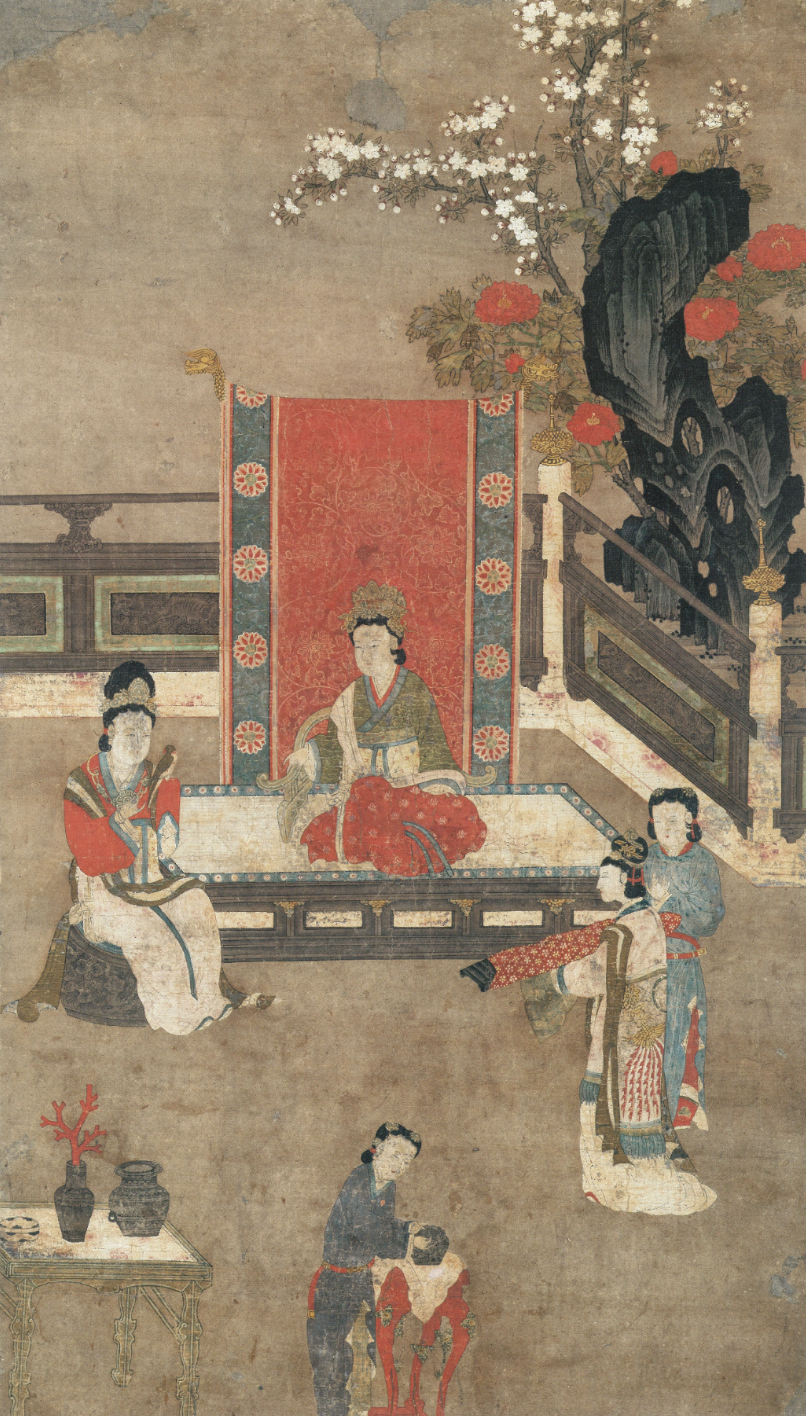
1. Court Ladies
Artist unknown, Korea; Joseon dynasty (1392–1910), c. mid-15th century
Ink and colours on silk; 101.8 × 58 cm
Private collection, Japan
(After ©Kokka, no. 1520, Tokyo, 2022, p.34-39.)
The near-total absence of portraits of queens in the Joseon dynasty (1392–1910) constitutes a striking anomaly in Korean painting history. A closer examination suggests that this phenomenon is closely tied to the historical transition from Buddhism to Neo-Confucianism in the Joseon society. Recently, a work published in Japan, Court Ladies (Gungnyeo-do) (fig. 1), has attracted renewed attention. In earlier years, Japanese scholars identified the piece as a ‘painting of a queen.’ Professor Itakurahas since proposed that the painting is related to Tang dynasty (618–907) representations of Yang Guifei and themes associated with the ‘four arts.’ O Dayeon has proposed that the work was likely produced during the first half of the 16th century. (O Dayeon, 2025, pp. 209–10). As an alternative interpretation, I propose that the work displays distant but discernible connections with Ming (1368–1644) dynasty woodblock prints and must also be situated within the broader context of female imagery in the early Joseon period (15th century). Under the increasingly rigid Neo-Confucian prescriptions governing women’s behaviour and mobility, royal and elite women could not directly participate in artistic production. As a result, most paintings featuring female figures were linked to Buddhist patronage, particularly through ritual commissions.
Early Joseon Buddhist paintings provide comparative materials. Notably, Court Ladies Painting shares specific motifs with these works, including vivid red garments and lotus flower decorations, suggesting a thematic affinity and structural commonality. Male court painters (hwawon), who had limited access to royal women, may have adopted a substitutive strategy by translating female types circulating in Ming–Qing printed imagery into representations of the ‘ideal woman.’ Within Korean scholarship, such figures in printed sources are often described broadly as ‘illustrations of ancient figures’ (gosainmulhwa), although the concept remains loosely defined and further research is needed.
In this light, Joseon painters did not merely absorb imagery from China; they actively transformed and indigenised it. Their proficiency in depicting female figures was already well established by this time. The Court Ladies also demonstrates the selective adaptation and rearticulation of imported motifs, and technical maturity is clearly visible in the work. By examining Buddhist paintings sponsored by royal women during the period of King Seongjong (r. 1469–95), many of which bear explicit inscriptions identifying their patrons—and by comparing their stylistic features with those of Court Ladies, the painting can be plausibly situated within Seongjong’s reign.
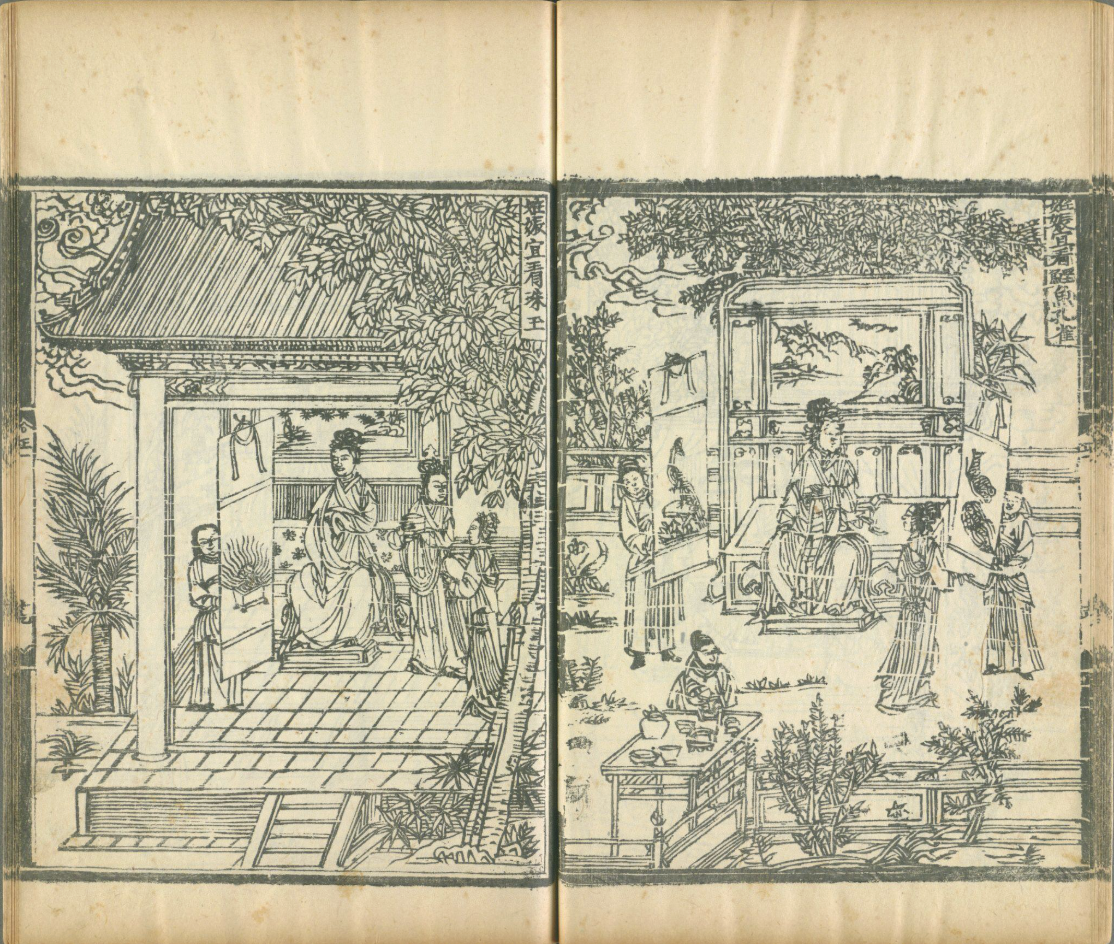
2. Yinshan zhengyao (Proper and Essential Things for the Emperor’s Food and Drink)
By Hu Sihui (act. 1314–30); Yuan dynasty (1272–1368), Neifu ed., [1330] 1456
Photo © National Palace Museum
Given the broader historical context of 15th century Joseon, particularly the discontinuation of the tradition of queen consort portraiture, Seongjong may have preferred commissioning didactic images of ‘exemplary consorts’ (hyeonhu bi-do), works aligned with Confucian moral admonition, rather than portraits imbued with Buddhist associations. Such a preference would be consistent with both his political strategy and broader intentions in directing the production of paintings.
From the late Goryeo dynasty (918–1392) through the early Joseon period, portraits of queen consorts, together with royal eojin, were enshrined in ancestral halls such as the Hondon and Seonwondon, where they served ancestral veneration and prayers for heavenly blessings. By the mid-15th century, however, the Joseon royal household had ceased to produce portraits of queen consorts. Works created prior to this point were largely destroyed in subsequent wars, which may account for their complete absence today. In the earliest decades of the dynasty, particularly under King Taejo (r. 1392–98)—court records document the production of portraits for queens Sinin (Han clan), Jeongan (Kim clan), Wongyeong (Min clan), Soheon (Sim clan), and Jeonghui (Yun clan). However, this practice came to an end during Seongjong’s reign, after which no portraits of queen consorts were recorded (Han, 2023).
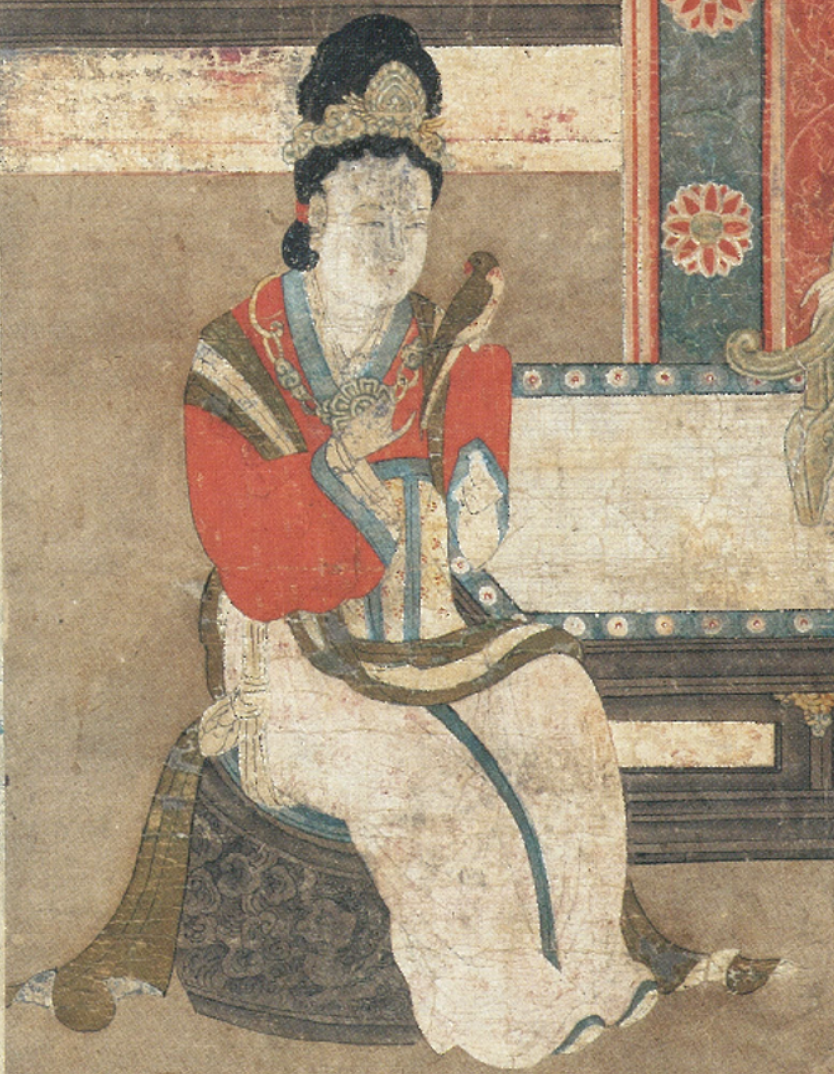
1a. Detail of figure 1, Court Ladies Painting, showing female on the far left
(After ©Kokka, no. 1520, Tokyo, 2022, p.34-39.)
Han Huisuk attributes the discontinuation of queen consort portraiture in Joseon to two main causes. The first was the persistence of Buddhist ritual practices inherited from the early dynasties. In the decades after Joseon’s founding, portraits of queen consorts continued to be produced and were often enshrined in palace halls or temples under royal patronage. For example, the Veritable Records note that ‘the portrait of Queen Sindeok was installed in Inan Hall’ (Joseon wangjo sillok, Taejo Annals, entry for the 7th year, 8th month, 2nd day) and that ‘a newly painted portrait of Queen Sinin was placed in Inso Hall, where the king personally offered ritual homage’. (ibid., entry for the 7th year, 12th month, 25th day) (Han, 2023).
However, this continuity began to shift under King Sejong. In accordance with King Taejong’s(r. 1400–18) view that the production of women’s portraits constituted an act ‘contrary to propriety’, Sejong (r. 1418–50) initiated the integration of Buddhist rites into the Neo-Confucian ritual framework laid out in the Zhuzi jiali (Family Rituals of Zhu Xi). Rather than relying on ‘true images’ (jinyeongn), that is, portraits, the new system emphasised the exclusive use of ancestral tablets (sinju) (Joseon Wangjo Sillok, Sejong Annals, entry for the 14th year, January 18). By the time of Seongjong, the transition from Buddhist-style portrait veneration to Confucian tablet-based rituals had been fully realised. This change represents a decisive turning point in the evolution of state rituals and constitutes the primary reason for the discontinuation of the production of queen-consort portraits (ibid., entry for the 13th year, June 25).
From the standpoint of the Joseon literati, who championed Confucian orthodoxy, portraiture was imbued with overt Buddhist associations and had no basis in the classical rites of antiquity. Consequently, both royal portraits and those of queen consorts were subject to ideological criticism. The literati generally disfavored portraiture intended for ritualistic purposes (Kang, 2012). After the completion of the National Five Rites of Joseon (Gukjo oryeui) in 1474 (the 5th year of Seongjong’s reign), which codified funerary practices and mandated the exclusive use of ancestral tablets, portraiture of queen consorts ceased entirely for ritual use.
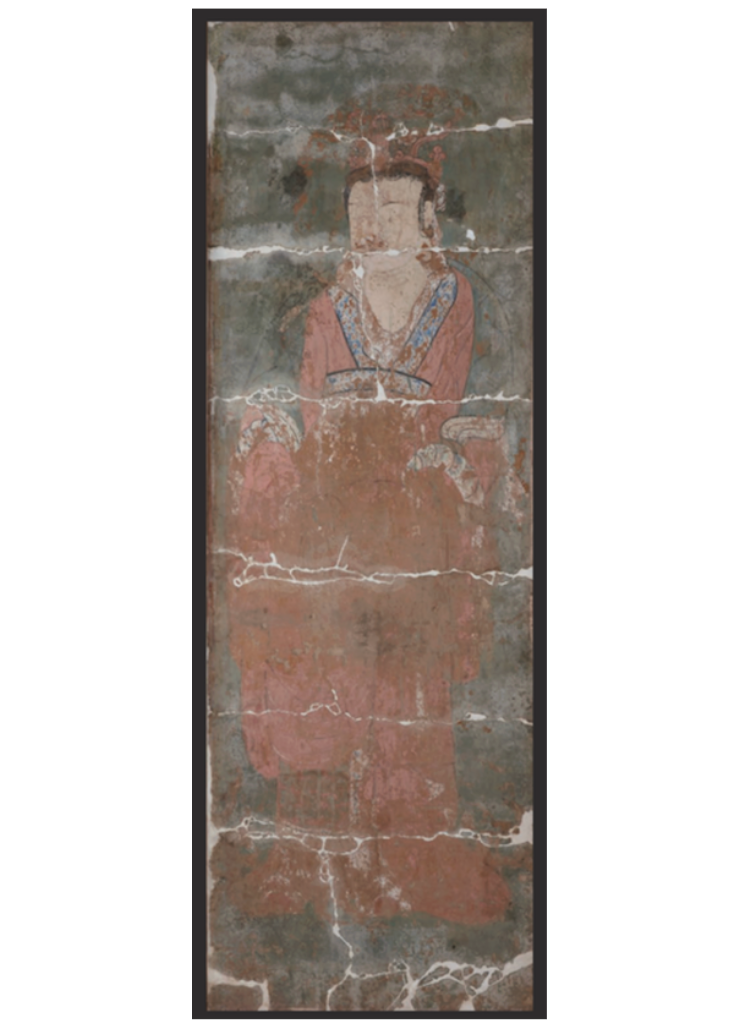
3.Mural painting of Brahma in the Patriarchs’ Hall of Buseoksa Temple
Korea, North Gyeongsang province, Yeongju; dated to the 3rd year of King U of Goryeo (1377)
Photo © Buseoksa Temple National Treasure No.46.
The second factor relates to the strengthening of the Confucian principle of the ‘separation of inner and outer’ (naeoebeop), a social norm that strictly prohibited free contact between men and women. Grounded in the Yegi (Liji, Book of Rites) and codified in the ‘Rites’section (Yejeon) of the early Joseon law code Gyeongje yukjeon, this principle imposed strict prohibitions on interactions between the sexes. Under these regulations, the permissible scope of kinship visits for yangban women was restricted to relatives within the third degree, severely limiting women’s contact with men outside this circle of kinship. The impetus for enforcing naeoebeop was influenced by the belief among early Joseon scholar-officials that the collapse of Goryeo was, in part, due to the moral laxity of women. (Joseon Wangjo Sillok, Taejo Annals, entry for 1st year, September 21).
This shift was reflected in the Gyeongguk daejeon, compiled during the reign of Taejong (r. 1400–18), which legally restricted yangban women’s social visits to relatives within the third degree; violations were treated as ‘misconduct’ (silhaeng). As a result, male court painters were effectively prohibited from directly interacting with members of the royal women’s quarters. Compounded by the absence of any tradition of training female painters, this situation made the production of portraits of queen consorts increasingly difficult. Although King Sukjong (r. 1674–1720) considered reviving the tradition of queen-consort portraiture, strong opposition from officials prevented its reinstatement. Thereafter, this genre of portraiture disappeared from the Joseon dynasty (Han 2023, 190–92).
Few early Joseon depictions of royal women have survived. The recent exhibition in Japan of Court Ladies, presented under the simple title ‘Court Ladies,’ is therefore particularly significant, as the naming itself aligns with these historical circumstances. An alternative perspective through which to interpret the work emerges from this context: Rather than restricting the analysis to a single, conventionally defined pictorial genre, this inquiry draws on a cross-genre corpus of early Joseon figure painting, Buddhist painting, and Buddhist sutra frontispieces to raise the question: In a period when no portraits of queen consorts were produced, how did male court painters create motifs for “female” figures despite such restrictions?
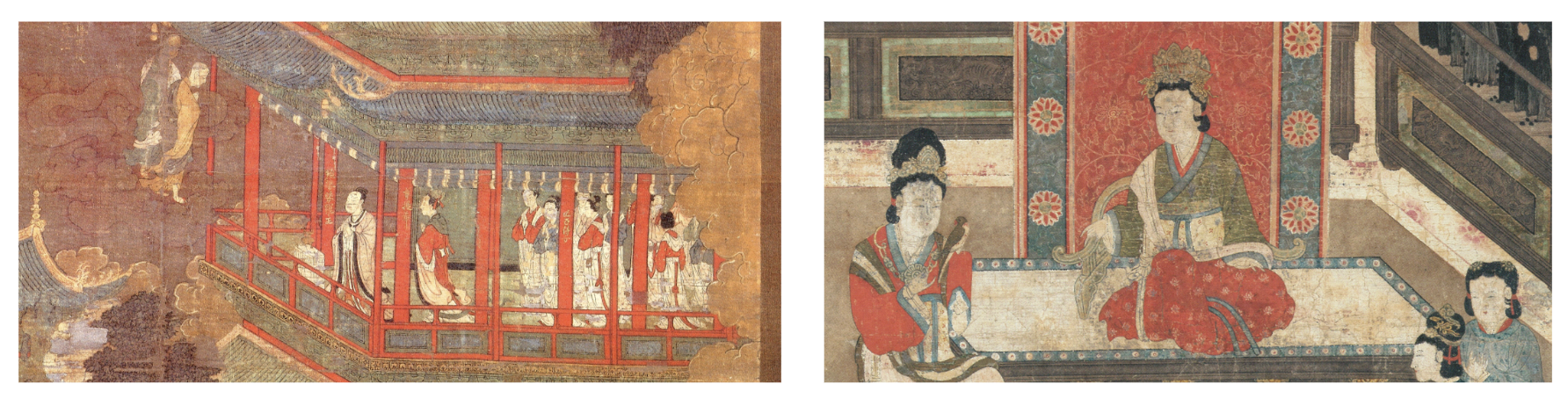
4. (Left) Detail from Illustration of the Introductory Section of the Contemplation Sutra (Gwan’gyeong seobun byeonsang-do) Artist unknown, Korea; Goryeo dynasty (918-1392).
Ink and colours on silk; 150.5 × 113.2 cm, Saifukuji, Japan.
Photo © Kikutake Jun’ichi and Jeong U-taek, Korai jidai no butsuga [Buddhist paintings of the Goryeo period] (Seoul: Sigongsa, 2000), fig. 53.
1b. (Right) Detail of figure 1, Court Ladies Painting, the central female figure seated on a chair thought to represent Queen Jeonghee(1418-1483).
(After ©Kokka, no. 1520, Tokyo, 2022, p.34-39.)
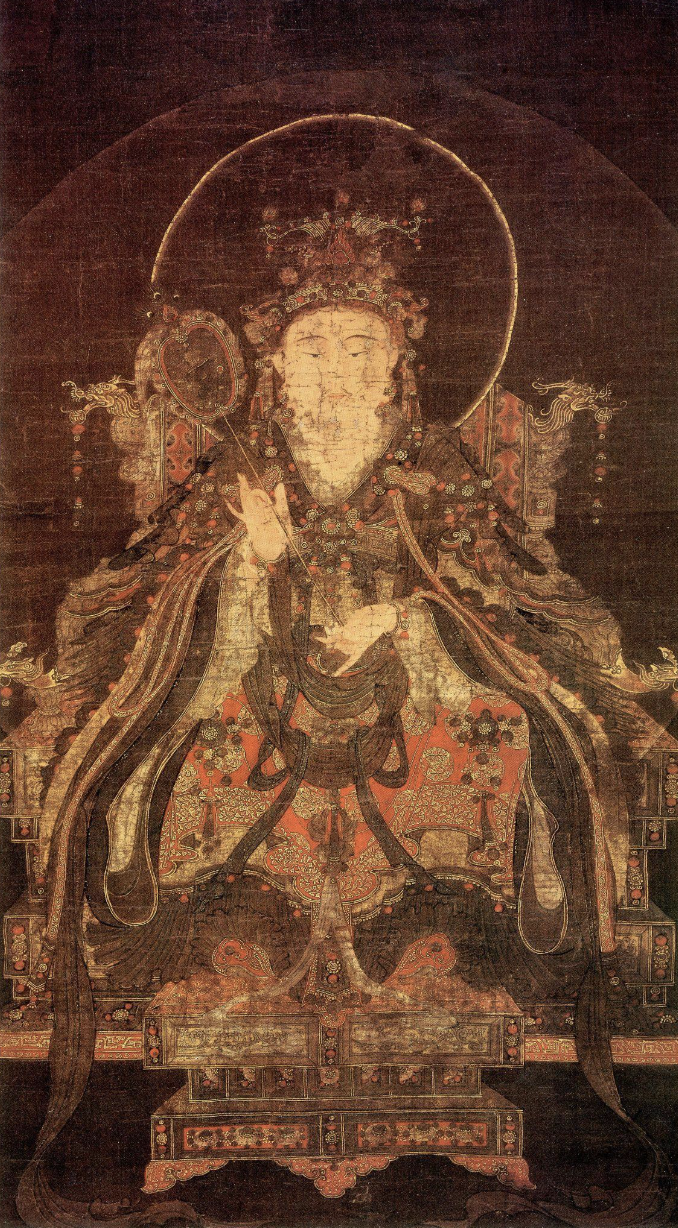
5a. Indra (previously identified as Marīcī)
Artist unknown, Korea; Goryeo dynasty (918-1392).
Ink and colors on silk, 97.9 × 54.5 cm.
Shōtaku-in, Japan.
(After ©Kikutake Jun’ichi and Jeong U-taek, Korai jidai no butsuga [Buddhist paintings of the Goryeo period] Seoul: Sigongsa, 2000, fig.121.)
Court Ladies shares certain motif-level affinities with illustrations in the early Ming printed edition of the late Yuan dynasty (1272–1368) treatise Yinshan zhengyao (Proper and Essential Things for the Emperor’s Food and Drink, first published in 1330 (fig. 2). Sections such as ‘Pregnant Women Should View Carp and Peacocks’ and ‘Pregnant Women Should View Pearls and Jade’ reveal comparable compositional structures. The text, which transmitted the dietary and health practices of the Yuan imperial court, appears to have circulated in the early Joseon royal court. The earliest medical compilations produced under King Sejong, most notably the Hyangyak jipseongbang (1433) and T’ae-san yorok (1434), suggest that knowledge from late Yuan sources was likely known within the court before a medical tradition was established in Joseon.
In Court Ladies, the woman on the far left (see detail in Fig. 1a) appears to hold a parrot rather than a peacock, suggesting that the work is not directly related to pregnancy rituals despite superficial similarities with the Yinshan zhengyao motifs. Nevertheless, certain features of the Ming woodblock editions, such as the placement of folding screens, railings, ornamental rocks, and peony blossoms, exhibit a more distant yet discernible line of transmission. Collectively, these design elements create an intimate inner domestic space associated with palace women, reflecting a selective reinterpretation of Chinese printed imagery in early Joseon.
Early examples of female figures in Goryeo Buddhist painting further illuminate the visual context within which the Court Ladies may be situated. In the third year of 1377, King U of Goryeo (r. 1374–84) commissioned the mural of Brahma in the Patriarchs’ Hall at Buseoksa Temple, Yeongju, North Gyeongsang province (fig. 3), which includes attendant female figures; similarly, the Illustration of the Introductory Section of the Contemplation Sutra (Gwan’gyeong seobun byeonsang-do) preserved at Saifukuji in Japan contains a motif featuring “five hundred maidens” (fig. 4). These examples, along with numerous early Joseon Buddhist paintings, share a conspicuous chromatic feature: the consistent use of red garments worn by female figures. By the late Goryeo period, at least by the fourteenth century, motifs derived from Chinese-style feminine imagery appear to have already been familiar on the Korean peninsula.
Although the mural of Brahma at Buseoksa corresponds more closely to the late Goryeo modes of Buddhist pictorial expression, the focus here lies not on the deity’s gender but on the red attire of the figure. The Illustrated Account of Envoys to Goryeo during the Xuanhe Era (Gaoli fengshi Xuanhe tujing), fascicle 20 (‘Gui Fu’), records that: ‘For queens and noblewomen, red was considered the most esteemed color, richly ornamented with embroidery; officials and commoners alike were forbidden to use it.’ This suggests that red was traditionally favored by elite Goryeo women. The prevalence of red garments in female motifs across these Buddhist works thus reflects the continuation, in early Joseon, of the chromatic tradition inherited from late Goryeo Buddhist painting.
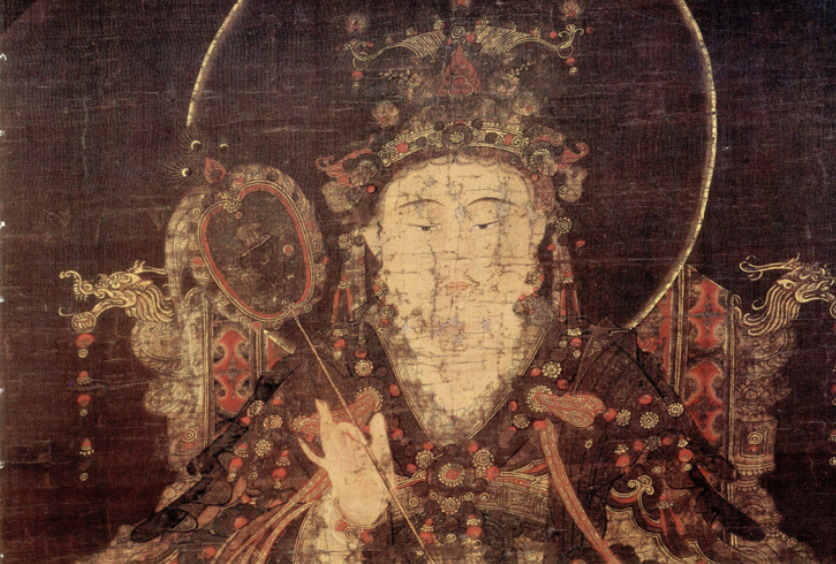
5b. Holding a fan the Details from Indra of Shōtaku-in (Marīcī).
(After ©Kikutake Jun’ichi and Jeong U-taek, Korai jidai no butsuga [Buddhist paintings of the Goryeo period] Seoul: Sigongsa, 2000, fig.121.)
The chair behind the central female figure in Court Ladies (see fig. 1b) features an attached back screen, recalling the decorative backrests of seats associated with royal women in Buddhist paintings. For example, the Indra (Marīcī) painting at Shōtaku-in (fig. 5a) and the Three Indra Deities painting at Eiheiji (fig. 6) both depict thrones adorned with dragon head motifs (fig. 5b). In addition, the background elements in Court Ladies, including ornamental rocks, peonies, and apricot blossoms, draw on a pictorial vocabulary associated with women of exemplary moral character.
The woman on the far right (fig. 1c) adopts a gesture of offering, presenting a textile bundle that appears to contain a gayageum (12-string zither). Her elevated position on the platform seat further distinguishes her from the surrounding attendants, underscoring her elevated status. Taken together, these visual cues suggest that she is not an ordinary court lady but a goddess.
In the foreground, another attendant (fig 1d) pours wine at a red table whose form closely resembles the baeansang (table) depicted in the Royal Protocols for the Posthumous Elevation of Queen Sunwon of King Sunjo (fig. 7). The baeansang was a piece of royal furniture used to hold chaekbo (royal seals and investiture documents) and was therefore intimately associated with the symbolism of royal authority (Kyujanggak Institute). These correspondences, while requiring further corroboration, suggest a preliminary hypothesis: the painting may be connected to Queen Dowager Jeonghui (Yun clan, 1418–83), who served as regent (suweon jeungjeong, or ‘rule behind the curtain) during the early Joseon period.
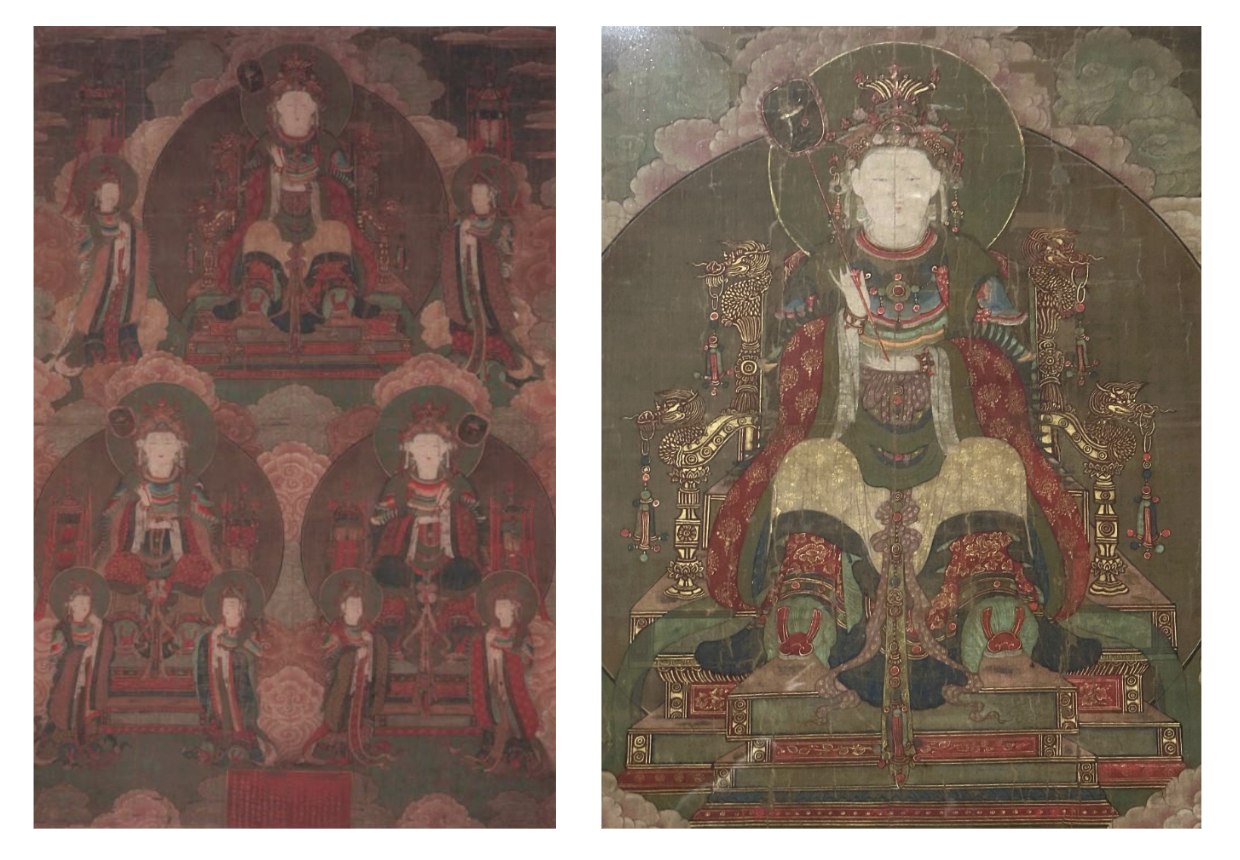
6. (Left) Three Indra Deities
Joseon dynasty(1392–1910), c. 1483.
Ink and colors on silk, 115.0 × 77.4 cm.
Eiheiji (Daihonzan Eiheiji), Eiheiji Town, Fukui Prefecture, Japan.
(After ©Unsullied, Like a Lotus in Mud, exhibition catalogue, Yongin, Hoam Museum of Art, p. 208–209)
6a. (Right) Photograph by the author. On the exhibition of Unsullied, Like a Lotus in Mud, Yongin, Hoam Museum of Art, 2024.
The poses of the first and second attendants on the left closely resemble those of court ladies (chaenyeo) depicted in the 16th century royal votive painting Illustration of the Prince of the Land of Bliss (Annakguk taija gyeong byeonsang-do) (fig. 8). In both works, women respectfully present objects with composed, forward-offering gestures. This parallel suggests that Court Ladies is unlikely to date later than the 16th century. Although produced later, the image may indicate the continued circulation of a visual strategy that associated Buddhist sanctity with royal authority.
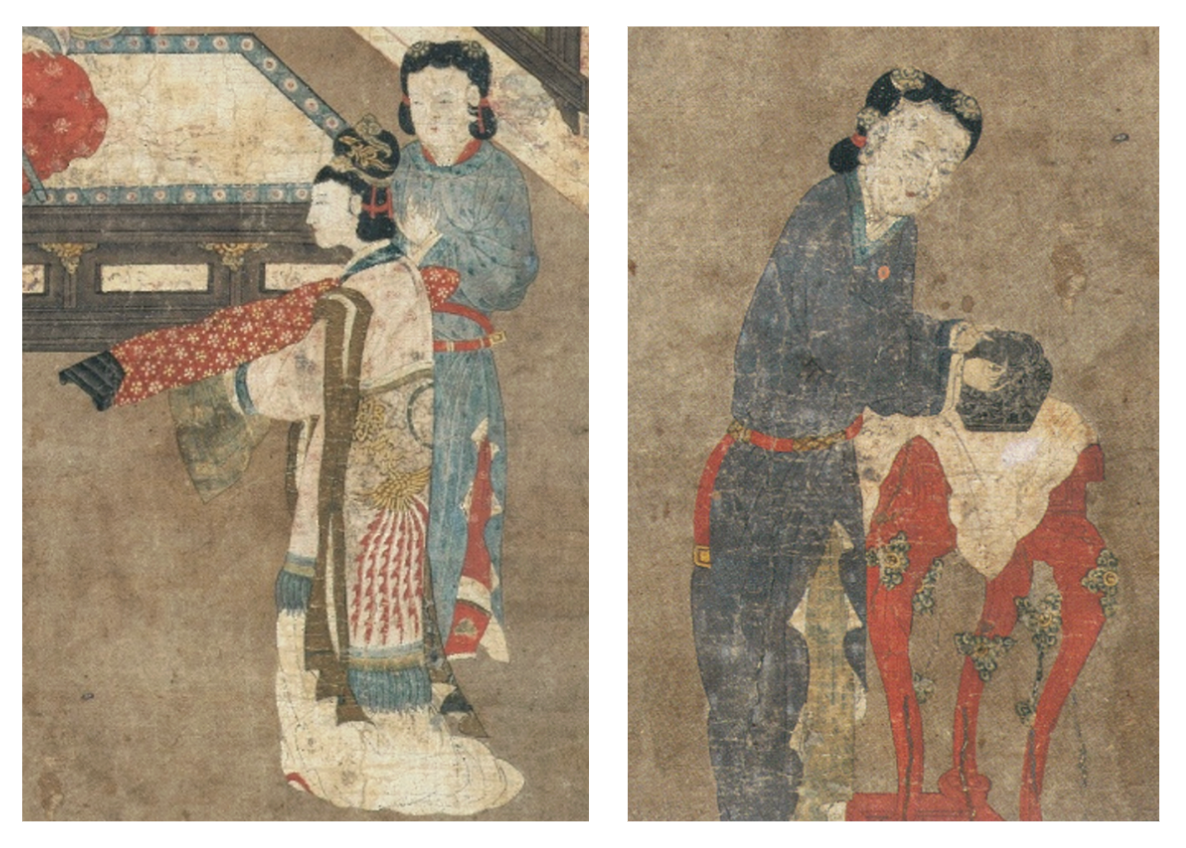
1c. (Left) Detail of figure 1, Court Ladies Painting, The woman on the far right is holding a gayageum(12-string zither)
(After ©Kokka, no. 1520, Tokyo, 2022,p.34-39.)
1d. (Right) Detail of figure 1, Court Ladies Painting, Wine-Pouring Attendant from Court Ladies
(After ©Kokka, no. 1520, Tokyo, 2022,p.34-39.)
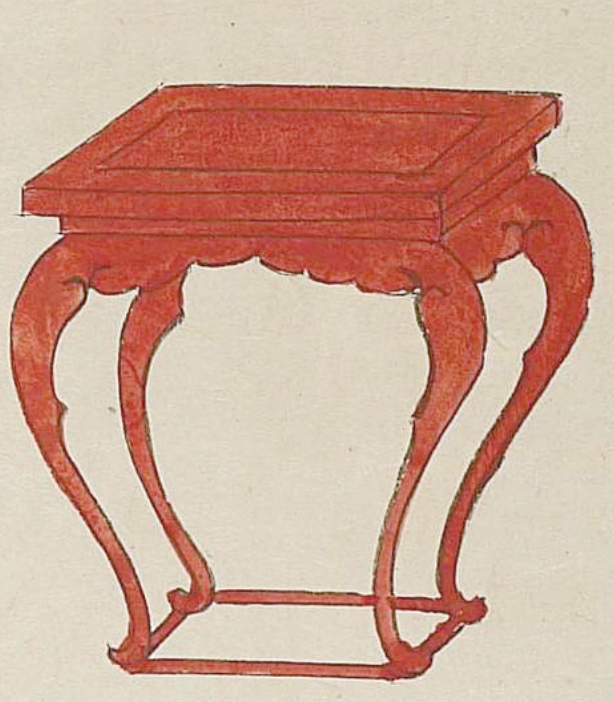
7. “Arrangement of the An Table” (Baeansang), from the Royal Protocols for the Posthumous Elevation of Queen Sunwon of King Sunjo (Sunjo daewang Sunwon wanghu chuso jeonho dogam uigwe).
By the Office for Bestowing Posthumous Titles (Jonhodogam), comp; Joseon dynasty (1392–1910), c. mid–late 19th century (c. 1858–1862).
©Kyujanggak Institute for Korean Studies, Seoul National University, Illustrated Encyclopedia of Royal Culture in the Joseon Dynasty, online database.
The form of the chair in Court Ladies indicates that its occupant was not an ordinary palace maid; such furniture would have been reserved for a woman of elevated status. The composition centres on a single seated woman before an attached screen, a configuration rarely seen in surviving early Joseon works. In most contemporary Buddhist paintings, red-robed female attendants appear only at the periphery so as not to disrupt the narrative structure of the Buddha’s life. In contrast, Court Ladies presents the seated woman as the focal point. Given the political circumstances of the 15th century, the most plausible identification for such a figure is Queen Dowager Jeonghui, who served as the regent behind the curtain.
Apricot blossoms, included in the painting, carry strong symbolic associations in Korean visual culture, including ‘attaining high distinction’ (ipsin yangmyeong) and success in the civil service examinations. Women were barred from taking examinations, so the most prominent means by which a woman could ‘attain distinction’ was through active engagement in governance, specifically, by serving as a regent. This iconographic layer reinforces the possibility that the central figure is a woman with political authority.
In the tenth month of 1462, the eighth year of King Sejo’s reign, Sejo reportedly witnessed an auspicious manifestation of the White-Robed Avalokiteśvara at Sangwonsa on Mt. Miji in Jipyeong-hyeon, Gyeonggi Province. This event was subsequently recorded in the Gwaneum hyeonsanggi (fig.9), with a commemorative text composed by Choe Hang (1407-1474) and an accompanying woodblock illustration.
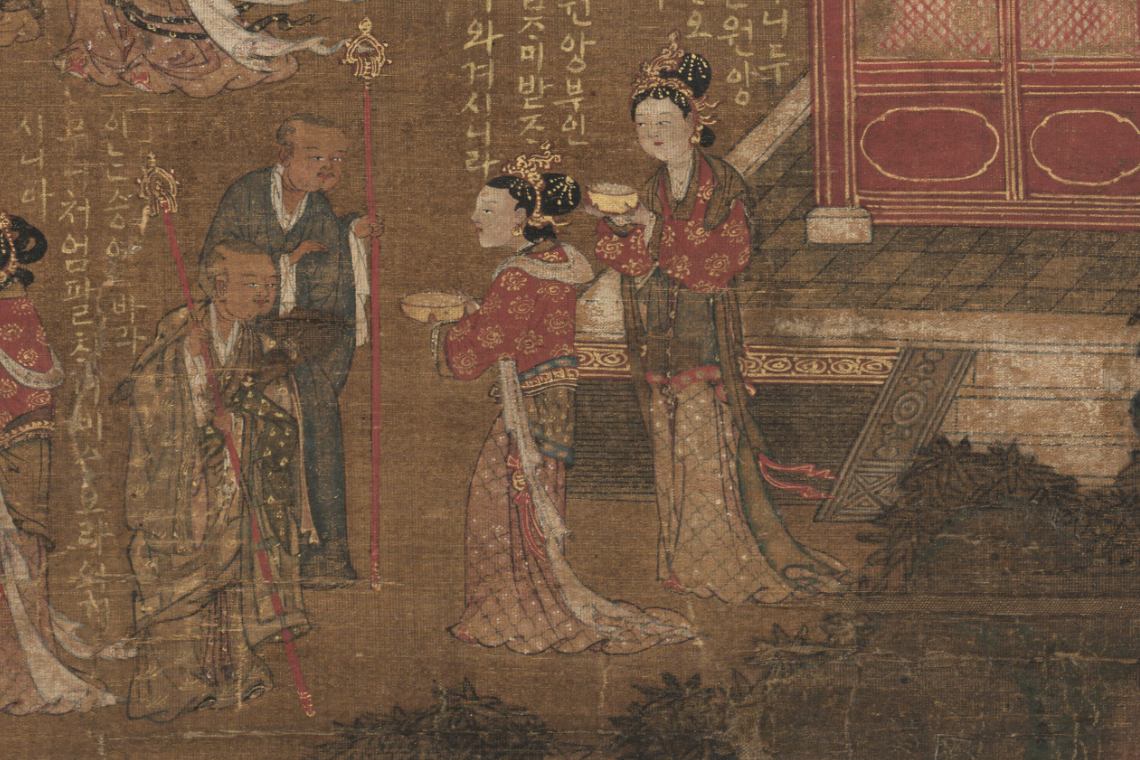
8. Illustration of the Prince of the Land of Bliss (Annakguk taija gyeong byeonsang-do), commissioned by the bhikṣunīs Hoein and Hoewol, Joseon dynasty (1392–1910), 1576.
Ink and colours on silk ;105.8× 56.8cm.
Aoyama Bunko Collection, Sakawa, Kōchi Prefecture, Japan.
(©After. Aoyama Bunko Collection).
Of particular interest is the representation of Avalokiteśvara in this illustration. Although previous scholarship has not addressed the gendered implications of the deity’s facial features, the face is rendered with notably soft and delicate contours. A comparison with Court Ladies image associated with Queen Jeonghui reveals striking formal affinities(compared to 1b), especially in the treatment of the facial outline and the ornamentation of the crown. Cho Kyu-hee has interpreted the landscape behind Avalokiteśvara in relation to the Five Peaks motif and the political context of female regency, particularly that of Queen Munjeong. (Cho, Kyu-hee,2021). Building on Cho’s interpretation, it is difficult to exclude the possibility that Queen Jeonghui, as King Sejo’s consort, would have had access to, or at least knowledge of, this printed image. While no direct documentary evidence currently confirms a genealogical relationship between the two images, the woodblock illustration may have formed part of the royal Buddhist visual repertoire available to court painters when producing images associated with Queen Jeonghui.
Additional visual evidence supports this interpretation of the results. The attire of the central figure, a green upper garment and red skirt, parallels that of Yaśodharā in the 15th century Illustration of the Buddha’s Renunciation (fig. 10). The lotus flower patterns on the floor in that painting also resemble the motifs on the central figure’s red skirt in Court Ladies (fig.1d), suggesting that the two works were created around the same time.
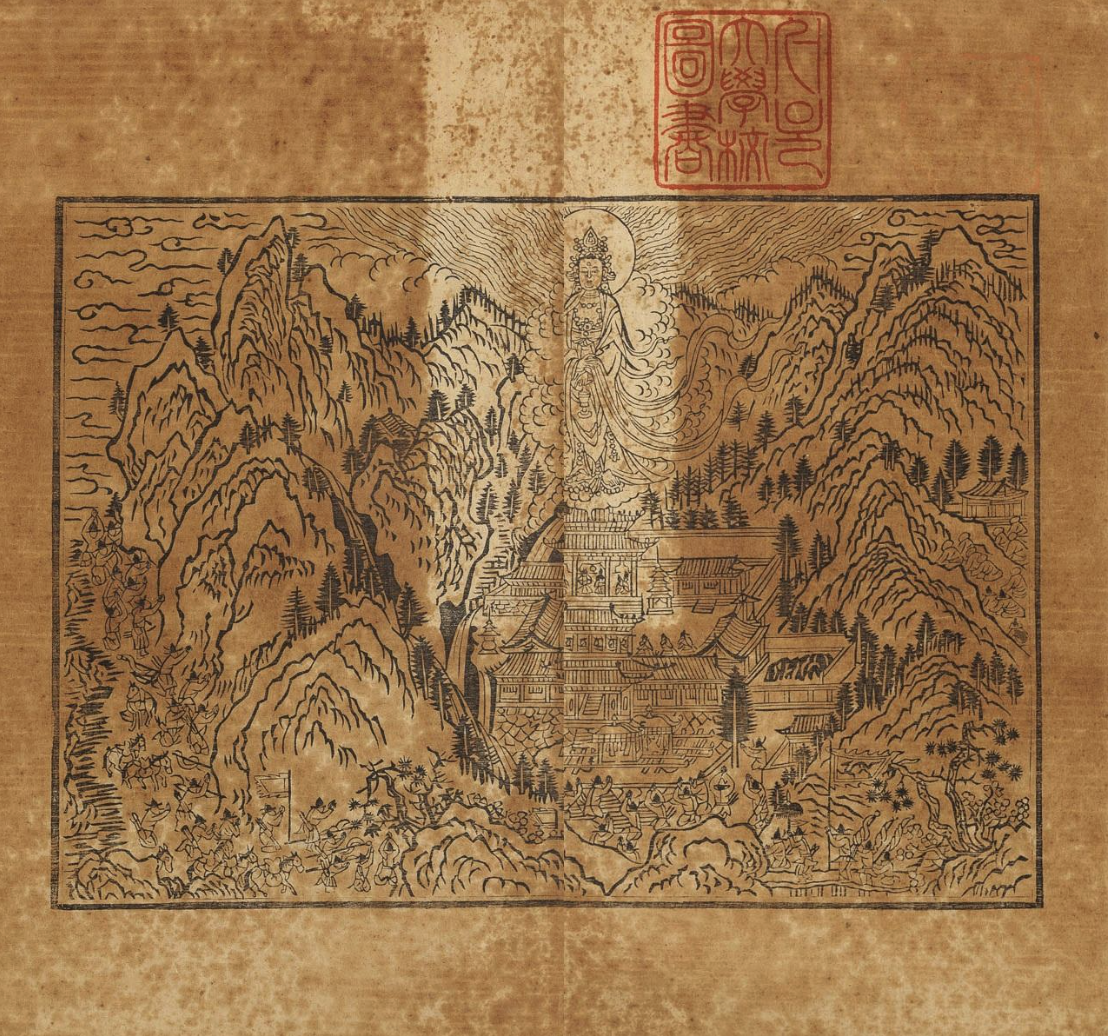
9. Illustration of the Manifestation of the White-Robed Avalokiteśvara from the Gwaneum hyeonsanggi.
unknown, Korea; Joseon dynasty, c. 1462.
©Woodblock-printed book; Kyujanggak Institute for Korean Studies, Seoul National University, Two extant copies are preserved today in the Kyujanggak Institute for Korean Studies (Kyu 6611 and Kyu 6612), online database.
Additionally, the frontispiece illustration of the Lotus Sutra commissioned in 1470 (2nd year of Seongjong’s reign) by Queen Dowager Jeonghui (fig. 11) exhibits ornamental motifs corresponding to the lotus designs on the vase placed behind the central female figure in the Court Ladies. Although one is a polychrome painting and the other a woodblock print, thus differing in line quality and technical execution, the lotus motif appearing in both is noteworthy. Comparative studies with other contemporaneous editions of the Lotus Sutra reveal that this lotus-based ‘scattered-flower’ motif was newly introduced in this period and therefore merits further attention (Kim, 2024, pp. 25–28).
Further corroboration is found in Noh Saseon’s (1427–98) inscription, which records that the Three Indra Deities painting of 1483 (fig. 6) was commissioned by Queen Dowager Jeonghui, Queen Sohye (1437–1504), and Queen Ansun (1445–98) (Ide, 2005, pp. 57–59; Kim, 2024, pp. 306–17). In that work (fig. 5b), the dragon-headed throne and several ornamental motifs bear striking similarities to elements in Court Ladies Painting, suggesting that both were royal commissions of the same period. Taken together, the evidence supports a preliminary conclusion: if the figure depicted is not a typical palace attendant but a woman of elevated status, the most likely identity is a royal woman from the reign of King Seongjong, specifically, Queen Dowager Jeonghui.
As Queen Jeonghui was the first queen in Joseon to exercise regency (suryeom cheongjeong) from 1469 to 1476, if only Indra (Śakra) in the upper register is depicted seated on a dragon throne, this may suggest that the image of Indra was deliberately superimposed with that of a ruler. (Cho, Kyu-hee,2021).
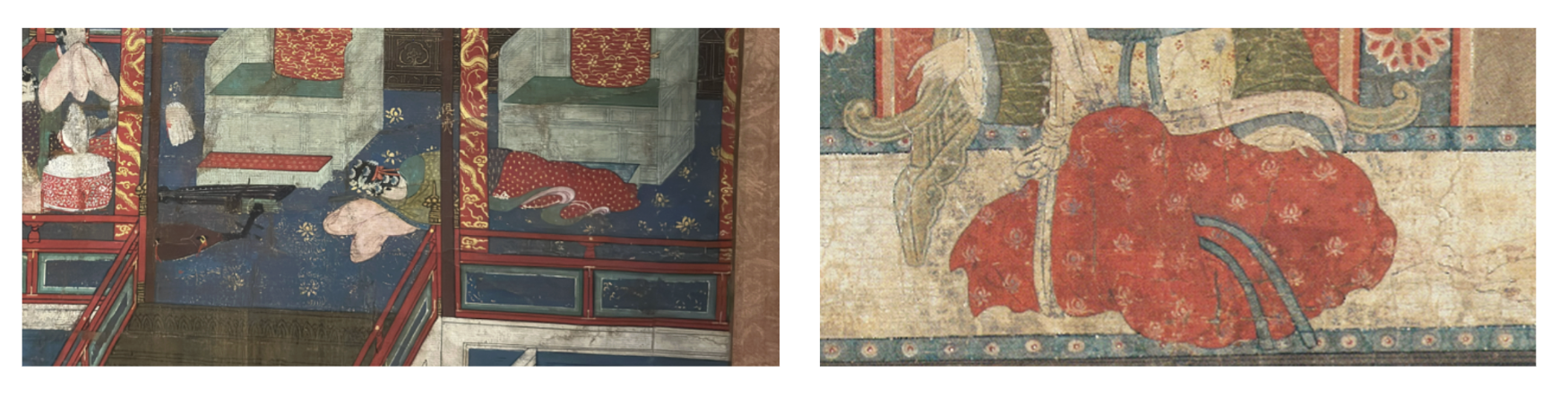
10. (Left) Illustration of the Buddha’s Renunciation (Seokga chulga-do),
Joseon dynasty (1392–1910), c. 15th century.
Museum of East Asian Art, Cologne.
Photograph by the author. On the exhibition of Unsullied, Like a Lotus in Mud, Yongin, Hoam Museum of Art, 2024.
1e. (Right) Detail of figure 1, Court Ladies Painting, the floral motifs depicted on the skirt of the central female figure.
(After ©Kokka, no. 1520, Tokyo, 2022, p.34-39.)
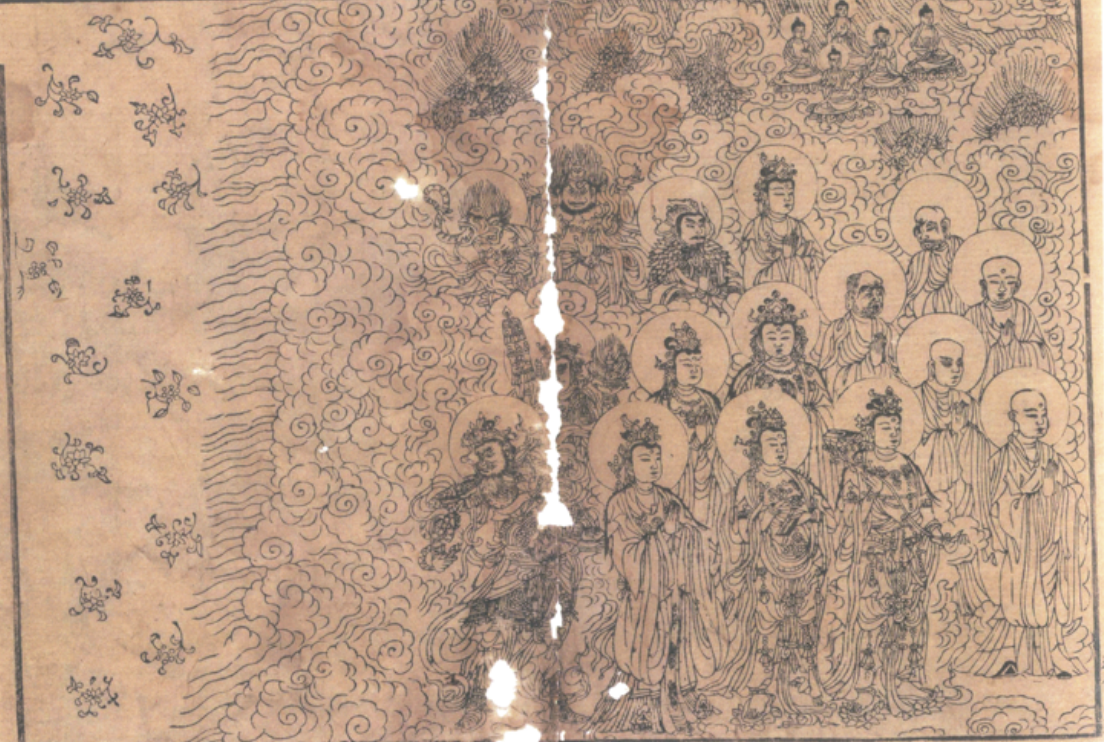
11. Detail from the frontispiece illustration of the Lotus Sutra (Myŏbeop yŏnhwa-gyeong) commissioned by Queen Dowager Jeonghui (1418-1483), Joseon dynasty (1392–1910), c. 1470.
(After ©Wonju Chiaksan Myeongjusa Temple Woodblock Printing Museum private collection catalogue, Buddhist Transformation Paintings from the Collection of the Wonju Museum of Ancient Prints, 2023).
According to art historian Shin Gwanghui, in Seokga tansaeng-do (fig.12, Painting of the Birth of Shakyamuni Buddha) he figure of Queen Maya appears in the same form, wearing a cloud-shoulder collar (ungyeon) and a garment with fishtail sleeves (gisyu), a mode of dress closely resembling that of the heaven deityIndra. In other words, the image simultaneously reflects the appearance of a Joseon royal woman and overlaps with the iconography of a celestial being (Shin 2023). This provides a close parallel to the treatment of the hem of the attendant’s skirt in Court Ladies (fig. 1b), where a similar manner of depiction is employed.
Additional support for a Seongjong-period date comes from stylistic parallels with the Bhaisjyagru Buddha Triad with Twelve Divine Generals (fig.12) produced in 1477 (Chenghua 3, Seongjong 8). The facial modelling of the Sunlight and Moonlight Bodhisattvas in that painting closely resembles the open-faced style of the flanking attendants in the Court Ladies. Moreover, the decorative motifs on the Sunlight Bodhisattva’s robes, and the textile patterns on the ritual altar(fig.12a), display striking affinities with those found in Court Ladies, a resemblance evident in direct comparison. These shared ornamental features strengthen the case for dating the Court Ladies to the reign of King Seongjong.
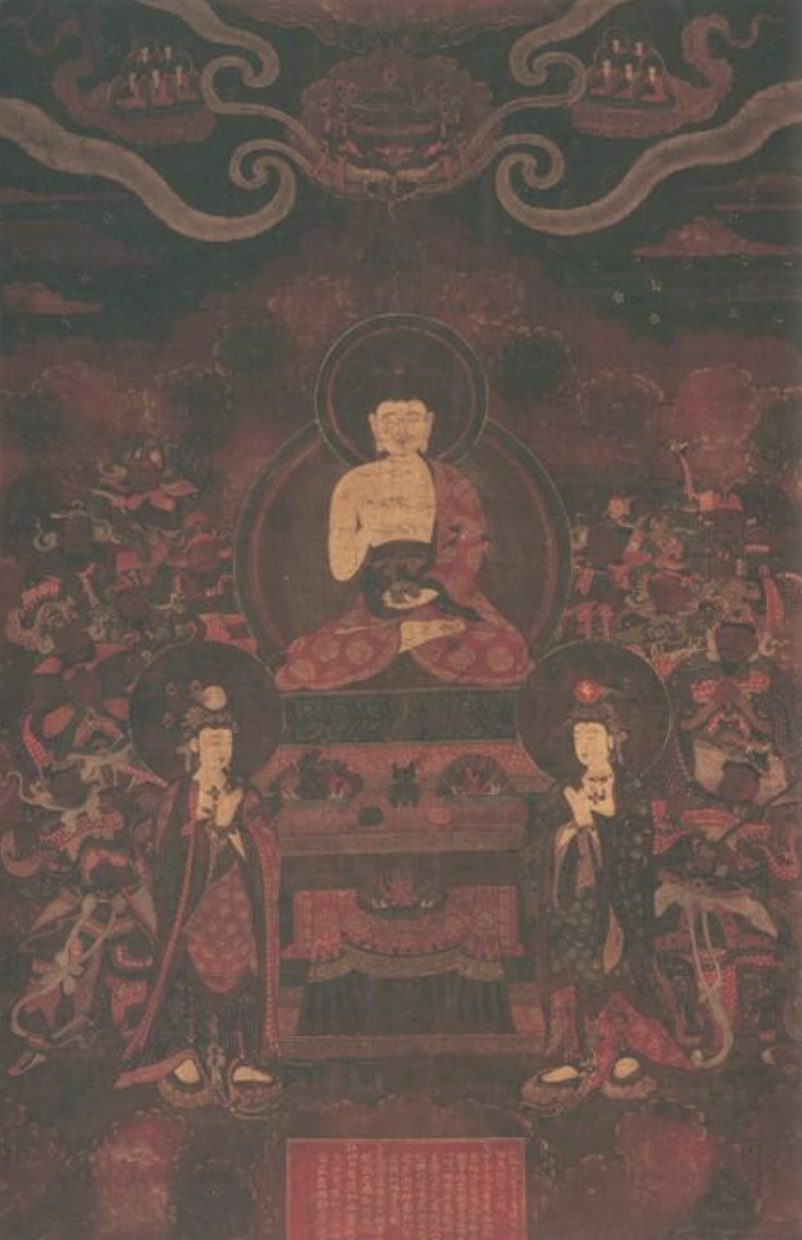
12. Bhaisjyagru Buddha Triad with Twelve Divine Generals commissioned by Princess Myeongsuk (1456–1482)., Joseon dynasty (1392–1910), c. 1477.
Ink and colour on silk, 176.5×74.5cm
Leeum Museum of Art, Korea
(After ©Unsullied, Like a Lotus in Mud, exhibition catalogue, Yongin, Hoam Museum of Art, p. 212–15)
As Itakura Masaaki has noted, the association between the central woman and the parrot in Court Ladies may evoke themes related to the Tang -dynasty narrative of Yang Guifei. Records from the Seongjong reign indeed document the production of a painting titled Yang Guifei Leaning on a Railing, (Yangbi iran-do) (Joseon wangjo sillok, Seongjong Annals, entry for the 11th year, October 14). This coincides with another crucial historical development: the gradual discontinuation of queen consort portraiture during Seongjong’s reign. According to the Veritable Records of the Joseon Dynasty (vol. 72, entry for 21 October, 7th year of Seongjong), as well as the research of Korean scholar Mun Seon-ju, King Seongjong actively promoted paintings intended as Confucian admonition, particularly images of ‘exemplary consorts’(hyeonhubi-do). Beginning in the seventh year of his reign, he repeatedly ordered the production of pictorial representations of virtuous women from Chinese historical narratives. Seongjong’s ongoing efforts, including his commissioning of paintings and the writing of prefaces to accompany them, indicate a deliberate shift away from earlier, more Buddhist-inflected modes of royal portraiture towards Neo-Confucian exempla centred on female virtue. This strategy may thus be interpreted as an intentional reorientation of pictorial production, mobilizing images of virtuous women to advance specific political and ideological aims.
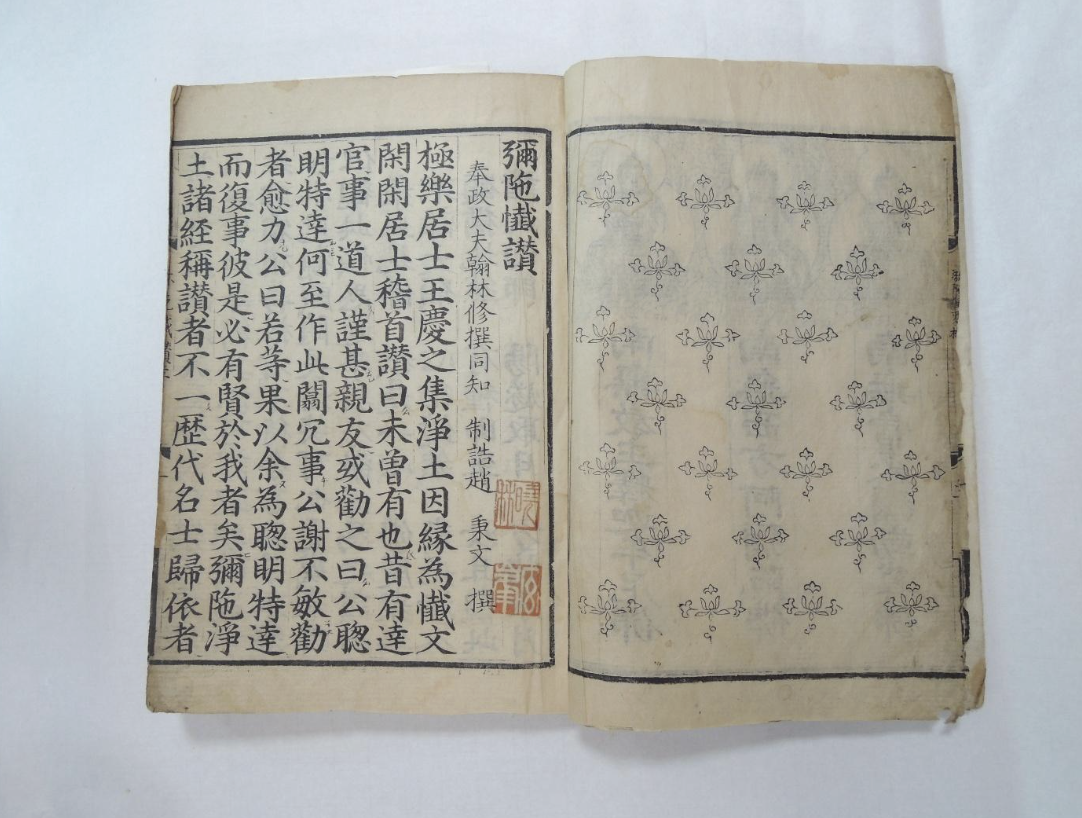
Further evidence is provided by the lotus motif stamped on the covers of the royal Buddhist text Yeryeom mitadoyang chambeop (Contrition in the Name of Amitabha Buddha), vols 1–5, sponsored in 1474 (5th year of Seongjong) by Queen Dowager Jeonghui (fig. 13). This design matches the lotus pattern in the 1470 frontispiece illustration of the Beophwa gyeong (Lotus Sutra) (fig. 11). This correspondence suggests that the motif may have functioned as a distinctive sign of a particular block-Jeonghui behind the curtain.
Considering the broader development of Chinese feminine imagery, Wu Hung (2019, pp. 334–36)—drawing upon the theoretical insights of Francette Pacteau (1994, p.12)—argues that the absence of identifiable, ‘real’ women is fundamental to the genre of beauty paintings. By the late Ming and early Qing, the substitution of idealized feminine types for real women reached its peak. Comparable substitution strategies likely circulated in earlier Joseon.
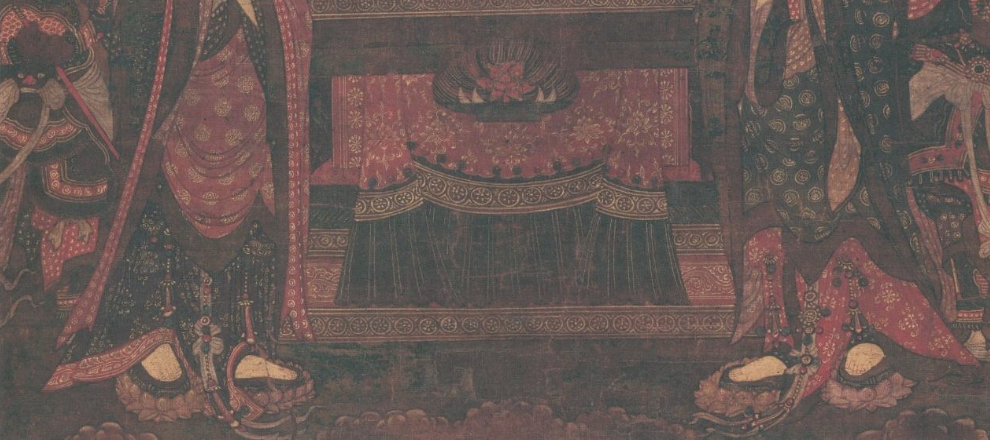
12a. Detail of figure 12, Bhaisjyagru Buddha Triad with Twelve Divine Generals. the decorative motifs on the Sunlight Bodhisattva’s robes, and the textile patterns on the ritual altar
(After ©Unsullied, Like a Lotus in Mud, exhibition catalogue, Yongin, Hoam Museum of Art, p. 212–15)
13.Yenyeom mita doryang chambeop (Contrition in the Name of Amitabha Buddha), Volume 1–5
By Queen Dowager Jeonghui (1418–83) sponsored in 1474 (5th year of Seongjong) , Joseon dynasty (1392–1910).
Photo ©Gobulsa Temple National Treasure No.2145
However, the situation in Joseon differed markedly from that in China. Under the combined pressures of Neo-Confucian moral discourse and the religious context, the visual meanings and functions of feminine imagery were reinterpreted. These images embody gender norms and ethical ideals specific to the Joseon sociocultural order. Within the Buddhist sphere, recent Korean scholarship has shown that royal women were active and consistent patrons of Buddhist art in the early Joseon period. Although no direct evidence exists showing that royal women inserted their likenesses into Buddhist paintings, studies strongly suggest that royal women played significant roles in the production, sponsorship, and visual shaping of such works (Lee, 2024, pp. 45). Thus, their influence constituted a meaningful, albeit indirect, agency within the Buddhist artistic milieu.
Yi-Rong Chen is a finalist in our 2026 Orientations x Susan Chen Young Art Writers Award competition and an M.A. student in the Department of Art History at Seoul National University.
Selected bibliography
Cho, Kyu-hee. “Sungbul gwa sungyu-ui chungdol, 16 segi jungyeop sansu pyohyeon-ui jeongchihak: Dogapsa Gwaneum bosal samsibi eungtaeng gwa Muigugokdo mit Dosando” [The Conflict between Buddhism and Neo-Confucianism: The Politics of Landscape Representation in Mid-Sixteenth-Century Joseon]. Misulsa wa Sigak Munhwa 27 (2021): 28–67.
Francette Pacteau, The Symptom of Beauty (1994); adapted by Wu, Hung, Nüxing Kongjian, Beijing, 2019.
Han Heesuk, ‘The Production and Cessation of Queen Consort Portraits in the Joseon Dynasty’, Jangseogak 50:176–204.
Ide, Seinosuke, ‘’ Taishakuten-zō, Kokka 1313 (2005): 57–59.
Kang Kwansik, ‘Five Codes for Reading Portraits of the Joseon Dynasty’, Journal of Art History 38 (2012): 3–4.
Kim, Ja-hyun, , ‘A Study on the Illustrative Woodblock Prints of the Lotus Sutra in Large-Character Editions of the Joseon Dynasty’, Dongak Art History 36 (2024): 5–38.
Kim, Junghee, ‘Royal Court Women and Patronage of Buddhist Painting in the First Half of the Joseon Dynasty’, in Unsullied, Like a Lotus in Mud, exh. cat., Hoam Museum of Art, Yongin, 2024, pp. 306–17.
Kwanghee Shin, ‘Joseon jeongi buljeon-do ui yeoseong imiji’, paper presented at the international Korean Art and Gender Conference, Seoul, 22–23 September 2023,pp.16.
Kyujanggak Institute for Korean Studies, Seoul National University, ‘Illustrated Encyclopedia of Royal Culture in the Joseon Dynasty’, https://kyujanggak.snu.ac.kr/dohae/sub/schDetail.jsp?no=D0470&category=A&sWord=%EC%83%81
https://kyudb.snu.ac.kr/book/view.do
Masaaki Itakura, Kokka, no. 1520, Tokyo, 2022,p.34-39.
Moon, Sunjoo, ‘A Study of Admonitory Paintings Featuring Women in the Joseon Dynasty: Focusing on the Political Nature of Stories of Virtuous Consorts and Illustrations of Exemplary Women’, Yŏksa Minsokhak 43 (2013): 91–131.
Seunghye Lee, ed., Unsullied, Like a Lotus in Mud, ext. cat., Hoam Museum of Art, Yoongin, 2024.
Sungoh Yoon, “A Disguised Sponsorship for Tenacious Buddhism in Early Chosŏn Korea: Queen Sohye (1437–1504) and the Buddhist Controversy in the Reign of King Sŏngjong,” Journal of Korean Religions 12, no. 2 (October 2021): 5–35.
O Dayeon, ‘“The Production and Function of Fifteenth-Century Joseon Court Painting,” Museum and Research, 3. 2025, pp. 209–10.