
Exhibition review: Crosscurrents: Masterpieces of Mughal, Safavid, and Ottoman Art at Singapore’s Asian Civilizations Museum
Tim Brinkhof
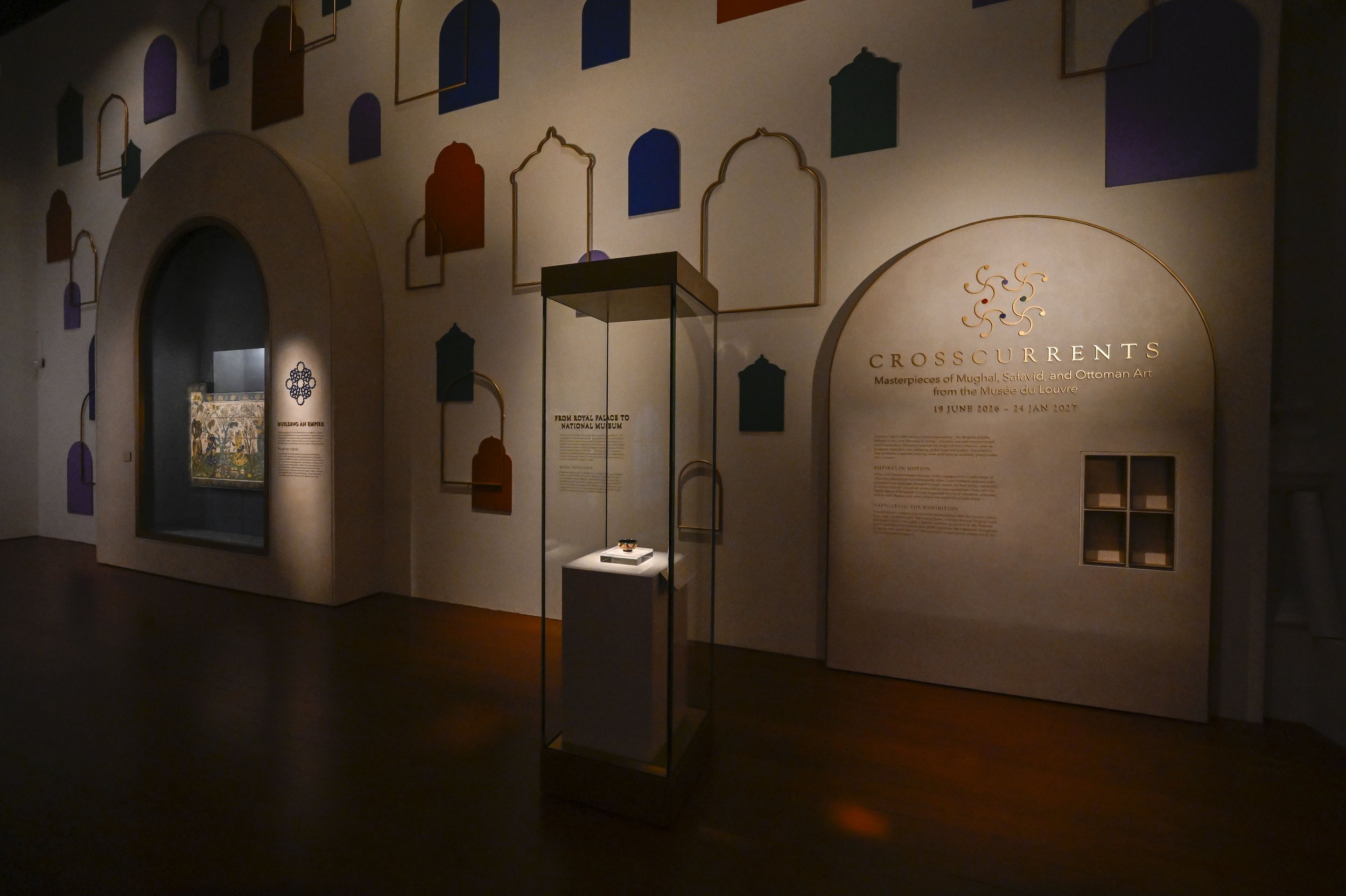
View of Crosscurrents: Masterpieces of Mughal, Safavid, and Ottoman Art.
Despite being the most populous part of the Islamic world, Southeast Asia is often seen as peripheral to the Middle East. A new exhibit at Singapore’s Asian Civilizations Museum – ‘Crosscurrents: Masterpieces of Mughal, Safavid, and Ottoman Art from the Musée du Louvre’– challenges this notion.
The exhibit, on display from 19 June, 2026 to 14 January, 2027, explores the overlapping heritage of three Muslim empires that flourished between 16th and 18th centuries. Spanning northern India, Iran, and Turkey, their neighboring territories and shared faith gave rise to a trade network that reached all the way to Southeast Asia.
The items loaned from the Louvre – which is currently in the midst of renovating its Department of Islamic Art – were previously on display at the Museum of Art Pudong in Shanghai under the title ‘The Wonder of Patterns: Masterpieces from India, Iran and the Ottoman World’, which ran until May 6 this year.
Rather than simply restaging the same exhibit, the ACM has placed the loaned items in dialogue with artefacts from its own, pan-Asian collections. This way, the curators are able to chart how Islam spread from the Middle East the Far East, eventually turning Brunei, Malaysia, and Indonesia into majority Muslim countries.
In lieu of an exhibit catalogue with introductory essays, a theoretical framework through which to approach ‘Crosscurrents’ may be found in a 2019 article by current ACM director Clement Onn. Published in the Journal of the Society of Renaissance Studies under the title ‘Circulating art and visual hybridity’, it argues “cultural exchanges are not one-directional transmission but rather a far more complicated process of hybridization.”
‘Crosscurrents’ starts on the museum’s second floor, where visitors are introduced to Safavid, Mughal, and Ottoman artwork in that order, and continues in the Design Gallery on the floor above, where items from all three are interspersed with artefacts from Brunei, Indonesia, Malaysia, and Myanmar.
A recurring theme in the exhibit is that Southeast Asian craftspeople did not copy Indian and Middle Eastern artforms, but reinvented them using local materials, techniques, and customs, creating what Onn refers to as ‘hybrid objects’.
A Malaysian Quran, made in the sultanate of Terengganu during the 18th or 19th century, adheres to the Ottoman Âyet-Berkenar format, where every page begins and ends with a completed verse, and starts with the conventional header ‘Surah al-Fatihah al-Kitab’, meaning ‘Opening Chapter of the Book’. At the same time, the manuscript features no less than three illuminated double-page spreads – a regional preference, according to the curators, and one that diverges notably from Ottoman Qurans, which typically includes only one spread at the front.
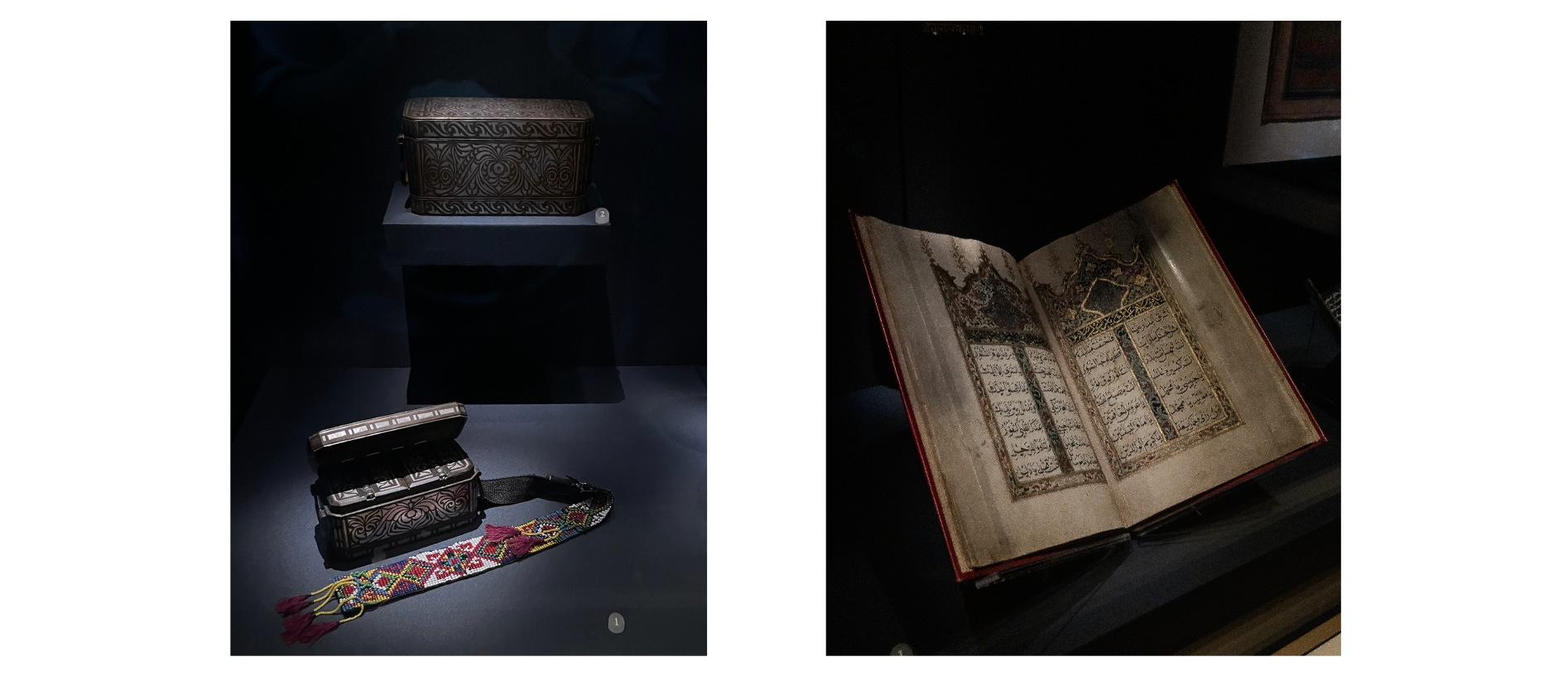
(Left) Betel Set
Sumatra or Riau Archipelago, Indonesia, late 19th or early 20th century
Wood, lacquer, mother of pearl, silver, gold
(Right) Quran
Terengganu, Malaysia, 18th or 19th century
Paper, ink, color and gold pigments, leather binding
The ‘hybridization’ of Southeast Asian and foreign influences can also be found in the distinctly Islamic geometric and floral motifs on late 19th or early 20th century brass and wooden betel boxes from Mindanao (southern Philippines) and the Sumatra or possibly Riau archipelago (Indonesia), which were used to store betel nuts. The floral motifs, in particular, may be traced back to Mughal courts, where traditional Indian naturalism combined with Safavid ornamentation and European scientific illustration.
Evidence of cross-cultural exchanges working in the other direction is most clearly visible in displays of 17th century Safavid earthenware which, to compete with an influx of Qing dynasty porcelain, adopted its blue-and-white color scheme so thoroughly that this palette largely lost its association with China, becoming to Iran what Delft Blue is to the Netherlands.
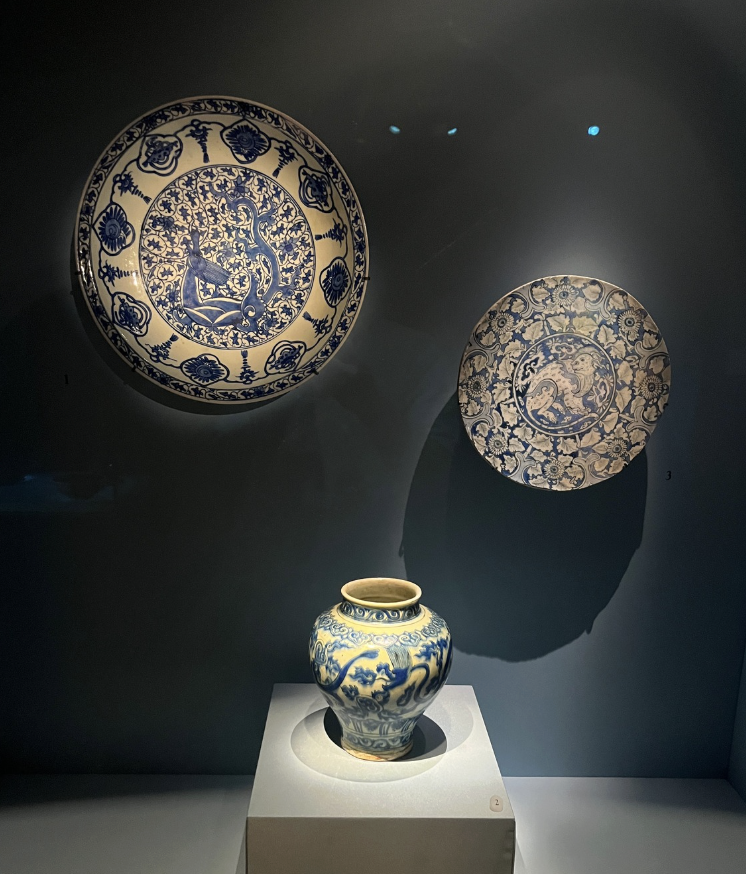
Left to right: Dish with dragon, Vase with dragons, Dish with qilin
Iran, circa mid-17th century
Glazed ceramic
Visitors are encouraged to view ‘Crosscurrents’ in relation to the ACM’s permanent galleries of East Asian Hindu, Buddhist, and Christian art, which shed additional light on how pre-Islamic traditions were incorporated into and combined with Islam rather than replaced by it, as was generally the case with Christianity.
One example of this incorporation is a palanquin ornament from the Pattani region of the Malay Peninsula. Made from jackfruit tree wood and decorated with zinc, brass, and copper plates, it represents a makara – a sea creature from Hindu mythology – yet was used by Muslim communities in ceremonies celebrating the circumcision of young boys.
How and why the makara became linked to this specific Muslim ritual is unclear. Considering these creatures were carved onto boats to provide protection on literal voyages, they may have served a similar purpose on the metaphorical journey from boyhood to manhood.
Christian art also shows signs of hybridization, albeit of a different flavor. A porcelain statuette of the Virgin and Child, made in China’s Fujian province in the late 17th century, depicts the Virgin standing on a cloud – imagery associated with the Bhodisatva Guanyin – while another statuette, made in mid-16th century Sri Lanka from ivory, shows the Virgin in dress and jewelry reminiscent of a Buddhist monk.
Compared to the palanquin ornament, where an Islamic tradition finds expression through a non-Islamic one, the non-Christian elements present in these Christian art pieces are secondary and subordinated to the dominant religion. This reflects the opposing ways in which Christianity and Islam took root in the Asian continent: while Christianity imposed itself as a means of consolidating colonial rule, Islam spread primarily through trade and marriage, without competing against preexisting belief systems.
‘Crosscurrents’ can also be compared to the ACM’s previous exhibit, ‘We Are the Pacific: A World Born of the Tropics’, which ran until 31 May, 2026, at Mexico City’s Colegio de San Ildefonso, and explored cultural exchanges between Asia and Latin America facilitated by the Manila-Acapulco Galleon trade networks of colonial Spain.
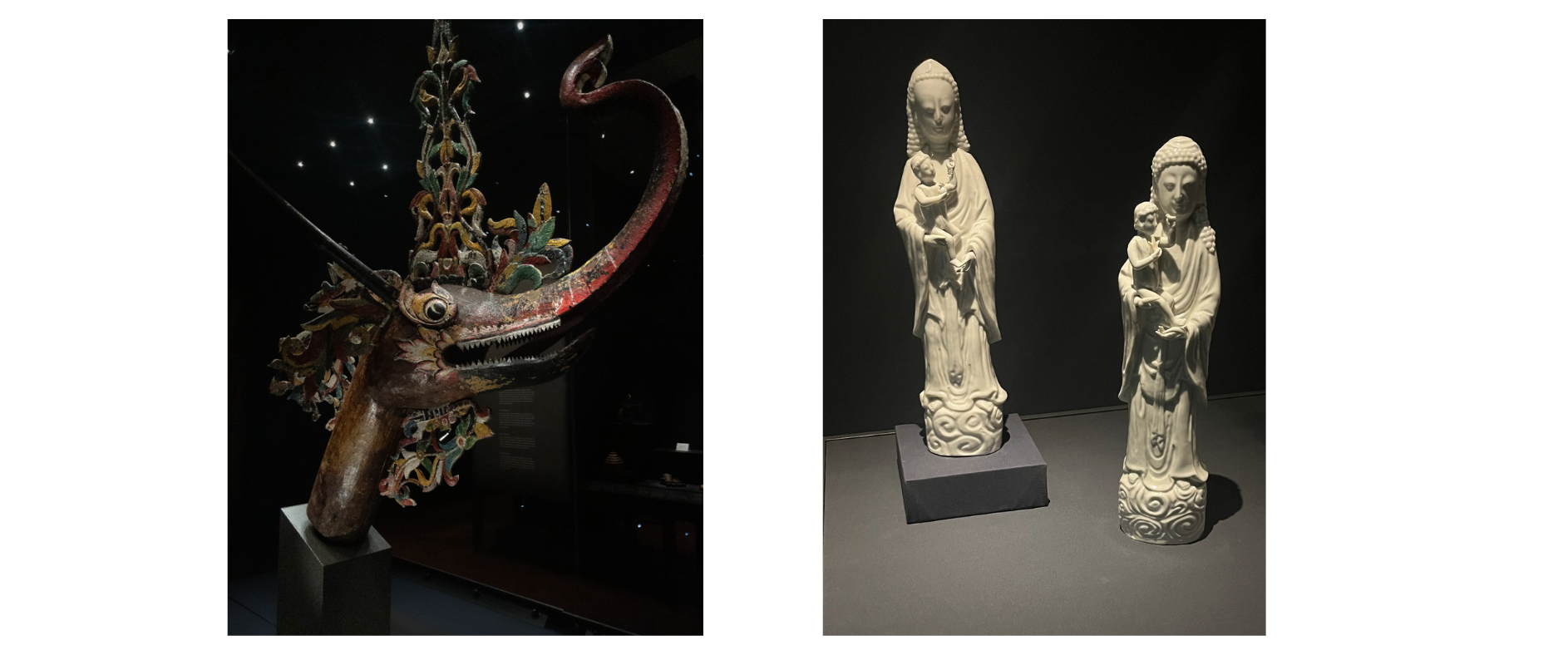
(Left) Makara palanquin ornament
Pattani, Malay Peninsula, 18th or 19th century
Jackfruit tree wood, zinc, brass, copper plates
(Right) Virgin and Child
China, Dehua, Fujian province, late 17th century
Porcelain
Both exhibits tell histories of globalization in which European powers play a marginal as opposed to central role. By doing so, they not only restore agency and relevance to parts of the world that have often been painted as passive or inconsequential, but also push back against the notion that, culturally, globalization is and has been tantamount to westernization.
The arguments put forward in these curatorial narratives correspond to de-westernizing trends in academia, exemplified by texts like Peter Frankopan’s The New Silk Roads (2018), Josephine Quinn’s How the World Made the West (2024), and Diego Javier Luis’ The First Asians in the Americas: A Transpacific History (also 2024).
Finally, the exhibits speak to the ongoing geopolitical shift towards an increasingly multipolar order – one in which Singapore’s corner of the globe hopes to play a leading part, just as it did in the past. By reappraising East and Southeast Asia’s historical, cultural and economic ties with other parts of the world – from the Middle East to Mexico – the city-state affirms its own identity as a both a product and benefactor of crosscurrents.
Tim Brinkhof is a journalist who has written for Artnet, Esquire, Village Voice and more.
All images credit of Tim Brinkhof.