
 Image 1 of 1
SEP/OCT 2026
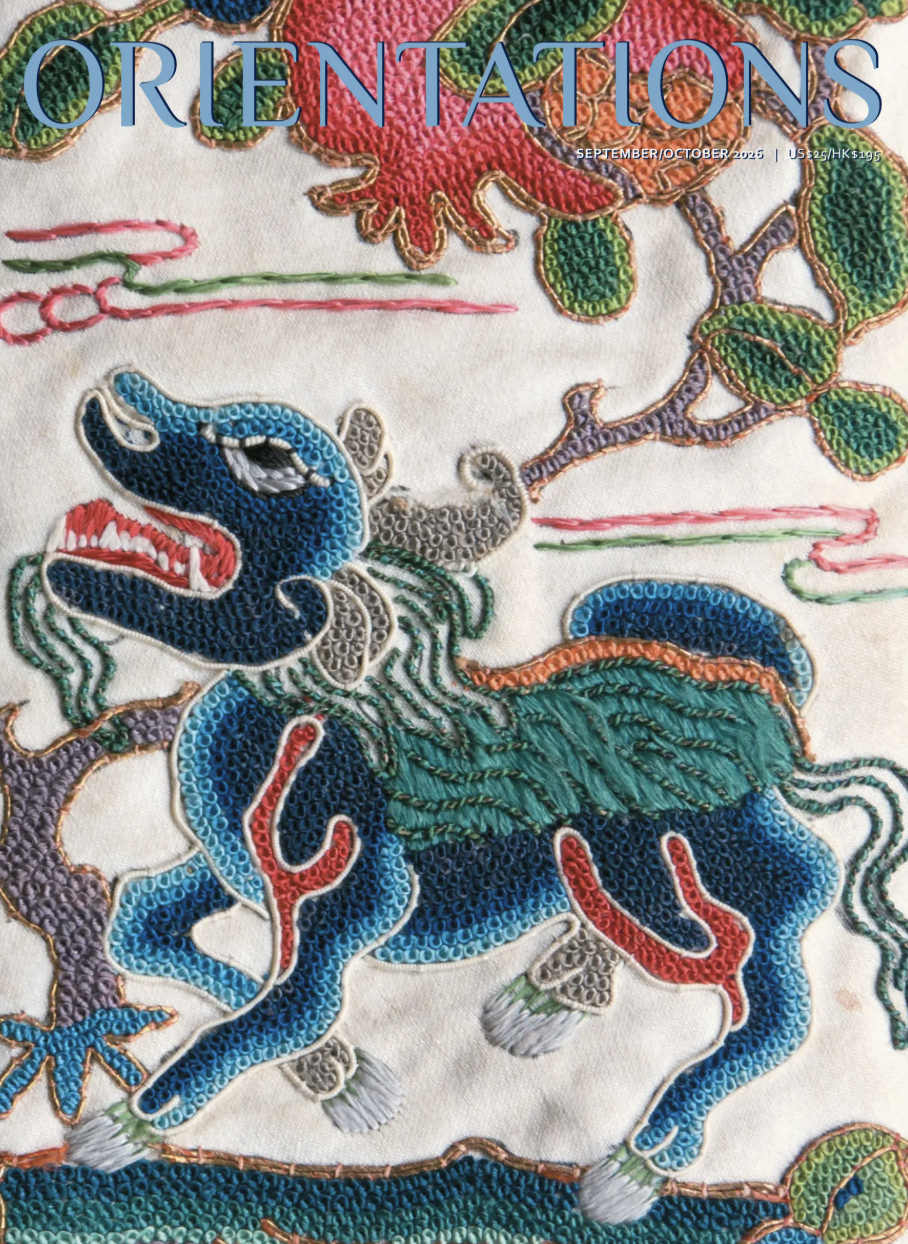
This issue commemorates the 120th anniversary of the Museum für Asiatische Kunst's East Asian Art Collection in Berlin with a series of case studies that examine how objects were made, moved, collected, and reimagined across time and space. The volume opens with an exploration of the enduring motif of the 'old fisherman' in Chinese painting, revealing how seemingly serene landscapes served as metaphors for political withdrawal during dynastic turmoil—a theme that resonates with the collection's own survival through war and upheaval.
The museum's foundational 1907 acquisition of Japanese paintings from the dealer Hayashi Tadamasa is critically reassessed, exposing the early curatorial challenges and prevalence of forgeries that shaped the collection's initial profile. The complex 'afterlife' of a 14th century Goryeo Buddhist scroll is traced through its reclassification from Chinese to Korean, its material conservation, and its fragmented provenance—a journey that reflects broader shifts in East Asian art historiography. A conservator's perspective on a late Qing dynasty woman's jacket highlights its intricate embroidery and the meticulous restoration required to prepare it for public display, and a new model for transnational provenance research is proposed through the study of a Yongzheng period porcelain bowl, demonstrating how collaborative inquiry can address questions of an object's history from imperial production to wartime circulation. Together, these essays trace a collection forged through war and rebuilding, shaped by misattribution and reclassification, and sustained through collaborative scholarship and conservation.
This fall, the 'Ten Kings of Hell: The Afterlife in Medieval Korea' exhibition at the Cleveland Museum of Art will mark a historic moment: the reunification of a dispersed Goryeo dynasty set of hanging scrolls of the Ten Kings of Hell. Dislocated from a Japanese temple during the Meiji period, the set has been reassembled for this landmark exhibition, restoring both its artistic integrity and its liturgical function after more than a century of fragmentation.
The 18th century robe à la chinoise is examined as a genuine hybrid object, revealing how hand-painted Chinese silks—produced through the Canton trade system and tailored into European fashions—embody a collaborative artistic process that unsettles simple binaries of East and West. The philosophical motif of the 'stringless qin' in Yuan dynasty literati painting is investigated to show that the deliberate absence of sound and strings served as a powerful device for evoking interiority, moral cultivation, and political withdrawal. A conversation with contemporary artist Imran Qureshi closes the volume, focusing on his monumental new mural for the Pergamonmuseum—his first permanent commission outside Pakistan. Situated in dialogue with a cupola from the Alhambra in Granada, the work deploys symbolic blues and reds to weave Mughal miniature traditions into a large-scale meditation on history and hope.
From Goryeo Buddhist scrolls to Qing dynasty textiles, from Yuan literati paintings to 18th century export silks, the issue reveals how objects acquire new meanings as they move between cultures, institutions, and centuries.
This issue commemorates the 120th anniversary of the Museum für Asiatische Kunst's East Asian Art Collection in Berlin with a series of case studies that examine how objects were made, moved, collected, and reimagined across time and space. The volume opens with an exploration of the enduring motif of the 'old fisherman' in Chinese painting, revealing how seemingly serene landscapes served as metaphors for political withdrawal during dynastic turmoil—a theme that resonates with the collection's own survival through war and upheaval.
The museum's foundational 1907 acquisition of Japanese paintings from the dealer Hayashi Tadamasa is critically reassessed, exposing the early curatorial challenges and prevalence of forgeries that shaped the collection's initial profile. The complex 'afterlife' of a 14th century Goryeo Buddhist scroll is traced through its reclassification from Chinese to Korean, its material conservation, and its fragmented provenance—a journey that reflects broader shifts in East Asian art historiography. A conservator's perspective on a late Qing dynasty woman's jacket highlights its intricate embroidery and the meticulous restoration required to prepare it for public display, and a new model for transnational provenance research is proposed through the study of a Yongzheng period porcelain bowl, demonstrating how collaborative inquiry can address questions of an object's history from imperial production to wartime circulation. Together, these essays trace a collection forged through war and rebuilding, shaped by misattribution and reclassification, and sustained through collaborative scholarship and conservation.
This fall, the 'Ten Kings of Hell: The Afterlife in Medieval Korea' exhibition at the Cleveland Museum of Art will mark a historic moment: the reunification of a dispersed Goryeo dynasty set of hanging scrolls of the Ten Kings of Hell. Dislocated from a Japanese temple during the Meiji period, the set has been reassembled for this landmark exhibition, restoring both its artistic integrity and its liturgical function after more than a century of fragmentation.
The 18th century robe à la chinoise is examined as a genuine hybrid object, revealing how hand-painted Chinese silks—produced through the Canton trade system and tailored into European fashions—embody a collaborative artistic process that unsettles simple binaries of East and West. The philosophical motif of the 'stringless qin' in Yuan dynasty literati painting is investigated to show that the deliberate absence of sound and strings served as a powerful device for evoking interiority, moral cultivation, and political withdrawal. A conversation with contemporary artist Imran Qureshi closes the volume, focusing on his monumental new mural for the Pergamonmuseum—his first permanent commission outside Pakistan. Situated in dialogue with a cupola from the Alhambra in Granada, the work deploys symbolic blues and reds to weave Mughal miniature traditions into a large-scale meditation on history and hope.
From Goryeo Buddhist scrolls to Qing dynasty textiles, from Yuan literati paintings to 18th century export silks, the issue reveals how objects acquire new meanings as they move between cultures, institutions, and centuries.