
 Image 1 of 1
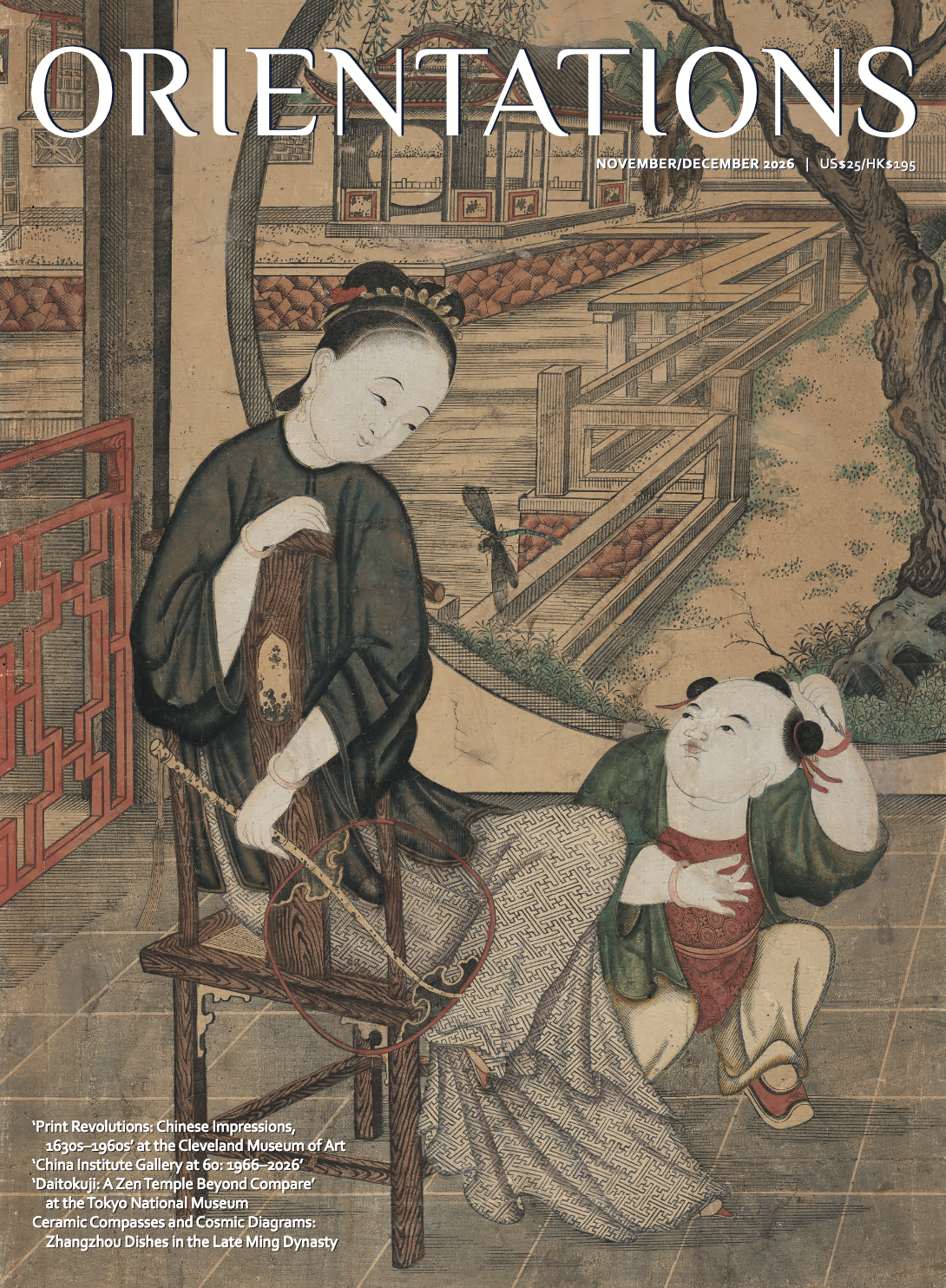
The November/December 2026 issue of Orientations is anchored by two major museum exhibitions—‘Print Revolutions: Chinese Impressions, 1630s–1960s’ at the Cleveland Museum of Art and ‘Daitokuji: A Zen Temple Beyond Compare’ at the Tokyo National Museum—as well as the exhibition, ‘China Institute Gallery at 60: 1966–2026’, in New York.
The issue opens with four articles on Chinese printmaking. Clarissa von Spee introduces the Cleveland exhibition, which draws on recent acquisitions from Christer von der Burg and Patricia and Thomas Ebrey to trace Chinese colour printing, from Ming embroidery pattern books and Suzhou prints from the Ding workshops to topographical prints of West Lake, the Modern Woodcut Movement, and the work of contemporary artist Cao Ou. Takayuki Aoki recounts the collection of the Umi-Mori Art Museum, Anne Farrer celebrates thirty years of the Muban Foundation and Muban Educational Trust and von Spee’s interview with von der Burg traces his formation of a pioneering Gusu print collection and its 2025 acquisition by the Cleveland Museum of Art and the Metropolitan Museum of Art.
Three articles examine China Institute Gallery’s history and its anniversary exhibition. Annette Juliano focuses on the pivotal years of 1944 and 1966, Alfreda Murck highlights six paintings from the anniversary exhibition, and David Ake Sensabaugh extends this focus on the scholar’s world through gardens and rocks.
We then turn to Japanese temple treasures. Takahashi Shinsaku introduces the Daitokuji exhibition commemorating the monastery’s 700th anniversary and Keiko Mikasa focuses on two Longquan celadon vases, both linked to abbot Kokei Sōchin and the Asakura warlords, discussing Longquan production, the Sinan shipwreck, and Japanese collecting hierarchies.
In the latest addition to our map series, Richard A. Pegg examines late Ming Zhangzhou ware dishes that depict Daoist cosmic diagrams.