
 Image 1 of 1
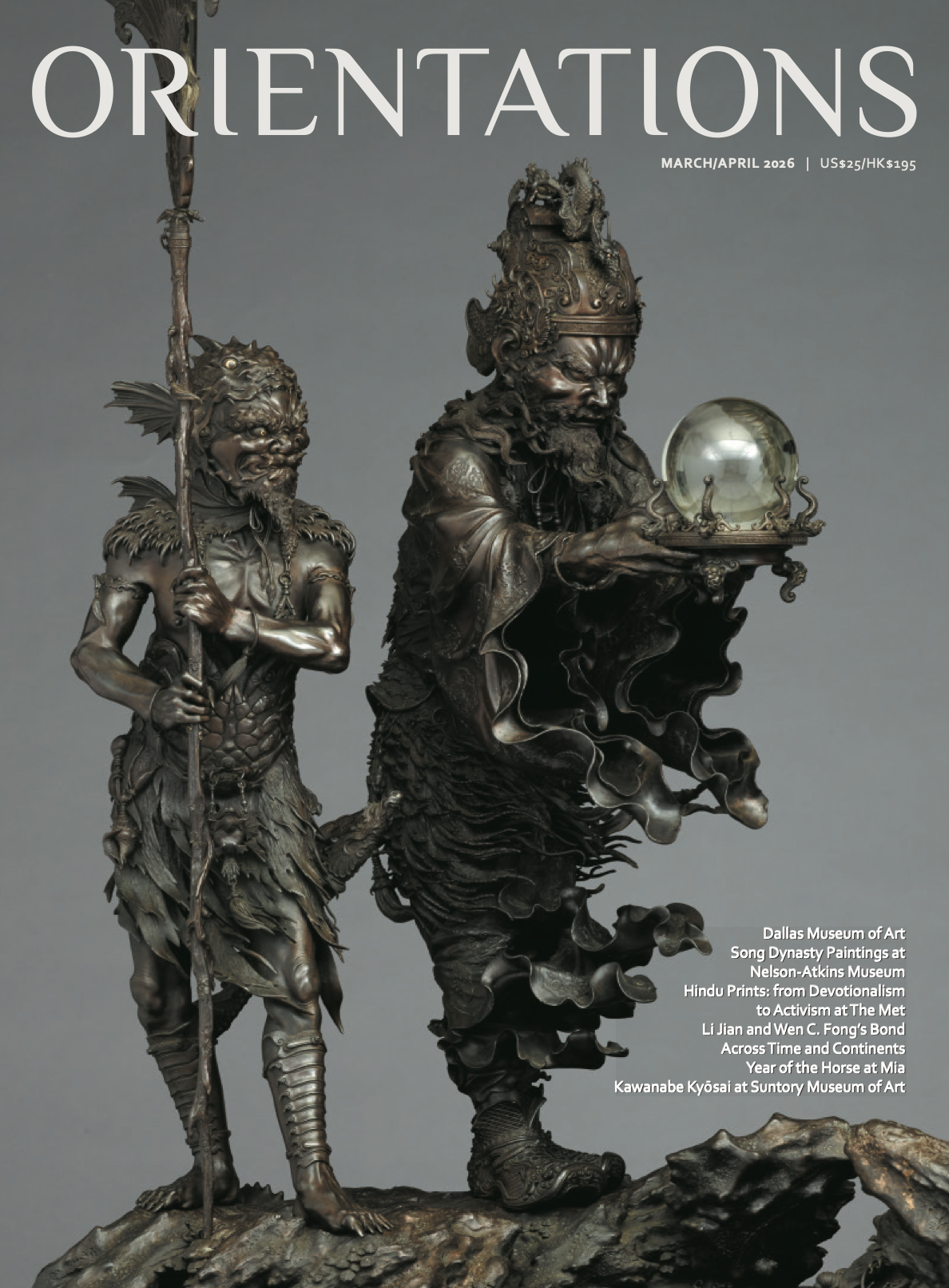
This issue showcases the depth and diversity of Asian art across American museum collections, with articles spanning millennia and multiple artistic traditions. We preview the forthcoming exhibition at the Dallas Museum of Art (DMA) on Japanese metalwork from the Muromachi through Meiji periods, which traces the evolution of metalworking from samurai armour to cloisonné enamels, culminating in the museum’s monumental bronze Dragon King Presenting a Jewel to Fujiwara no Hidezato—a masterpiece of Meiji sculpture.
Edmund de Unger (1918–2011), whose lifelong fascination with Islamic art began at the age of six, inspired by his father’s carpet collection, was the founder and driving force behind the Keir Collection. Through a landmark loan from this collection, the DMA has transformed its presentation of Islamic art, showcasing de Unger’s visionary collecting and shaping the museum into one of America’s most significant Islamic art repositories. We also recount another chapter in collecting history by tracing how the DMA acquired one of the largest collections of postwar Japanese art outside Japan. The Nelson-Atkins Museum is renowned for its collection of Song dynasty landscape paintings. We explore their spiritual and philosophical dimensions, revealing how Daoist concepts of nature and the cosmos shaped works by Xu Daoning, Xia Gui, and Qiao Zhongchang. A companion provenance study traces how these masterpieces journeyed to Kansas City through networks of early 20th century dealers and collectors.
‘Household Gods: Hindu Devotional Prints, 1860– 1930’, an exhibition on view at the Metropolitan Museum of Art until 17 June 2027, introduces a groundbreaking genre focusing on the museum’s rich holdings.
The exhibition ‘Year of the Horse: Hoofbeats Through Time’ at the Minneapolis Institute of Art presents a survey of three millennia celebrating the Chinese zodiac. Through ten thematic lenses—from sacred Bronze Age ritual objects to contemporary photographs by Yang Yongliang.
Finally, we examine Kawanabe Kyōsai’s complex artistic legacy in an introduction to the Suntory Museum of Art’s exhibition drawn from the Israel Goldman Collection.
This issue showcases the depth and diversity of Asian art across American museum collections, with articles spanning millennia and multiple artistic traditions. We preview the forthcoming exhibition at the Dallas Museum of Art (DMA) on Japanese metalwork from the Muromachi through Meiji periods, which traces the evolution of metalworking from samurai armour to cloisonné enamels, culminating in the museum’s monumental bronze Dragon King Presenting a Jewel to Fujiwara no Hidezato—a masterpiece of Meiji sculpture.
Edmund de Unger (1918–2011), whose lifelong fascination with Islamic art began at the age of six, inspired by his father’s carpet collection, was the founder and driving force behind the Keir Collection. Through a landmark loan from this collection, the DMA has transformed its presentation of Islamic art, showcasing de Unger’s visionary collecting and shaping the museum into one of America’s most significant Islamic art repositories. We also recount another chapter in collecting history by tracing how the DMA acquired one of the largest collections of postwar Japanese art outside Japan. The Nelson-Atkins Museum is renowned for its collection of Song dynasty landscape paintings. We explore their spiritual and philosophical dimensions, revealing how Daoist concepts of nature and the cosmos shaped works by Xu Daoning, Xia Gui, and Qiao Zhongchang. A companion provenance study traces how these masterpieces journeyed to Kansas City through networks of early 20th century dealers and collectors.
‘Household Gods: Hindu Devotional Prints, 1860– 1930’, an exhibition on view at the Metropolitan Museum of Art until 17 June 2027, introduces a groundbreaking genre focusing on the museum’s rich holdings.
The exhibition ‘Year of the Horse: Hoofbeats Through Time’ at the Minneapolis Institute of Art presents a survey of three millennia celebrating the Chinese zodiac. Through ten thematic lenses—from sacred Bronze Age ritual objects to contemporary photographs by Yang Yongliang.
Finally, we examine Kawanabe Kyōsai’s complex artistic legacy in an introduction to the Suntory Museum of Art’s exhibition drawn from the Israel Goldman Collection.