
 Image 1 of 1
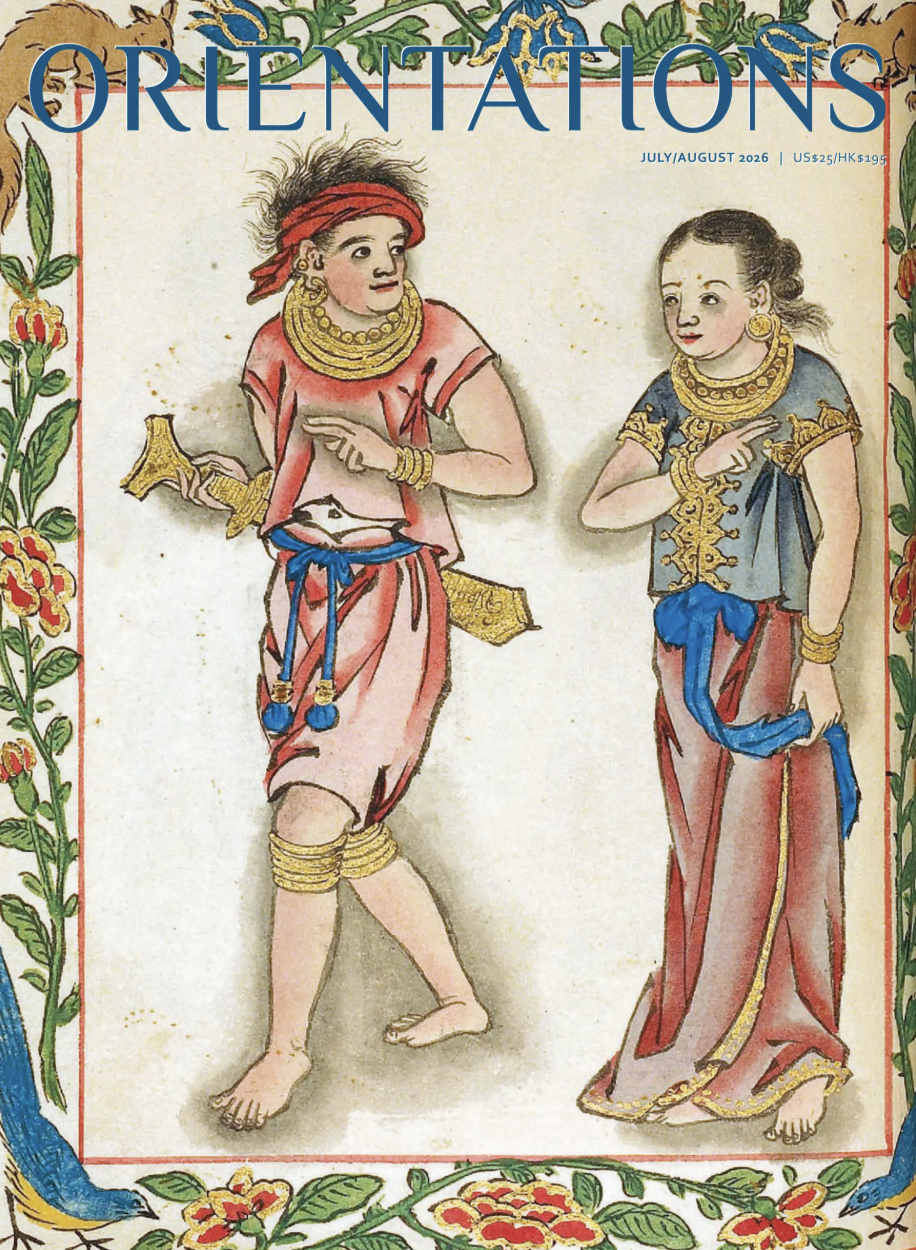
This issue gathers articles that examine Asian art and material culture through specific case studies spanning the contested legacies of American colonial collecting in the Philippines, medieval Javanese bronze casting, and contemporary Korean fabric architecture. Together, they challenge conventional narratives of stylistic influence, cultural ownership, and transcultural exchange by attending closely to how objects were made, moved, collected, and reimagined across time and space.
Jim Moss, Bryan Miller, and Tiffany Fryer examine the University of Michigan’s 1922–25 Philippine Expedition, tracing how American imperial ambitions shaped the accumulation of Chinese ceramics and Indigenous Filipino materials while highlighting contemporary reparative efforts to reconnect these collections with descendant communities. Victor Estrella complements this with microscopic analysis of gold artefacts from the same expedition, revealing sophisticated local artisanry long obscured by colonial frameworks.
Yuheng Zhang’s study of celadon trade ceramics shows how Philippine sites became crucial nodes in maritime networks spanning China and Southeast Asia. Transcultural mimesis emerges as a central theme. Stella Wu analyses a Chinese reverse-glass painting of the Indian nawab Shuja-ud-Daula and his sons, tracing the image’s migration from a British artist through Indian painters to Cantonese workshops—and eventually to American collections—in a triangular relay that unsettles simple narratives of colonial visual dominance. Sizhao Yi examines a miniature Qing ivory book carved with Du Fu’s poem on the ‘Eight Drinking Immortals’, revealing a sophisticated interplay between materiality, text, and the embodied experience of reading.
The issue also features new research on South and Southeast Asian religious art. Gerald Kozicz and Di Luo revisit Robert Heine-Geldern’s 1925 study of the Heidsieck collection of Javanese bronzes, recovering both a remarkable corpus of Buddhist metalwork and the biography of a displaced scholar. Chaitanya Sambrani offers an introduction to Vishnu’s avataric forms across fifteen centuries of South and Southeast Asian art, framing these transformations within the devotional bhakti tradition.
Hongjiao Yang presents newly attributed self-portrait sculptures of the Tenth Karmapa, Choying Dorje, evidencing the 17th century master’s synthesis of Himalayan and Chinese styles. Stephen Little surveys the newly opened David Geffen Galleries at the Los Angeles County Museum of Art, where innovative installations—from a monumental 12th century thangka to Do Ho Suh’s fabric recreation of a Joseon palace hall—embody a curatorial vision prioritising connection, experimentation, and the dismantling of traditional hierarchies.
We also interview Wu Keyu, son of Wu Guanzhong, to highlight the significant donations of his father’s works to the Hong Kong Museum of Art.
This issue gathers articles that examine Asian art and material culture through specific case studies spanning the contested legacies of American colonial collecting in the Philippines, medieval Javanese bronze casting, and contemporary Korean fabric architecture. Together, they challenge conventional narratives of stylistic influence, cultural ownership, and transcultural exchange by attending closely to how objects were made, moved, collected, and reimagined across time and space.
Jim Moss, Bryan Miller, and Tiffany Fryer examine the University of Michigan’s 1922–25 Philippine Expedition, tracing how American imperial ambitions shaped the accumulation of Chinese ceramics and Indigenous Filipino materials while highlighting contemporary reparative efforts to reconnect these collections with descendant communities. Victor Estrella complements this with microscopic analysis of gold artefacts from the same expedition, revealing sophisticated local artisanry long obscured by colonial frameworks.
Yuheng Zhang’s study of celadon trade ceramics shows how Philippine sites became crucial nodes in maritime networks spanning China and Southeast Asia. Transcultural mimesis emerges as a central theme. Stella Wu analyses a Chinese reverse-glass painting of the Indian nawab Shuja-ud-Daula and his sons, tracing the image’s migration from a British artist through Indian painters to Cantonese workshops—and eventually to American collections—in a triangular relay that unsettles simple narratives of colonial visual dominance. Sizhao Yi examines a miniature Qing ivory book carved with Du Fu’s poem on the ‘Eight Drinking Immortals’, revealing a sophisticated interplay between materiality, text, and the embodied experience of reading.
The issue also features new research on South and Southeast Asian religious art. Gerald Kozicz and Di Luo revisit Robert Heine-Geldern’s 1925 study of the Heidsieck collection of Javanese bronzes, recovering both a remarkable corpus of Buddhist metalwork and the biography of a displaced scholar. Chaitanya Sambrani offers an introduction to Vishnu’s avataric forms across fifteen centuries of South and Southeast Asian art, framing these transformations within the devotional bhakti tradition.
Hongjiao Yang presents newly attributed self-portrait sculptures of the Tenth Karmapa, Choying Dorje, evidencing the 17th century master’s synthesis of Himalayan and Chinese styles. Stephen Little surveys the newly opened David Geffen Galleries at the Los Angeles County Museum of Art, where innovative installations—from a monumental 12th century thangka to Do Ho Suh’s fabric recreation of a Joseon palace hall—embody a curatorial vision prioritising connection, experimentation, and the dismantling of traditional hierarchies.
We also interview Wu Keyu, son of Wu Guanzhong, to highlight the significant donations of his father’s works to the Hong Kong Museum of Art.