
 Image 1 of 1
JAN/FEB 2026
The first issue of 2026 begins with the Museum Rietberg in Zurich. Founded in 1952, it has placed itself at the forefront of museological innovation by prioritizing sensorial immersion, collaborating with the international community, and integrating contemporary art as critical commentary. This fresh perspective can be seen in the museum’s landmark show ‘Mongolia: A Journey through Time’, open through 22 February 2026. The history of Mongolia cannot be reduced to nomadic tropes; rather, it was fundamentally shaped by sophisticated, multicultural urban centres that served as dynamic hubs of Eurasian exchange for over two millennia, facilitating the flow of goods, technologies, and ideas across continents.
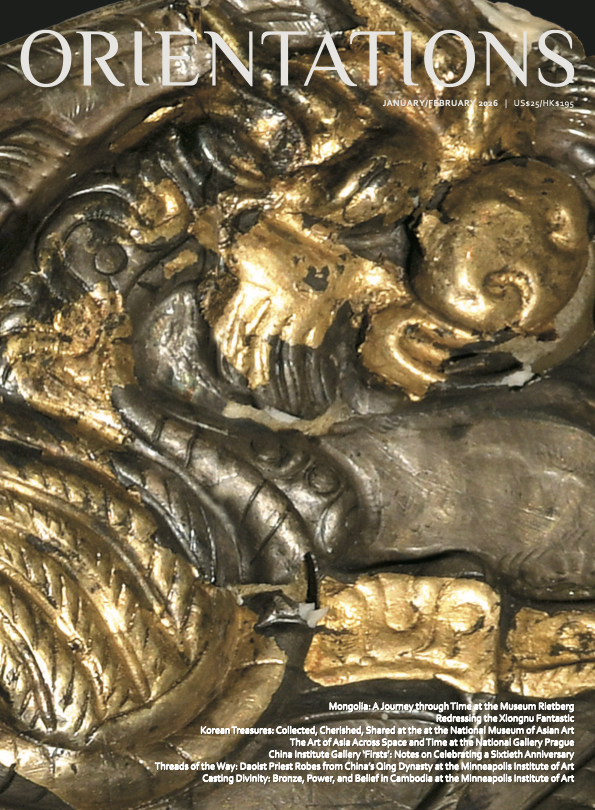
We reexamine the artistic language of power on the ancient steppes and reveal that the composite creatures of the Xiongnu Empire were not derivative of Chinese or Near Eastern myths. Instead, they were local hybrids that embodied the steppe’s ecology and cosmology, serving as powerful icons of Xiongnu political authority and a deliberately crafted, cosmopolitan visual language. This historical narrative has spurred a critical contemporary analysis, and we find that, while the integration of contemporary art powerfully questions historical clichés relating to Mongolia, it also risks flattening complex contexts.
In 2021, the family of Lee Kun-Hee, the former chairman of Samsung Group, announced an unparallelled donation of approximately 23,000 artworks—an unprecedented gift in both scale and scope—to the National Museum of Korea and the National Museum of Modern and Contemporary Art, both in Seoul. We explore how this donation encapsulates Korea’s entire artistic journey—from Joseon (1392–1910) Neo-Confucian ideals and royal authority to Buddhist devotion and modernist innovation—and underscores the vital role of private philanthropy in preserving and sharing national heritage on a global stage.
We also introduce the National Gallery Prague’s new permanent exhibition, ‘The Art of Asia Across Space and Time’, which frames the museum’s collections within a candid history of Central European collecting. In addition, 2026 marks the sixtieth anniversary of New York’s China Institute Gallery, and we highlight key exhibitions over the years that have offered American audiences profound and nuanced access to China’s cultural wisdom and aesthetic traditions.
The Minneapolis Institute of Art (Mia) holds a large collection of Qing dynasty (1644–1911) Daoist robes. Far more than ritual garments, they function as cosmograms; wearing such a robe , the priest’s body becomes a living altar and the axial pivot of the universe, aligning heaven, earth, and humanity through the very act of ceremony. ‘Royal Bronzes: Cambodian Art of the Divine’ is also on view at Mia through 18 January 2026. We conclude that from prehistory to the Angkor period (c. 800–1300 CE), bronze was understood as a transcendent medium. The works on view formed a sacred conduit between human and divine realms, materially expressing political power, complex theology, and an evolving, distinctly Khmer artistic language of the spiritual.
This issue illustrates how art is curated and collected, how ancient empires expressed their might, how modern nations renegotiate their histories, and how material objects—whether silk, metal, or pigment—can embody both divine cosmology and human authority.
The first issue of 2026 begins with the Museum Rietberg in Zurich. Founded in 1952, it has placed itself at the forefront of museological innovation by prioritizing sensorial immersion, collaborating with the international community, and integrating contemporary art as critical commentary. This fresh perspective can be seen in the museum’s landmark show ‘Mongolia: A Journey through Time’, open through 22 February 2026. The history of Mongolia cannot be reduced to nomadic tropes; rather, it was fundamentally shaped by sophisticated, multicultural urban centres that served as dynamic hubs of Eurasian exchange for over two millennia, facilitating the flow of goods, technologies, and ideas across continents.
We reexamine the artistic language of power on the ancient steppes and reveal that the composite creatures of the Xiongnu Empire were not derivative of Chinese or Near Eastern myths. Instead, they were local hybrids that embodied the steppe’s ecology and cosmology, serving as powerful icons of Xiongnu political authority and a deliberately crafted, cosmopolitan visual language. This historical narrative has spurred a critical contemporary analysis, and we find that, while the integration of contemporary art powerfully questions historical clichés relating to Mongolia, it also risks flattening complex contexts.
In 2021, the family of Lee Kun-Hee, the former chairman of Samsung Group, announced an unparallelled donation of approximately 23,000 artworks—an unprecedented gift in both scale and scope—to the National Museum of Korea and the National Museum of Modern and Contemporary Art, both in Seoul. We explore how this donation encapsulates Korea’s entire artistic journey—from Joseon (1392–1910) Neo-Confucian ideals and royal authority to Buddhist devotion and modernist innovation—and underscores the vital role of private philanthropy in preserving and sharing national heritage on a global stage.
We also introduce the National Gallery Prague’s new permanent exhibition, ‘The Art of Asia Across Space and Time’, which frames the museum’s collections within a candid history of Central European collecting. In addition, 2026 marks the sixtieth anniversary of New York’s China Institute Gallery, and we highlight key exhibitions over the years that have offered American audiences profound and nuanced access to China’s cultural wisdom and aesthetic traditions.
The Minneapolis Institute of Art (Mia) holds a large collection of Qing dynasty (1644–1911) Daoist robes. Far more than ritual garments, they function as cosmograms; wearing such a robe , the priest’s body becomes a living altar and the axial pivot of the universe, aligning heaven, earth, and humanity through the very act of ceremony. ‘Royal Bronzes: Cambodian Art of the Divine’ is also on view at Mia through 18 January 2026. We conclude that from prehistory to the Angkor period (c. 800–1300 CE), bronze was understood as a transcendent medium. The works on view formed a sacred conduit between human and divine realms, materially expressing political power, complex theology, and an evolving, distinctly Khmer artistic language of the spiritual.
This issue illustrates how art is curated and collected, how ancient empires expressed their might, how modern nations renegotiate their histories, and how material objects—whether silk, metal, or pigment—can embody both divine cosmology and human authority.