
María Drolma
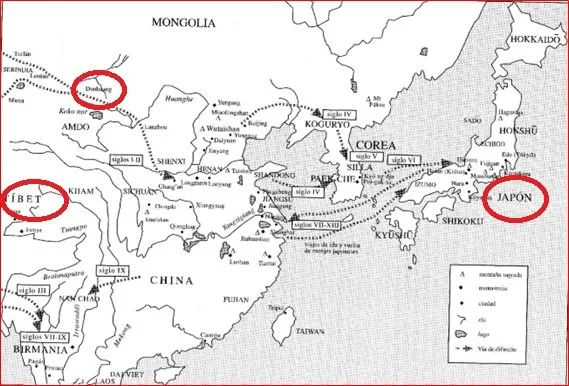
The stupa is the first Buddhist symbol to represent the Buddha, since Buddha Shakyamuni mentioned stupas for the conservation of his bodily relics when passing away. They are the first aniconic representation of the Buddha, universally acknowledged up to today. We see paintings of stupas, constructed with words, along the Silk Road, in Tibet, and all the way to Japan, around the 10th through the 12th to 13th centuries. All of these painted-written stupas represent the holy body, speech, and mind of the Buddha(s), the Enlightened Awareness of Beings.
In 2023, I encountered the first depiction of a stupa as a ‘continental prototype’ in O´Neal’s Word Embodied: The Jeweled Pagoda Mandalas in Japanese Buddhist Art (2018) (fig. 1). These Chinese written stupas—or five-storied pagodas that spread from China to Korea and Japan as Buddhism expanded along the Silk Road from the 2nd century—may stem from interpreting stupas as repositories for Buddha’s relics: perhaps the Buddha’s ‘house’, a ‘roof’-like tower to shelter them. The pagoda uses Chinese long characters in an unconventional arrangement for readers yet follows a systematic path along the red arrows. The Heart Sutra, the central text in Mahayana Buddhism, appears in black ink with its title positioned above like a canopy (fig. 1b) (O’Neal, 2018, pp. 122–3). O’Neal outlines the transcription route, beginning with a star at the upper margin of the pagoda’s base and tracing the marked red dots.
Assuming that the dotted red lines linking the seemingly scattered characters are drawn afterward, as suggested by their unruly and wavy nature, it is not until well passed the sutra’s halfway point that the superficially random appearance of a collage of characters arranged without meaning or order is broken and the interior order, once presumed to be structureless, is revealed to be a patterned system of semantically connected lines of texts arranged symmetrically along the vertical axis. (O’Neal, 2018, p. 123).
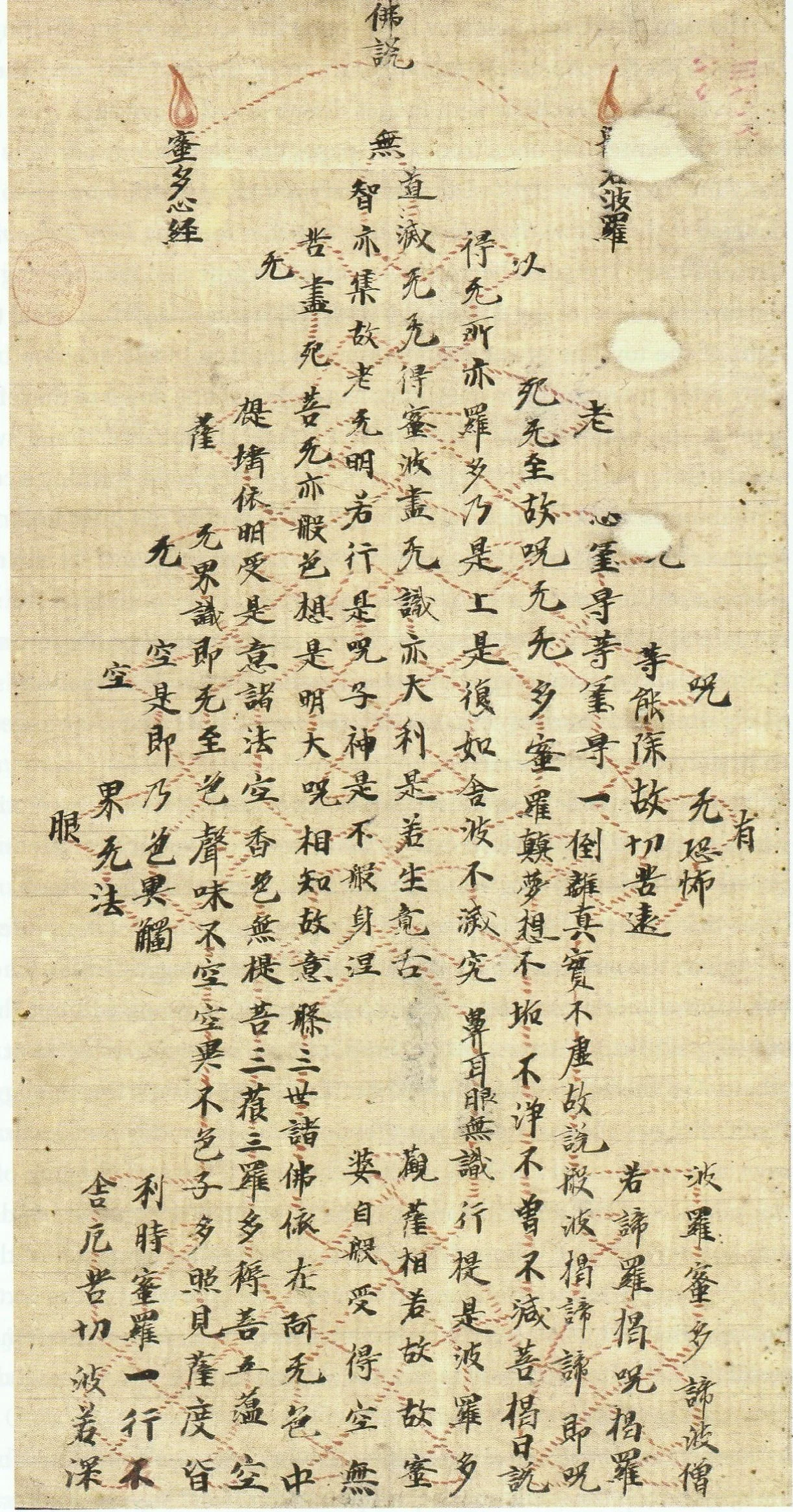
1
Transcription of the Heart Sutra as Chinese pagoda from Dunhuang
China, 10th century
Black and red ink on paper; 47 x 22 cm
British Library, London, (Stein collection Or.8210/S. 4289)
After O’Neal, 2018, fig. 3.1a.
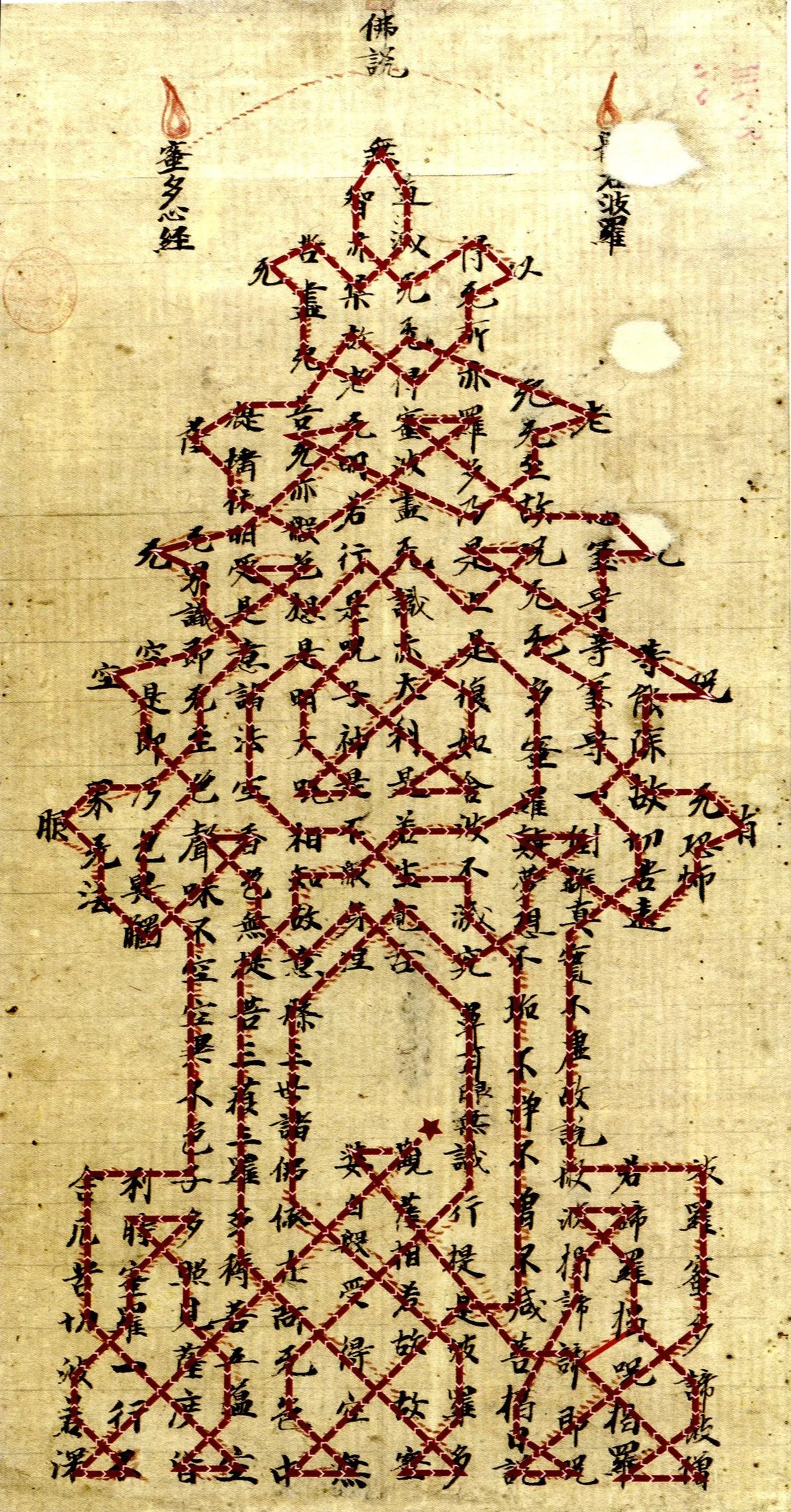
1b
Diagram order with red arrows following the transcription of the Heart Sutra
Courtesy of Dalila D’Amico, Graphic Design Department, University Edinburgh
kindly permitted from O’Neal.
This follows the symmetry along a vertical central axis (yasti) in a stupa, as noted by Seckel (Seckel and Leisinger, 2004, pp. 41–42). In red ink, two flames—or possibly three, since the sheet is cut above—are linked in a bow like a parasol over the pagoda with red dots (O’Neal, 2018, p. 123). This network of red ink dots, which O’Neal has described as a guide for viewers tracing a scriptural path or recalling a circulatory system through red lines (O’Neal, 2018, p. 128), may represent ‘seals’, such as the one from the British Library in the upper left corner of the pagoda; these are consecration marks for the pagoda and its potential production, appearing not on other images of Japanese written pagodas from the 12th and 13th centuries (fig. 2) but on Tibetan consecrated written stupas (figs 6–8, 10). The Chinese characters depict a five-storied pagoda with an empty space in the lower dome reserved for the image(s) of Buddha(s) (figs 2 and 3), along with a base or throne (fig. 3).
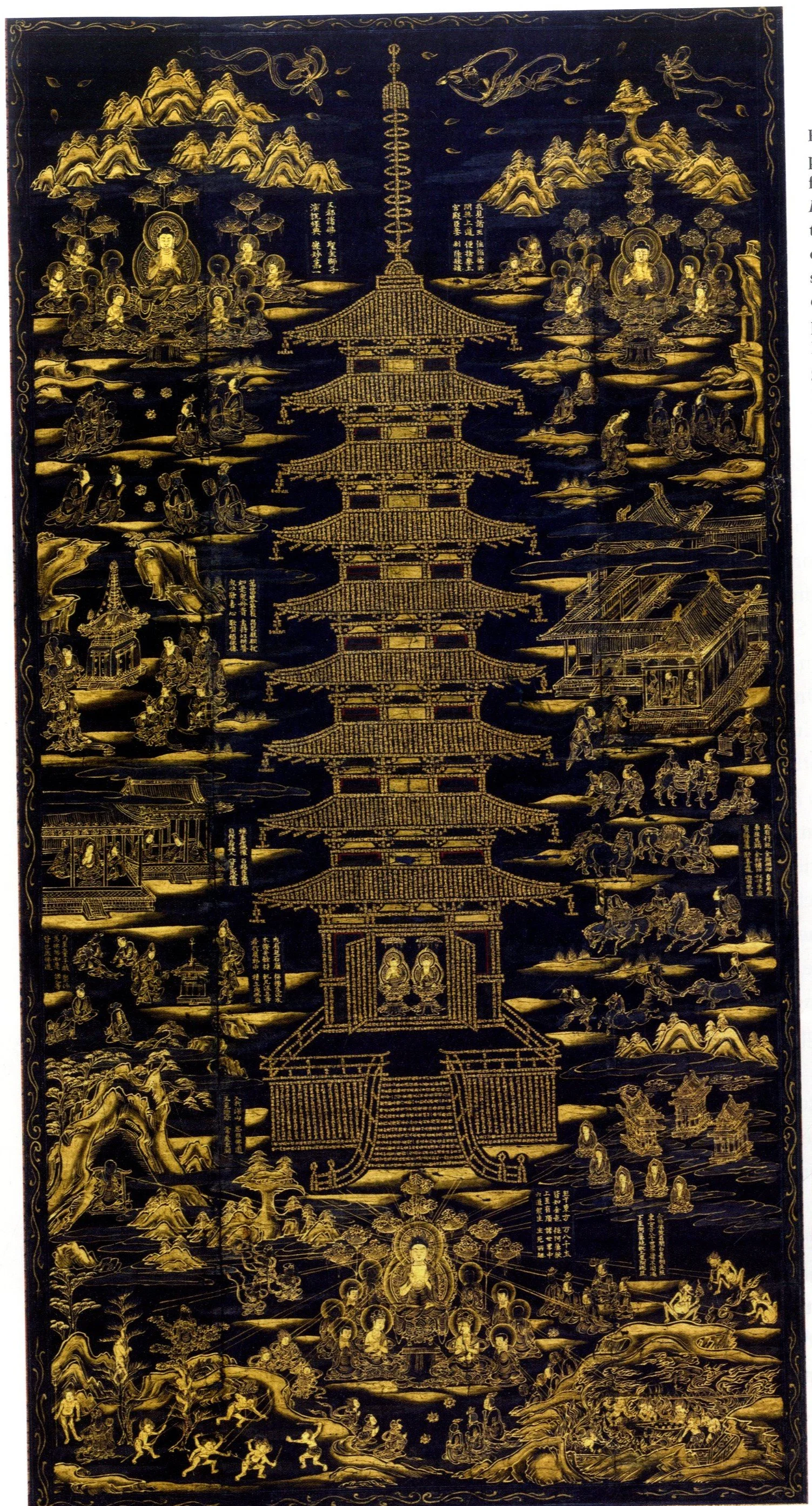
2
Japanese Jewelled Pagoda Mandala, fascicle 1 of the Lotus Sutra with depictions
China, 13th century
Gold, silver, slight colour on indigo paper
Ryûhonji, Kyoto, Japan
After O´Neal, 2018, fig 1.3
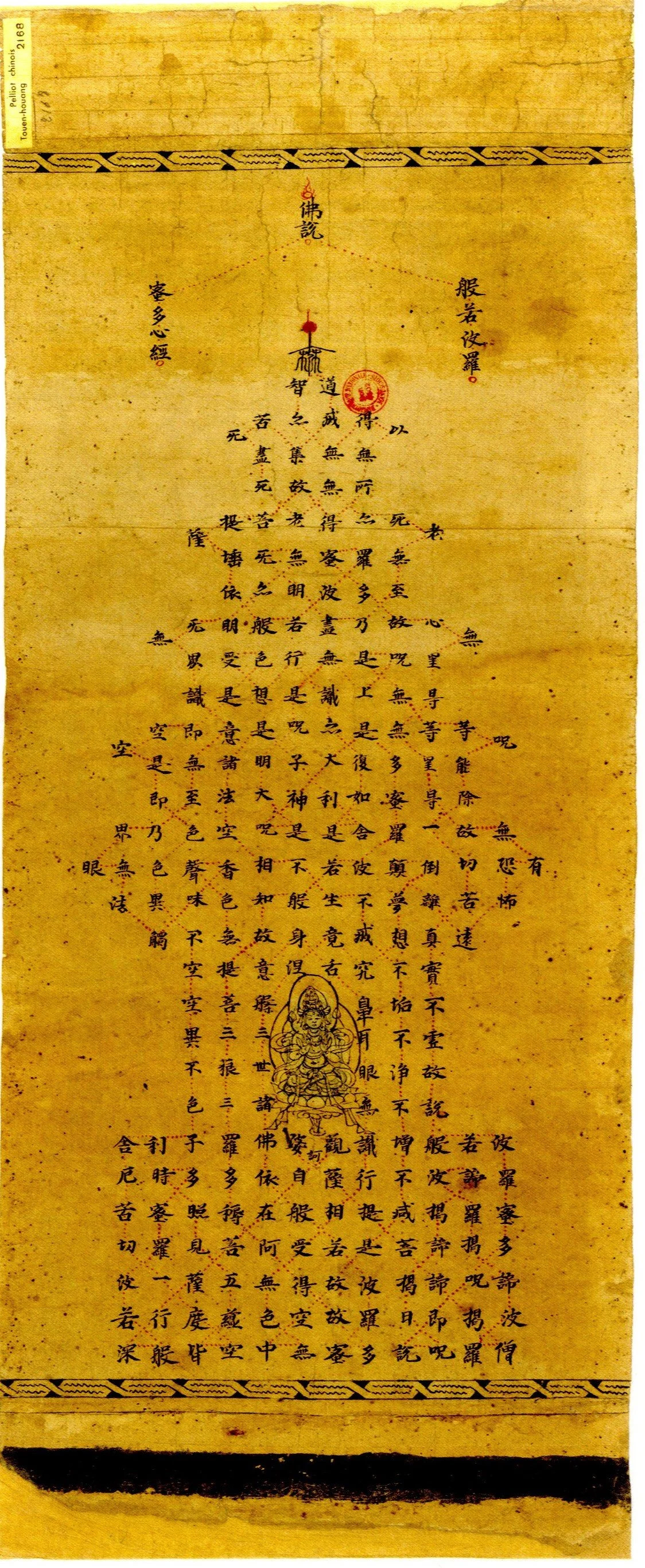
3
Transcription identical with fig.1 of the Heart Sutra with Buddhist image inside Dunhuang
China, 10th c.
Bibliotéque National France, Paris, (Pelliot Collection P. 2168)
After O`Neal, 2018, fig. 3.2
The pagoda originates from Dunhuang, the Silk Road’s main crossroads and grotto centre (2nd BCE–15th century), particularly for Buddhism between the 6th and 10th centuries (fig. 5). This 10th-century date situates the pagoda in figure 1 within the Tibetan indirect rule over Dunhuang, as noted by Takata (2019). Direct Tibetan control spanned 786–848, while the Tibeto-Chinese community continued for centuries into the Guiyijun period from 848 to the early 11th century (Takata, 2019, p. 88). This may suggest that our embodied Chinese pagoda existed within Tibetan threads, linked to consecration through red ink dots (fig. 6b).
The study of Arts and Crafts within Buddhist philosophy has long been one of the five major sciences (pañcavidyā) taught at monastic universities such as Nalanda and Vikramashila in India from the fifth to the thirteenth century, and in Tibet after the fifth century. This suggests that images and artistic objects serve as the ‘body’ of the Buddha. If we consider Tibetan Vajrayana Buddhism, for example, without painting or writing the pagoda, there would be no body or image of the Buddha. In the two instances shown in figures 1 and 2, the pagodas formally exist as the body. The Enlightened Awareness Beings, or Buddha(s), are shown on modern Tibetan altars through three separate items: stupas for mind, pecha or Tibetan scripture books for speech, and images such as sculptures or paintings for body. This arrangement matches our embodied, word-composed pagodas.
4
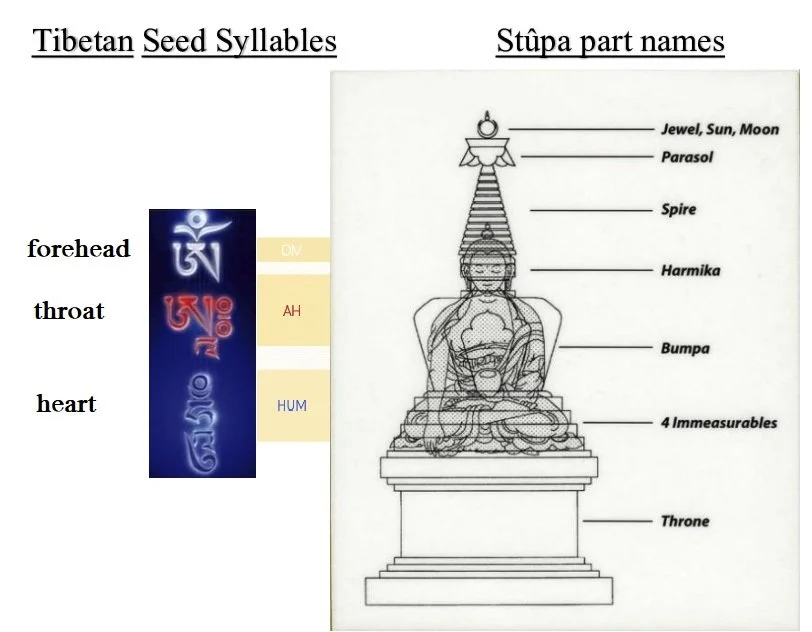
Tibetan seed syllables om-ah-hum ‘sealing’ the body-speech-mind of Buddha (left) and stupa part names with Buddha sketched on it (right)
5
Map of Asia with Silk Road, Tibet and Japan and the diffusion of Buddhism in East Asia
After Cornu, 2004, p. 108
The pagoda’s role may have been rolled, as suggested by the three larger to smaller burnt dots in figure 1, functioning as a relic for architectonic stupas. Bentor notes that from the 7th century onward in India, archaeological evidence shows stûpas holding a written or stamped version on miniature clay tablets of the ‘verse of interdependent origination’, which formed their core because this verse is thought to capture the essence of the Buddha’s teachings. This verse is therefore called Dharmadhatu or Dharma-relic (Bentor, 1989, pp. 3–4).
The Heart Sutra functioned as a Dharma relic within Mahayana Buddhism, making its placement in a constructed stupa quite fitting. In their article, Wu and Yan observe that Buddhism spread along the Silk Road from roughly the 2nd to the 10th century through such structures: ‘(…) in areas such as Gaochang [present Xinjiang province], where Mahayana Buddhism was predominant, stupas served as central structures for religious activities’ (Wu and Yan, 2025, p. 19).
6
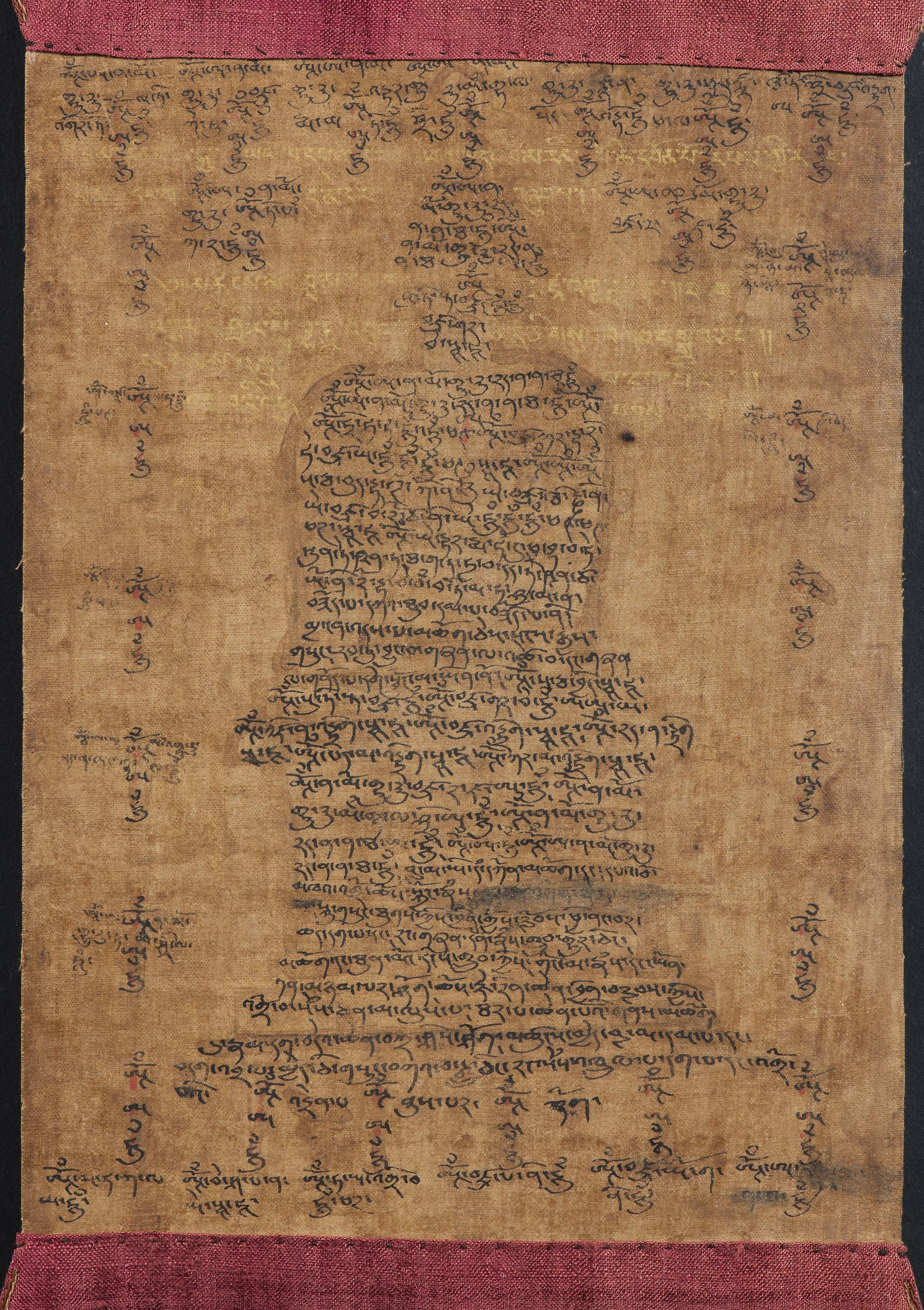
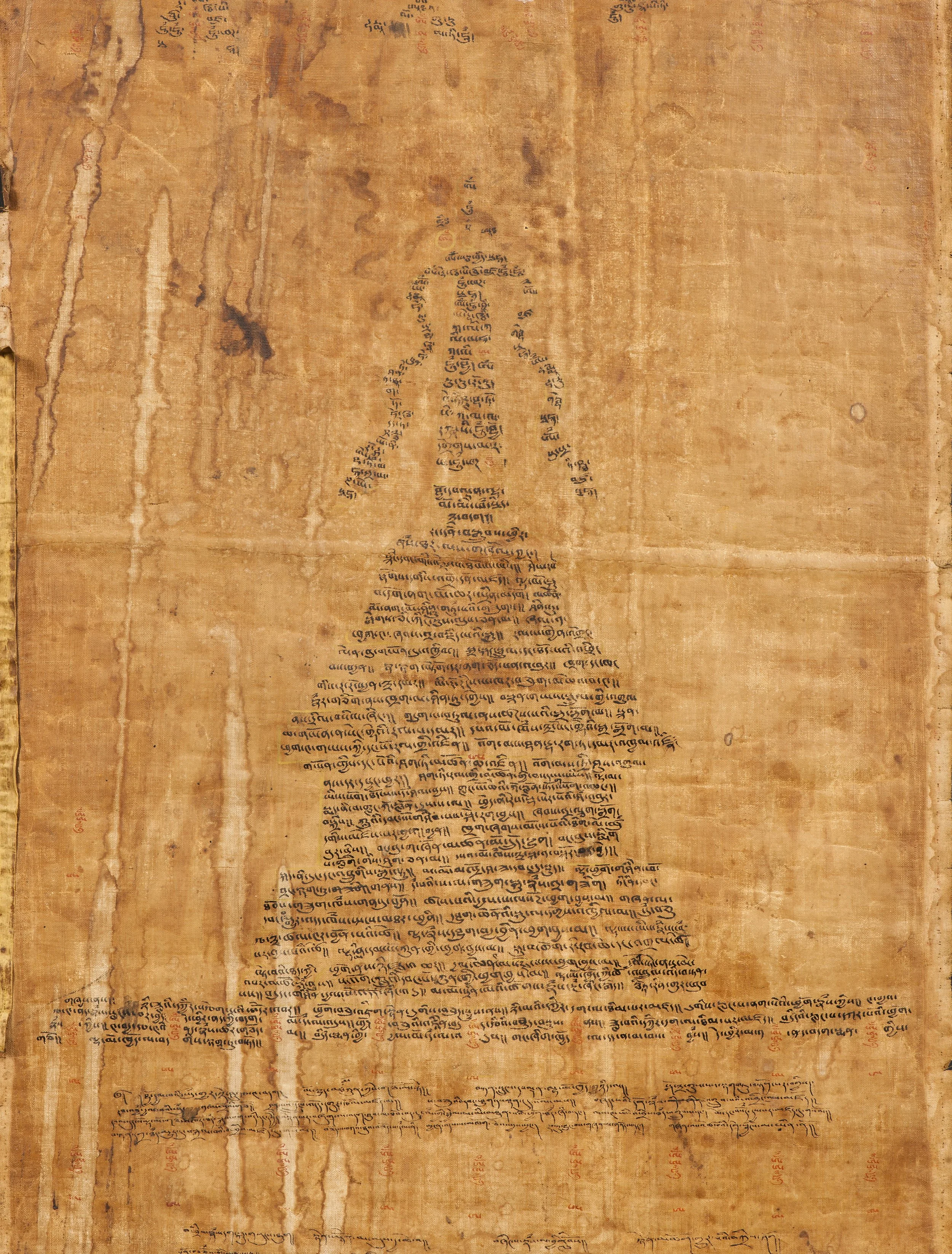
Painting of stupa composed by Tibetan script on the back side of fig. 6.c, enthroned with two pendants, Tibet, 1210–36
Paper with gold, black, red ink; 27.5 x 20.7 cm
ABP 028, Foundation Alain Bordier-Tibet Museum, Gruyères, Switzerland
6b
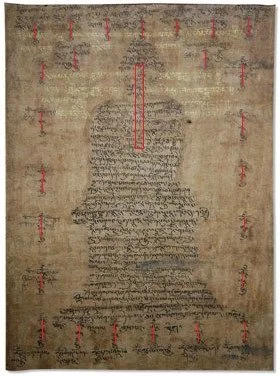
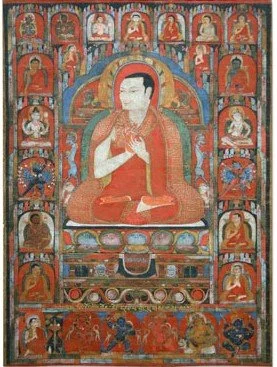
Red ink, two ‘seals’ of dots underneath om-ah-hum seed syllables in stupa and surrounding (ABP 028). It was not on public view at Tibet Museum, it was on the back side of Kuyelwa Richen Gönpo (1143–1217) (fig. 6c), the second Abbot at Taklung (fig. 5), a Kagyu lineage monastery.
6c
Kuyelwa Rinchen Gönpo, Second Abbot of Taklung monastery, Tibet, 1210–36
Glue distemper on cotton, 27.5 x 20.7 cm,
ABP 028, Foundation Alain Bordier-Tibet Museum, , Gruyères, Switzerland
7
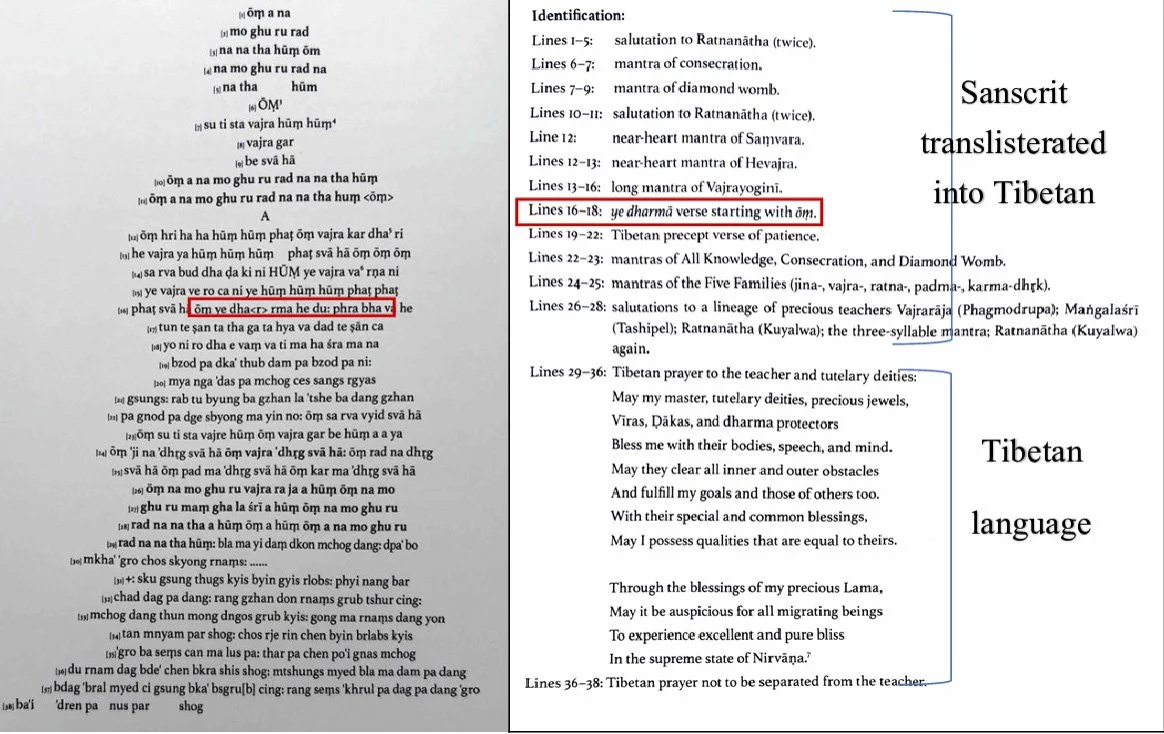
Trasncription of stupa on the back of Kuyelwa Rinchen Gönpo (fig. 6)
After Casey 2023, p. 660.
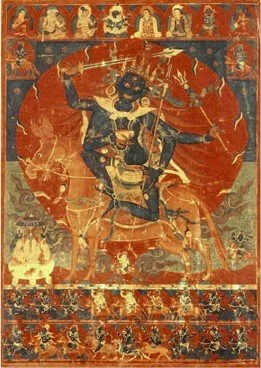
In an introductory video at the Tibet Museum in Gruyère, Switzerland, I observed a Tibetan painting of a stupa rendered with Tibetan script, resembling figure 1 (fig. 6). The portrait of Kuyelwa Rinchen Gönpo had been consecrated on its reverse through the stupa, a practice shared by all other paintings from the monastery (Casey, 2023, vol. 2, p. 658–63, translit. cat. 17) (fig. 7). Magali Jenny noted another example in the Tibet Museum: the protectress ‘deity’ Palden Lhamo, Glorious Goddess, likely from the Marsthang Kagyu school, with a stupa painted on its back (fig. 8). The term ‘deity’ (lha) applies because these figures symbolise sambhogakaya, or bodies of enjoyment, of enlightened beings.
In figure 6, the stupa contains headless black ink letters in dbu med, while golden dbu can headed letters sit above and across the top (Casey, 2023, p. 659). The black ink Tibetan script uses dbu med for Sanskrit transliteration and mantras intended for consecration at the upper section, and a Tibetan prayer appears at the base (fig. 7). This arrangement of script and content matches Luczanits’ stupa showing Phakmo Drupa (1110–70), a prominent Kagyu master and teacher of the Taklung monastery founder, at his Power Point presentation Tibetan portraiture as Embodiement of Buddha (fig. 9).
8
Dhumangari Shri Devi (Palden Lhamo Düsölma) (left)
Tibet, 1300–1400
Glue distemper on cotton; 72 x 51 cm
Stupa composed with Tibetan script on its back side, red, black ink (right)
ABP 009, Foundation Alain Bordier - Tibet Museum, Gruyères, Switzerland
8b
In red ink, as noted in figure 1, the ‘seals’ or consecration dots appear above the umbrella, inside the stupa, and around it, beneath black ink reading om-ah-hum (fig. 6b). The Tibetan seed syllables om-ah-hum denote the three syllables that ‘seal’ a human body’s forehead, throat, and heart, signifying the illuminated body, speech, and mind of Buddha(s) (figs 4b and 6b). These are present, as on Palden Lhamo’s stupa with red ink seed syllables om-ah-hum, written inside and around the stupa (fig. 8, right). On fig. 6 and 7: ‘Written just above the forehead [the syllable OM] of the corresponding main figure on the obverse, it acts as the first syllable of the three-syllable mantra and the mantra of the consecration in lines 6–7 (Casey, 2023, p. 660,
fn. 3)’.
‘These three [seed] syllables are applied to the back of the figures on the level of forehead, neck and heart. Through the application of this mantra at the back of the figures the painting becomes a suitable receptacle for the sacred, and thus can be consecrated’ Luczanits desrcibes in his Power Point. This supports our view that the syllables om-ah-hum consecrate a stupa (Buddha), so the embodied threefold nature of Enlightened Awareness Beings appears in these Tibetan paintings. The same would extend through red ink dots in figure 1. With the depiction of the written stupa or pagoda, we might assume it stayed consistent across Asia from the Silk Road and Tibet to Japan between the 10th and 13th centuries. On the stupa of Phakmo Drupa’s portrait, one, usually two, and occasionally three yellow dots are applied; these match the yellow or golden line outlining the stupa (fig. 9, right). In another stupa from Taklung monastery shown in Casey’s book, the drawing uses gold or yellow alongside red ink to reflect the link between yellow and red dots. Moreover, the deployment of Dharma-relics—such as the Heart Sutra (fig. 1) or its ‘verse of interdependent origination’ on Tibetan stupas (fig. 7, marked in red) —represents a progression in Indian consecration practices.
‘The Chinese travellers to India in the seventh century, I Ching and Hsuan Tsang, observed this custom of placing the 'verse of interdependent origination' in a written form inside stupas as well. (…) The 'verse of interdependent origination' is still deposited at present time inside Tibetan stupas and images, however, the concept of Dharma-relic grew significantly to include the scriptures, large number of dharanis, works by Tibetan authors, etc.’ (Bentor, 1989, p. 4)
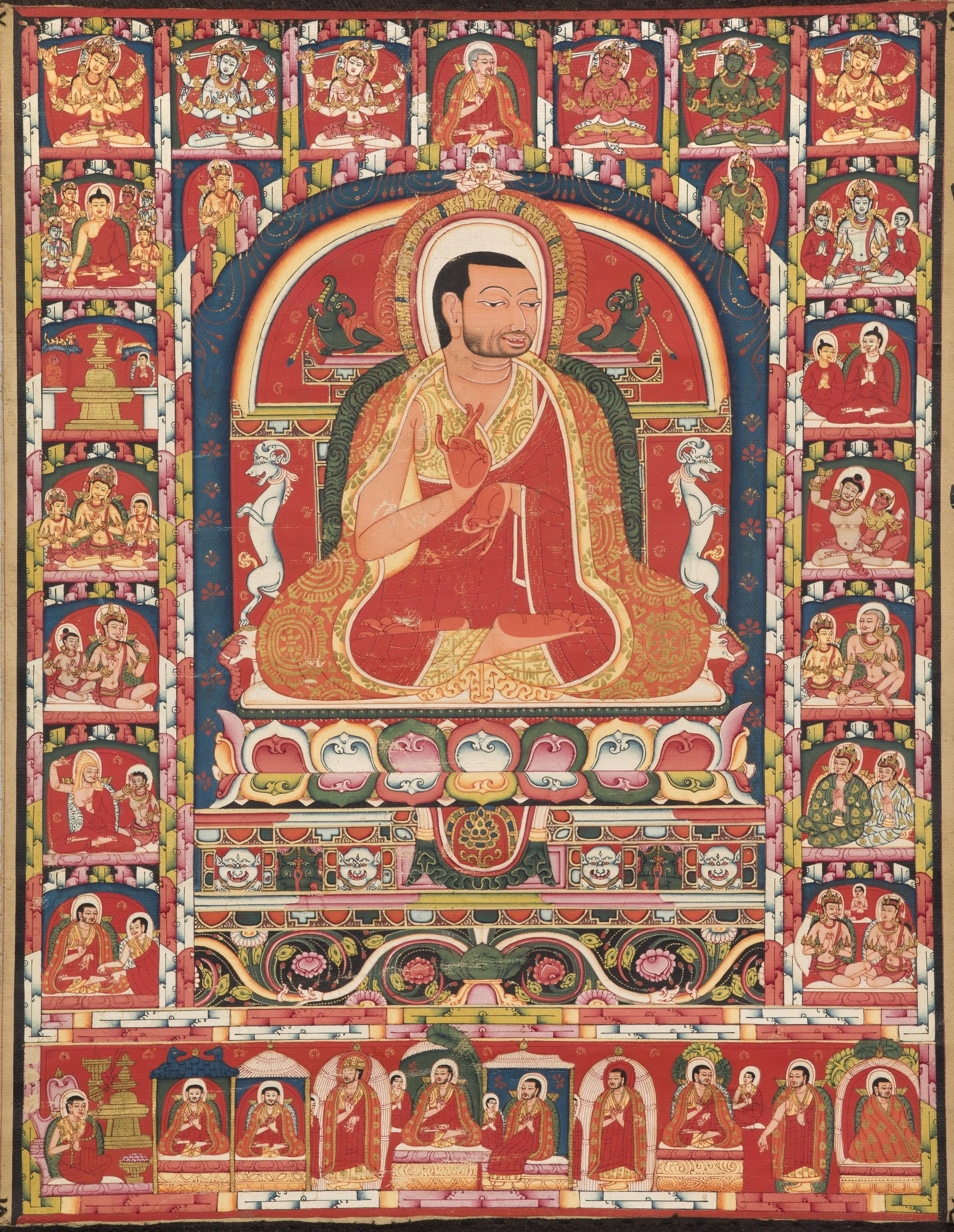
9
Phakmo Drupa Dorje Gyelpo (1110–70) with his Previous Incarnations and Episodes from His Life (left)
Consecration stupa on its back side (right)
Central Tibet; ca. 1270
Pigments on cloth; 32.1 x 25.7 cm
Rubin Museum of Himalayan Art C2005.16.38 (HAR 65461)
Photo by Dave de Armas © Rubin Museum of Himalayan Art, 2012
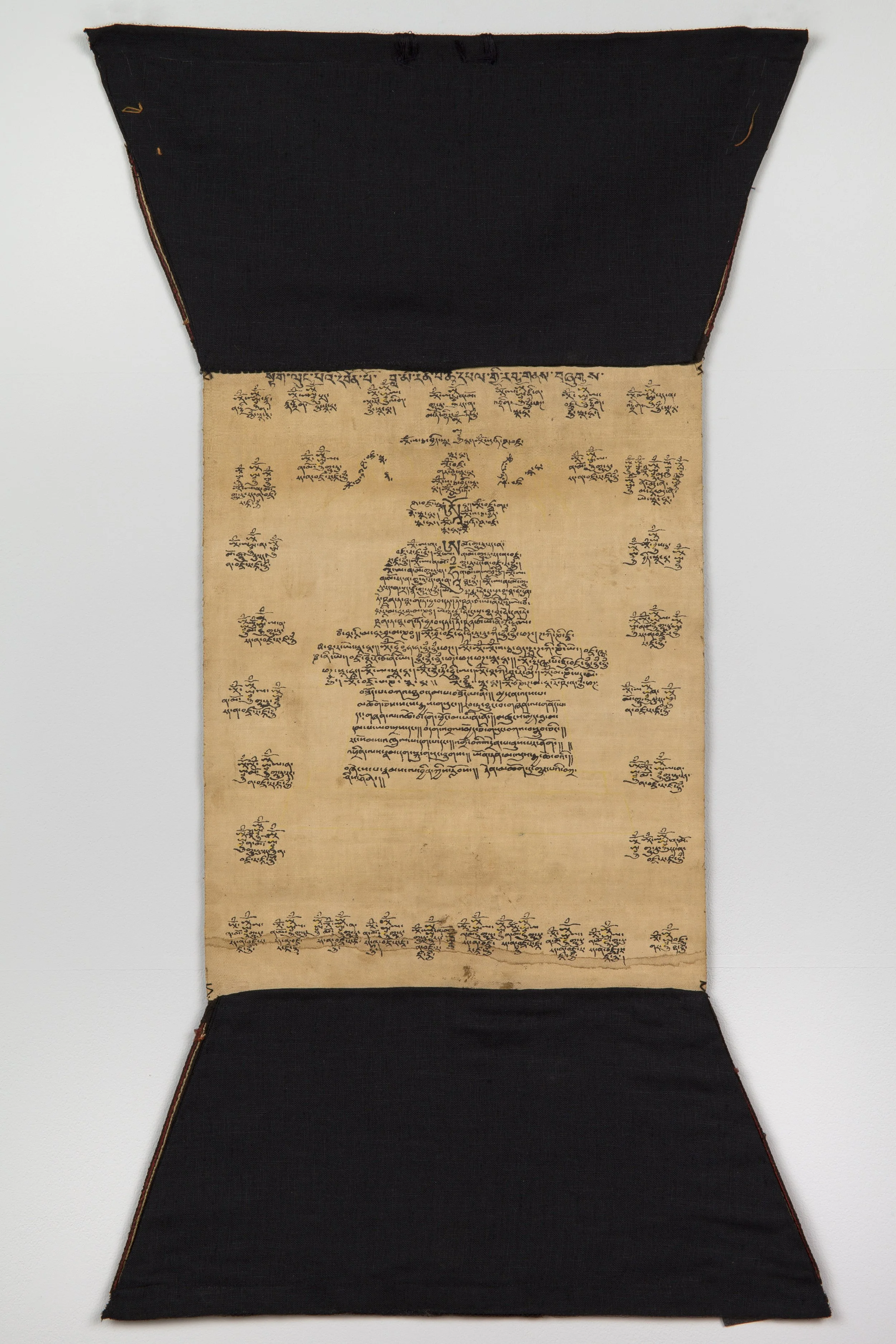
The verse of interdependent origination appears ‘inside’, as shown in the transcription (fig. 7, marked in red), matching its placement on Phakmo Drupa’s stupa (fig. 9), and indicates that Tibetan stupas and Chinese pagodas are consecrated with ‘relics’. A possible reason for such structures, consecrated with Dharma-relics and red dots or seed syllables, may lie in Atisha’s (982–1054) consecration text concerning the viewer of conventional truth or reality. This text from the Tenjur (Toh. 2496) was reviewed on 84000.com but remains unpublished in original Tibetan and not translated into English.
Atisha, the second and final introducer of Buddhism to Tibet in the 11th centuryfollows Bentor (1996, p. 16) in stating that, from an ultimate truth perspective, the Buddha’s body, speech, and mind extend everywhere. Yet when we, as viewers, have not reached this state—the conventional truth perspective—we must consecrate an object, painting, or stûpa to make it clearly visible that the deity or deities, manifest as tantric Buddhas, reside within it.
Consecration translates the Tibetan term rab-gnas. In Vajrayana Buddhism, the ‘holy’ is the Enlightened Awareness Being (Sanskrit: Jñānasattva; Tibetan: Ye-shes-sems-dpa’), invited through ritual to dwell in the sacred object (rten), rendering it fit for worship (Bentor, 1989, p. 1). Thus, we observe stupas or pagodas holding Buddha relics and consecrated, as noted earlier; in 11th-century Tibet and likely all Buddhist Asia, the same issue applied.
‘The latter point is made also by Atisa who, in his frequentely quoted consecration text in the Tanjur, says: The consecration is both necessary and unnecessary. When examined ultimately [i.e. in ultimate trueth], who blesses what how? From the beginning [it was there] without birth or cessation; how could it be established/consecrated? For those who possess the realization of all dharmas as clear light consecration of objects for worhisp are unnecessary. Neither is it for those who have not realized emptiness but have realiced that stûpas, books, images and so forth emerge from blessed Emanations of the Buddhas, and do not arise otherwise. If they have strong faith, a consecration is not necessary. For the beginners, the untrained, in relative trueth, in worldly labels, for beings who do not know the real essence, the teacher taught consecration.’ (Bentor, 1996, p. 16)
Turning to the production of painted stupas bearing Tibetan script, no published work appears to address these embodied forms. Research could be valuable because, according to Lucanzits and Bock, such objects are widespread in Tibetan art. Both acknowledge numerous examples from lineages like Nigma and Sakya, though Lucanzits admits to not having observed one from the Gelugpa tradition.
From an anthropological and geographical perspective, Japan at the edge of East Asia before the Pacific Ocean stands out because it has gathered all forms of Buddhism, including Vajrayana, much like Tibet (Drolma, 2024, p. 100). Tibet, at the Third pole in Asia, has gathered the Vajrayana Buddhist tradition, but maintains like Japan many ‘old’ forms that have disappeared elsewhere on the Asian continent, for example the two threads hanging from a thangka or kakemono.
Our Chinese, Japanese, and Tibetan pagodas and stupas demonstrate the embodiment of script as the body, speech, and mind of Enlightened Awareness Beings. It is possible that the Chinese pagoda absorbed Tibetan influences during the tenth century. The objects presented here reflect the broad expansion of Mahayana Buddhism across Asia in the medieval period (10th–13th century). This situation raises several questions about painted stupas or pagodas formed with script in Asia for future study.
María Drolma is President of Centro de Retiros Budista Arya Tara, former Associate Professor at Centro de Estudios de Asia Oriental, Universidad Autónoma de Madrid (2004–2010)
Selected Bibliography
Bentor, Yael, ‘Sutra-style Consecration in Tibet and its Importance for Understanding
the Historical Development of the Indo-Tibetan Consecration Ritual for Stupas and Images, Tibetan Studies, Jan 1, 1989,
pp. 1–12.
Bentor, Yael, Consecration of Images and Stupas in Indo-Tibetan Tantric Buddhism.
Leiden, 1996.
Casey, Jane, Taklung Painting: A Study in Chronology, 2 volumes, Chicago, 2023.
Cornu, Philippe, Diccionario Akal del Budismo, Madrid, 2004.
Drolma, María : Introducción al Budismo en 7 temas, Sevilla, 2024
O´Neal, Halle, Word Embodied: The Jewelled Pagoda Mandalas in Japanese Buddhist
Art, Boston, 2018.
Seckel, Dietrich and Andreas Leisinger, ‘Before and beyond the Image: Aniconic
Symbolism in Buddhist Art’, Artibus Asiae. Supplementum, vol. 45, 2024, pp. 3
–107.
Tokio Takata, ‘Tibetan Dominion over Dunhuang and the Formation of a Tibeto-
Chinese Community’, Buddhist Road Paper, 6.1. Special Issue: Special Issue: Central Asian Networks. Rethinking the Interplay
of Religions, Art and Politics Across the Tarim Basin (5th–10th c.), ed. Erika Forte (2019), 2019, pp. 85–106.
Wu, Jing and Wei Yan, ‘Architectural Evolution of Stupas in the Western Regions
During the Han and Tang Dynasties’, Buildings, 2025, 15, 1056 (https://doi.org/10.3390/ buildings15071056).