
Frederic Leighton: A 19th Century Collector of Islamic Art
Melanie Gibson
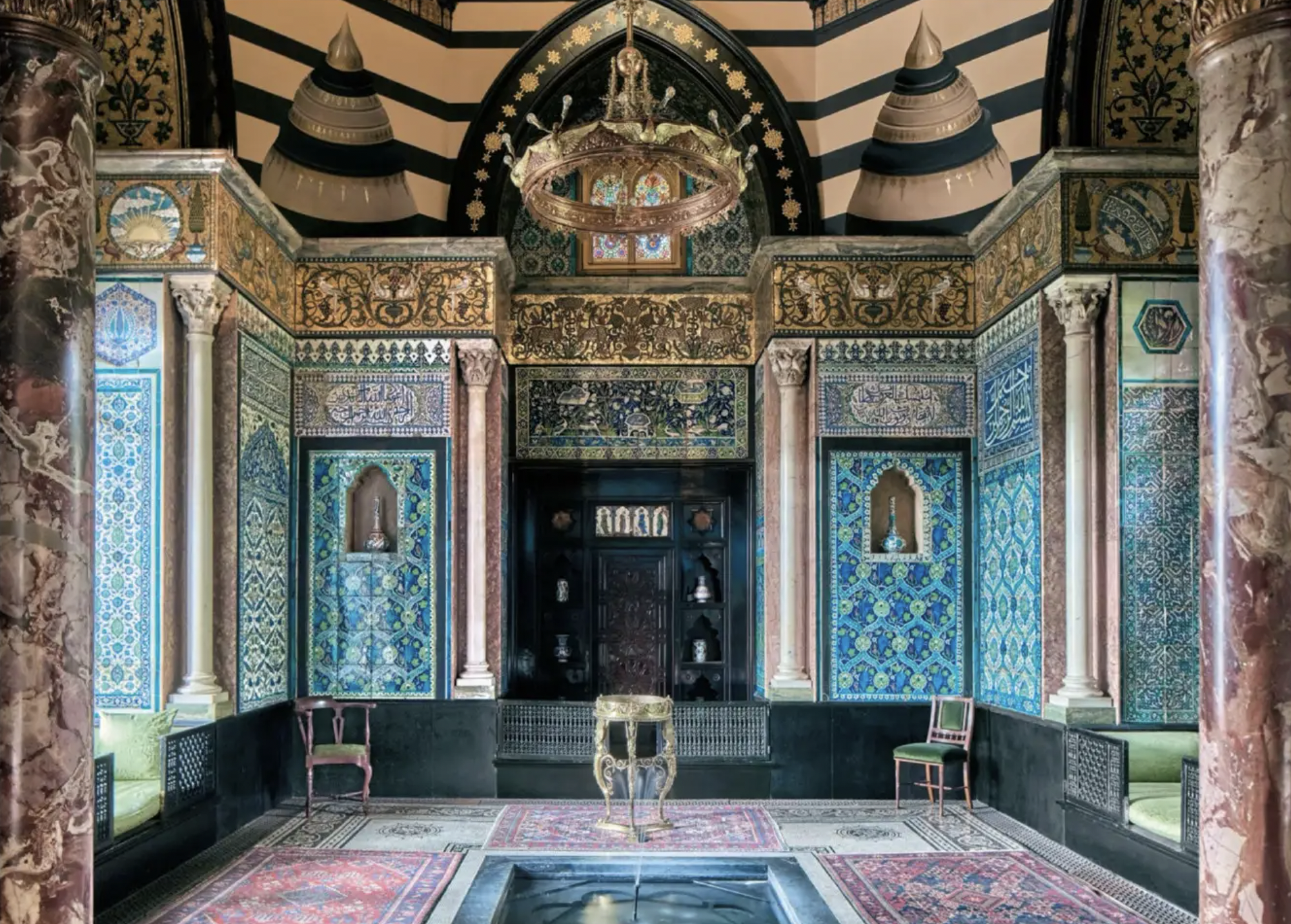
1. Entrance view of the Arab Hall at Leighton House, looking across the fountain to the west wall
Photo by Siobhan Doran © Royal Borough of Kensington and Chelsea
The Victorian artist Frederic Leighton (1830-96) is primarily celebrated for his art and for the building of an exquisite 'Arab Hall' in his London studio house (fig. 1). His role as an important collector of Islamic art has not been well understood, and for good reason-after his death, his private art collection, which included hundreds of ceramics, textiles, and carpets from around the Middle East, was entirely dispersed.
Leighton's 'Islamophilia', or admiration for the art and architecture of the Islamic world, emerged when he was a young man. His early training as an artist took place in Italy and Germany, and in 1855 he began studying in Paris. It was from here that he made his first exploration, travelling to Algiers in the autumn of 1857. He wrote in a letter that this visit 'made a deep impression' on him, leaving him with an abiding love for 'the East'. By the time he was elected President of the Royal Academy in 1878, Leighton had travelled around the southern Mediterranean, visiting southern Spain (twice), Turkey, Egypt, Syria, and Sicily between 1866 and 1877. During this decade he was establishing his reputation as an artist, and he made sketches during these trips, but this was not his primary purpose. His interest in visiting the cities of Granada, Istanbul, Cairo, and Damascus was to explore their distinctive architecture and to build his collection of Islamic art.
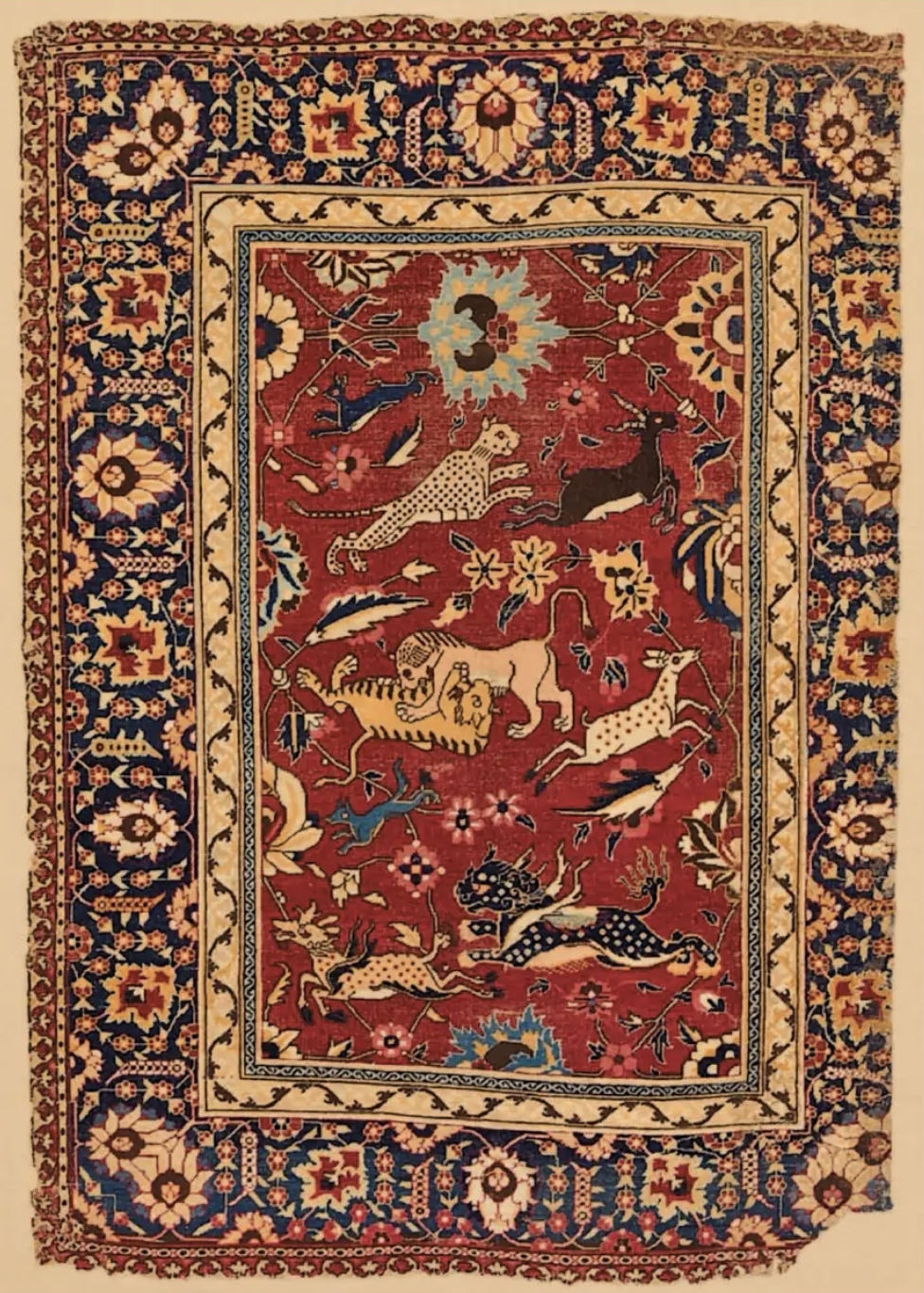
2. Carpet
Pakistan, probably Lahore; C. 1625-50
Cotton warp and weft, wool pile; 194 X 134 cm
Museum of Islamic Art (TE.20.1997), Doha, Qatar
Photo © Samar Kassab
One of his early acquisitions in the field of Islamic ceramics was made on his behalf by Charles Newton (1816-94), a curator of classical antiquities at the British Museum, who bought about thirty Iznik plates for him in Rhodes in 1863. His wife's companion, the young Gertrude Jekyll (1843-1932), a student at the National School of Art in London, observed the purchase and noted that these were 'the beautiful, glazed earthenware platters of Persian design, with conventional flower patterns on a white ground, known as Lindos or Rhodian ware'. By this date Leighton had moved from Paris and was renting a studio in central London. One year later he bought a plot of land in Kensington and immediately commissioned his friend, the architect George Aitchison (1825-1910), to start building him a studio-house. At this moment he started collecting seriously, and one of his first purchases was a carpet bought in 1865 from the auctioneer at Christie, Manson & Woods (fig. 2). Described at the time as a 'Persian' carpet, it had previously belonged to the Scottish artist David Wilkie (1785-1841), who had included it in two of his own paintings. Leighton once told a group of visitors to his house that the carpet had belonged to Mary, Queen of Scots, a romantic but incorrect attribution. It was, in fact, not made in Iran but in present-day Pakistan, probably at Lahore, during the reign of the Mughal ruler Shah Jahan (r. 1628-58). Leighton clearly admired its vibrant colours and pattern: a dark crimson centre woven with lions, tigers, and mythical beasts chasing deer, framed within a wide floral border. The carpet was not usually laid on the floor, although that is how he showed it in his 1877 painting Study at a Reading Desk, but was framed and displayed at the top of the stairs, as indicated in a photograph taken in 1895.
In the autumn of 1867 Leighton was finally able to visit Rhodes himself; there had been an outbreak of cholera that had prevented him from going there the previous year. His long trip began in Vienna, took in Istanbul, Bursa, and Izmir, and ended up in Athens. From Rhodes he wrote to his father that he had bought: à number of beautiful specimens of old Persian faience (Lindos ware), chiefly plates'. Feeling rather guilty about the high cost of the pieces, he added, 'I spent a considerable sum, knowing that such a chance would never again be given me, I could, any day, part with the whole lot for at least double-probably treble-what I gave'. On later trips to Egypt (1868) and Syria (1873) Leighton added to his collection. He bought hundreds of tiles in Cairo that were installed on the wall at the bottom of the stairs in his London house a year later, and many more tiles in Damascus, which were later used to form the basis of the decoration of the Arab Hall, built between 1877 and 1881.
Over his lifetime, Leighton put together a large collection of Islamic pieces. Tiles, woodwork, and coloured glass windows became permanent fittings in the Arab Hall, and there were numerous objects hung on the walls and arranged throughout the house. In every room, floors were covered in different-sized carpets and furniture pieces were draped with patterned and embroidered textiles. Much of his ceramic collection, particularly the Iznik plates, tankards, and other vessels, was displayed on the walls and shelves of the dining room, but dishes were also hung on the two sides of the drawing room alcove, and groups of objects were arranged on surfaces and cabinets in the studio. Leighton's collection was evidently an important one, but it has never been properly considered as such because it was entirely dispersed after his death in January 1896. His sisters, Alexandra Orr (1828-1903) and Augusta Matthews (1835-1919), inherited the house but without the means to maintain it, and six months later were obliged to ask Christie, Manson & Woods to arrange an auction of the contents. Up for sale were works by contemporary European artists, as well as 14th century Italian paintings, Michelangelo drawings, Durer engravings, and Japanese prints, together with furniture, carpets, textiles, and quantities of ceramics. The first three days were devoted to the sale of 'The Collection of Old Rhodian, Persian, Anatolian and Hispano-Mauro Pottery, Bronzes and Oriental China, Inlaid Furniture, Persian Prayer Rugs & Costumes', which included some 100 pieces of 'Persian, Rhodian, and Anatolian' ceramics (double the number of Chinese and Japanese pieces), 69 carpets, and dozens of costumes and textiles. Clearly, Islamic art objects represented a very significant part of Leighton's overall collection of furnishings and decorative objects.
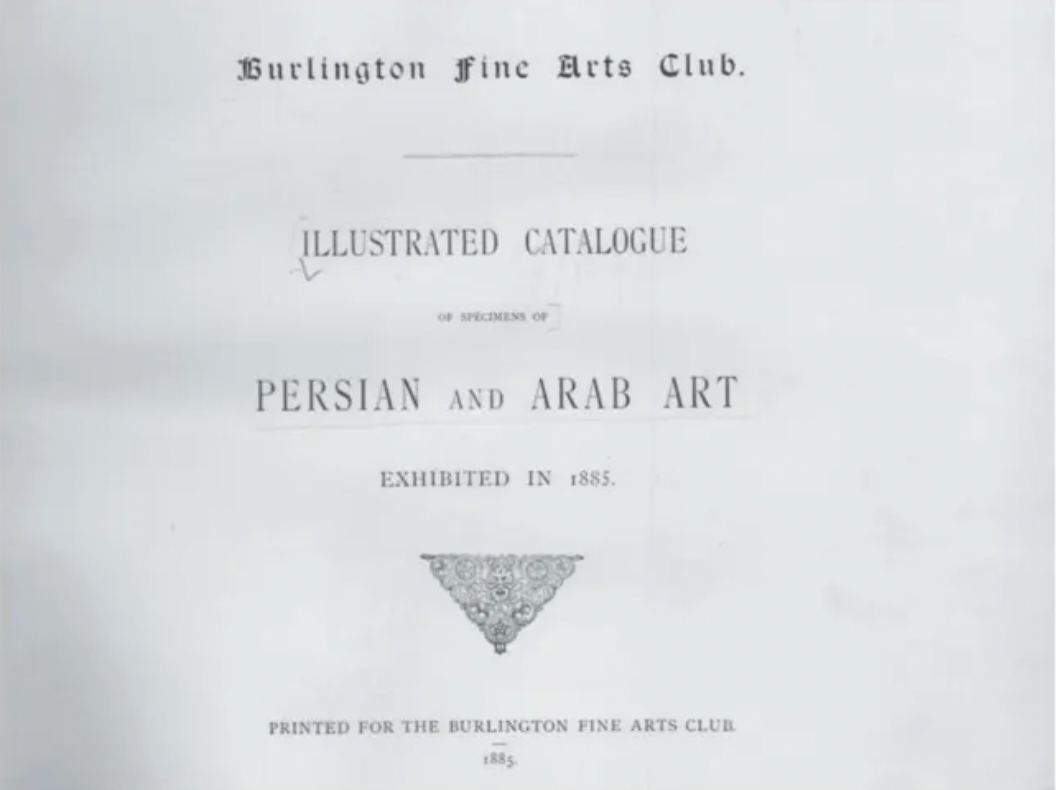
3. Frontispiece of the catalogue by Henry Wallis accompanying the 'Exhibition of Persian and Arab Art', London, 1885
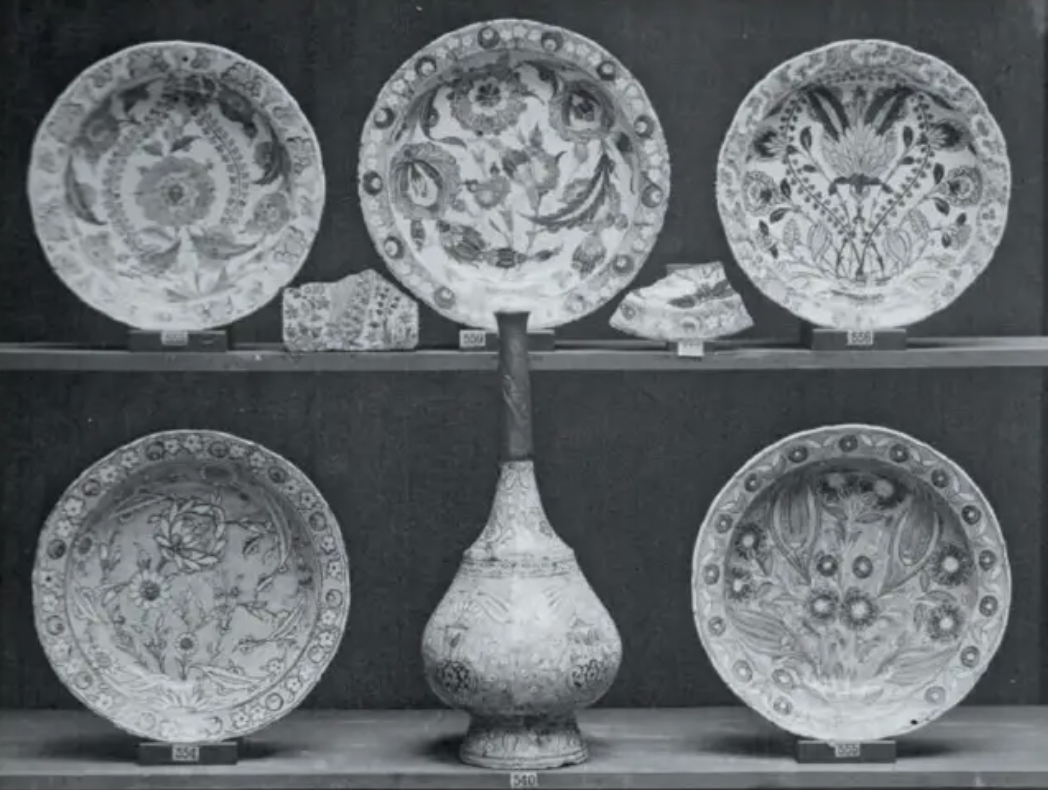
4. Plate 11 in the 1885 catalogue of the 'Exhibition of Persian and Arab Art', showing two pieces loaned by Leighton: the plate in the middle of the top shelf and the bottle below it
Catalogues were prepared for the auction and have survived, yet are only partially helpful in identifying objects as the level of expertise and knowledge in the field of Islamic art was, at this stage, patchy and full of misconceptions. In most cases, the descriptions are rarely accurate enough to recognise the pieces, although they do give colours and approximate dimensions. A more useful source of information is the 'Exhibition of Persian and Arab Art' held in 1885 at the Burlington Fine Arts Club, a private collectors' club where Leighton was a member and to which he lent 47 of his finest pieces, mostly ceramics, but also one work on paper and two carpets (fig. 3). The accompanying book, with an introduction written by his friend, the artist and collector Henry Wallis (1830-1916), is more precise than the auction catalogues in its descriptions and includes a number of black-and-white photographs. Two of the objects shown in figure 4 belonged to Leighton: the large Iznik dish in the centre of the upper shelf, now in the Louvre Museum in Paris, was decorated with a floral pattern in vibrant blue, turquoise, and olive green, and dates to circa 1540-60. The bottle below it, its broken neck repaired with engraved metal, was made slightly earlier, circa 1535-45, also at Iznik; it now belongs to the Bruschettini Foundation, Genova, Italy.
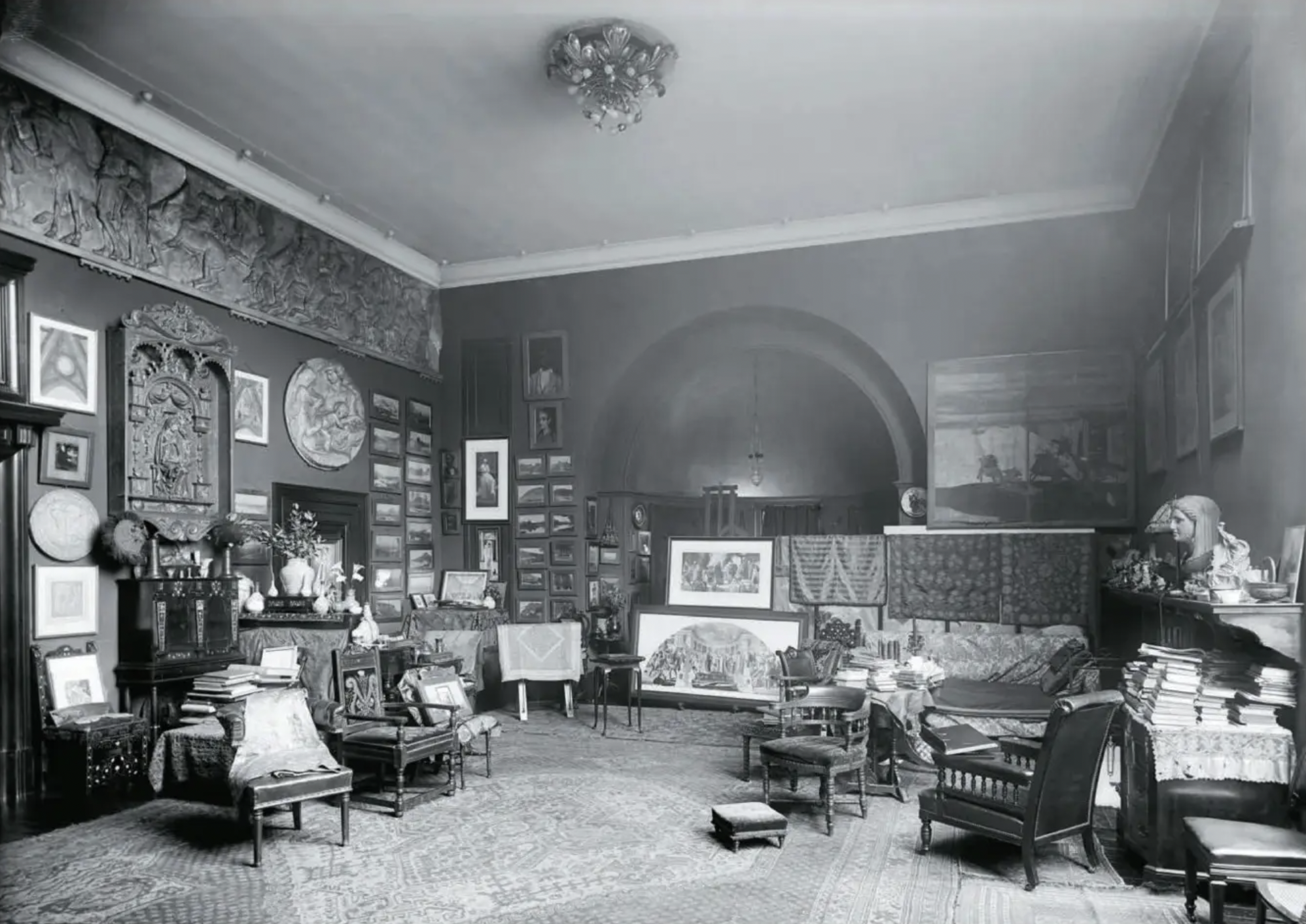
5. Partial view of the studio of Frederic Leighton (1830-96) Albumen print by Bedford Lemere & Co., 1 April 1895
A third source is provided by a series of eight photographs of several rooms in Leighton's house, including both ends of the studio, the drawing room, and the Arab Hall, all of which were taken on 1 April 1895 by the firm Bedford Lemere & Co. Inevitably, these photographs reflect the interiors after a certain amount of rearrangement, but the images are of sufficiently high quality for some of the objects to be picked out. In the studio, for instance, a group of blue-and-white ceramics made in 17th century Iran can be seen massed on a table with Iznik and Kutahya ceramics from Turkey (fig. 5). In the photograph of the Arab Hall, it is possible to identify nine objects made in Iznik and Damascus and to trace the history of four of these into the present day.
The sale and dispersal of Leighton's collection of Islamic art have obscured his appreciation of this field. His reputation as an Islamophile has rested entirely on the Arab Hall in his studio house, a space where he displayed some of the architectural salvage acquired on trips to Egypt and Syria. The retrieval and identification of just a few of the pieces that he displayed around his house shows that this was not his sole achievement and that he can be ranked amongst the great collectors of the late 19th century.