
An Interview with Jacqueline von Hammerstein-Loxten
Orientations: Shall we begin from the birth of the Pagoda Paris? When was it built and who was its owner and designer? How did the Pagoda take on this unique appearance as Asian-style architecture standing out in the central district of Paris?
Jacqueline von Hammerstein-Loxten: World-renowned Asian art dealer and collector C. T. Loo (1880–1957) masterminded the inception and realization of the Pagoda. Loo commissioned the Pagoda in 1926 and with the help of the architect Fernand Bloch (1864–1945), construction of this extraordinary structure commenced on the foundations of an existing building. Such an authentic Chinese monument was quite the scandal in the very conservative neighbourhood of the Rothschild, Camondo, and Jacquemart-André families.
For almost 100 years, the red Pagoda has stood as a silent ambassador at the corner of rue de Courcelles and rue Rembrandt in the 8th district of Paris. Situated in the midst of Haussmannian architecture and typically Parisian street views, this historical monument is just a stone’s throw away from the magnificent Parc Monceau.

Jacqueline von Hammerstein-Loxten
O: What was the original function of the Pagoda? Can you share stories of some of the significant events taking place inside the building after its establishment in the 20th century?
JvHL: The concept of the Pagoda was revolutionary. At a time when objects were typically concealed and encased, a visitor to the Pagoda could enjoy and discover Chinese art beyond the fashionable chinoiserie that had dominated western interiors for a long time. Loo invited his clients to touch, feel, and familiarize themselves with an object. He often suggested to his clients that they take an object home before deciding to purchase it.
Loo opened the doors of his majestic Pagoda in 1928 as his flagship gallery and as a place for cultural exchange. He was a proud recipient of the prestigious ‘Légion d’honneur’ and he headed up several committees for the promotion of Chinese art. Collectors from all over the world flocked to Paris to marvel at the ever-changing and growing collection of C. T. Loo at his red Pagoda. Loo showed his clients how to live with Chinese and Asian art by effortlessly incorporating these pieces into their existing interiors rather than safeguarding them in glass cases. Art pieces became tangibly incorporated into the lives of their collectors, no longer simply lifeless objects d’art.
The Pagoda showcased Chinese furniture and paintings as well as stone sculptures and polychrome murals. C. T. Loo introduced Chinese bronzes and jades as well as Indian art to the market. The first floor was entirely—and still is—covered with magnificent lacquer panels and lacquer elements, some as old as the Ming dynasty (1368–1644). This splendid ensemble forms a series of hidden wall cabinets, where Loo kept his most treasured pieces revealed only to a very select elite. His clientele ranged from Coco Chanel (1883–1971), His Majesty the King of Sweden (r. 1950–73), and the Duchess of Windsor (1896–1986) to the financial aristocracy of the Rothschilds, Rockefellers, and Vanderbilts and only those collectors with an eye for the exquisite.
A walk around the different spaces of the Pagoda was like a journey into Chinese and Asian heritage, with carefully curated and selected pieces that best represented the different facets of artistic values, a meeting point for researchers, scholars, art lovers,
and museum directors alike.
With the opening of the Pagoda in Paris, Loo achieved his dream of promoting China through artistic and cultural heritage and of elevating the image of Chinese artefacts to their rightful position as fine arts. C. T. Loo organized countless exhibitions, many of them hosted at Pagoda Paris, and published scholarly catalogues to accompany these exhibitions that provided integral artistic and cultural context for the collectors. His treasures can today be seen in most of the leading institutions and museums in Europe and North America. Thanks to his efforts, Chinese art came to be displayed in dedicated Chinese art collections at museums and was no longer considered as ethnic art.
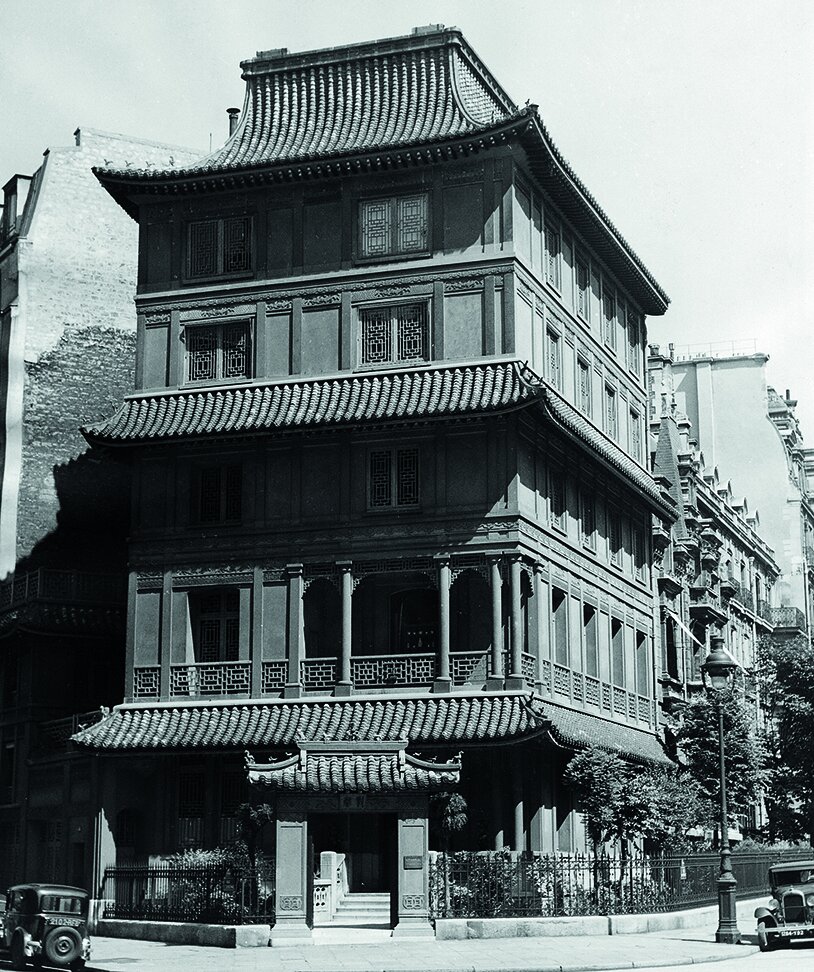
Black-and-white photograph of exterior view of the Pagoda in 1930, just after its opening
O: How would you describe today’s Pagoda?
JvHL: Today the Pagoda still intrigues people from all over the world. The doors to this architectural masterpiece are closed to the public, but behind these closed doors it remains a showcase for extravagant events, luxury fashion shows, exquisite art salons, and exhibitions.
The research of Chinese and Asian art continues and with reinforced links to some of the most prominent museums, notably in the USA. The Pagoda and its enormous archives still hold a key position in solving the mysteries of Asian art dealings. I also work in close cooperation with the outstanding team of the Nelson-Atkins Museum of Art in Kansas City. Thanks to their independent and extensive work on the C. T. Loo collection and a very fruitful exchange over the last years, we are now able to shine a brighter and finer light on the solid relationship C. T. Loo held with this preeminent institution and its keepers.
A second phase of the renaissance of the Pagoda is planned for the near future to ensure that this historical monument will continue to exist for the generations to come.

Interior view of the Pagoda showing original lacquer panelling
VOLUME 54 - NUMBER 3
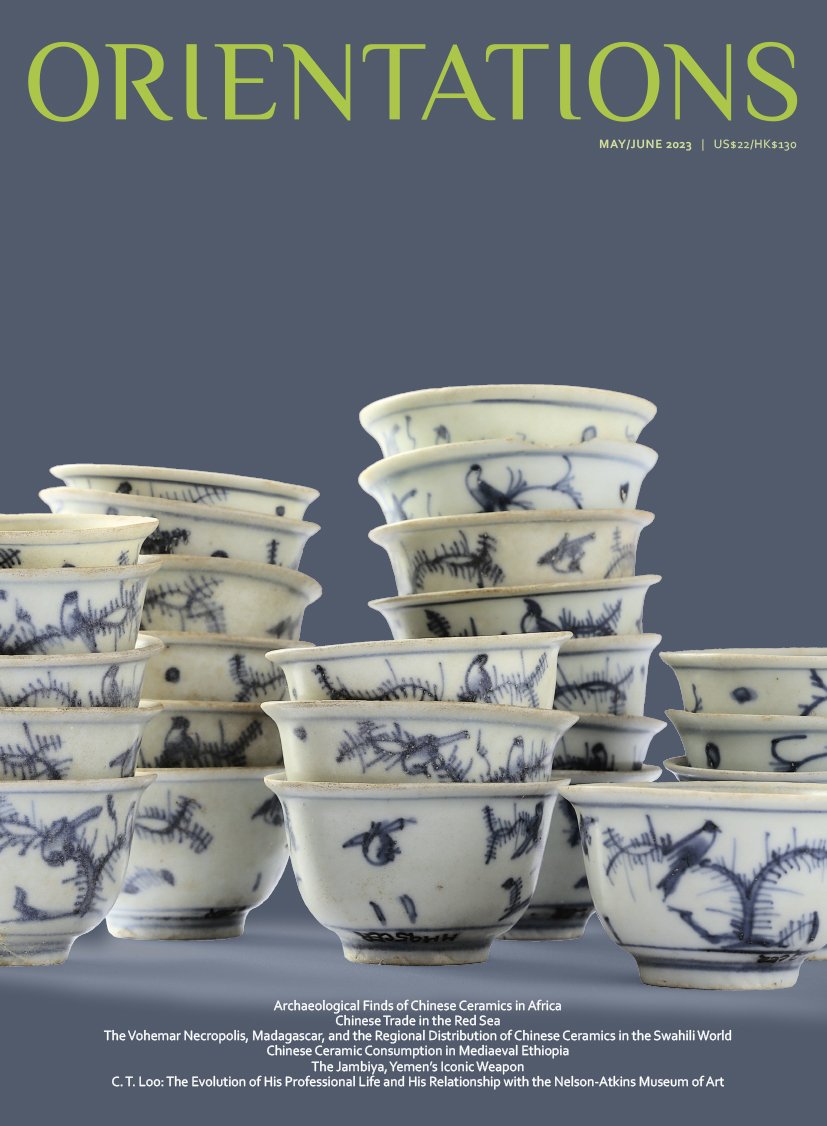
I discovered a small shop in Lamu on my trip to the island off the coast of Kenya in 2017 where the owner made delightful silver jewellery with Chinese ceramics picked up from the beach. Although I have read of Zheng He’s voyages during the Ming dynasty through the South China Sea, Indian Ocean, Arabian Sea, Red Sea, and along the east coast of Africa —and have seen numerous depictions of giraffes on Chinese paintings in museums around the world—the lack of significant collections in East Africa does not bring this region of the world to mind when thinking of Chinese art. Thus, it was fortuitous that Bing Zhao, research director of the East Asian Civilizations Research Centre (French National Centre for Scientific Research) and regular contributor to Orientations, proposed a special issue focusing on archaeological finds of Chinese ceramics in East Africa, especially as we have been devoting since 2021 one issue per year to Asian art to Asian art in areas of the world less well known for it. We are pleased to have Bing Zhao as our guest editor and to share in her knowledge of the interchanges and influences between China and Africa.
Last June, I had the chance to visit legendary dealer C. T. Loo’s Pagoda Paris, a building I had wandered by numerous times before without the chance to see the magnificence of its interior. We interview the owner, Jacqueline von Hammerstein-Loxten, on the birth of the Pagoda and future plans. A part of Loo’s immense success was his wide and complex network of suppliers and collectors. We unravel his professional life and attempt to separate fact from myth. Many museums in the USA and Europe were clients of Loo, one being the Nelson-Atkins Museum of Art in Kansas City. A few years prior to the opening of the museum in 1933, trustees went on a buying spree and Loo was one of the dealers they worked with, purchasing more than 100 objects from him including two temple rooms and numerous iconic sculptures; recent provenance research by the museum on these objects can be found on its website. Lastly, we delve further into the Chinese Temple Room and the Indian Temple Room, their connections with Loo, and how he capitalized on the popularity of period rooms in museums in the late 19th to early 20th century. Regardless of the controversary surrounding his business practices, he undoubtedly made a lasting impact on Western tastes in Asian art and its presentation.
FEATURES
Bing Zhao. Illuminating Sino-African Maritime Exchanges Through Archaeological Finds of Chinese Ceramics in Africa
Clifford Pereira. Imported Ceramics and the Swahili Culture of the Coast of Kenya
Hannah Parsons-Morgan. Chinese Ceramic Consumption in Medieval Ethiopia: An Archaeological Perspective
Bing Zhao. The Vohemar Necropolis, Madagascar, and the Regional Distribution of Chinese Ceramics in the Swahili World (13th–17th century)
Dr Teresa Canepa and Beth Gardiner. Espadarte (1558) Evidence of Early Portuguese Trade in Porcelain via Africa
Roberto Gardellin. Chinese Trade in the Red Sea: Two Shipwrecks with Yuan Blue-and-White Porcelains
Rachel Parikh. Forging a Legacy: The Jambiya, Yemen’s Iconic Weapon
Joanna M. Gohmann. Big Business: The Evolution of C. T. Loo’s Professional Life
MacKenzie Mallon. Collecting Relationships: C. T. Loo and the Nelson-Atkins Museum of Art
Ling-en Lu, Kimberly Masteller, and Michele Valentine. Creating Spaces for Asian Art: C. T. Loo and the Nelson-Atkins Museum of Art